
When choosing rat poison or identifying poison you found, understanding the active ingredient is critical for both effectiveness and safety.
Bromethalin is one of several common rat poison chemicals, and it works very differently from the more familiar anticoagulant poisons. So what rat poison has bromethalin?
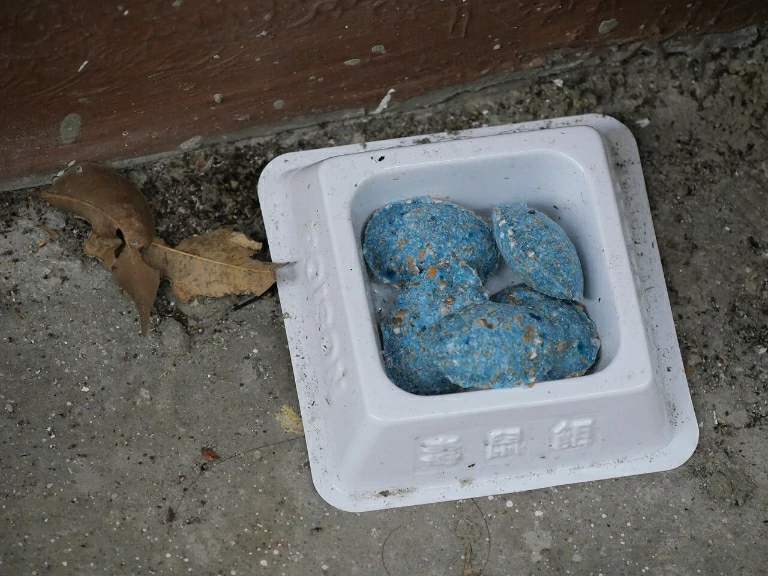
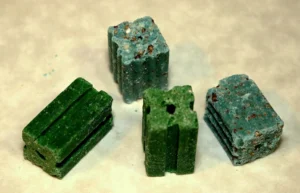
Common rat poisons containing bromethalin include select Tomcat formulations, Hot Shot MaxAttrax Rodent Bait, and Assault Rat & Mouse Bait. Bromethalin products are often dark green, brown, or tan in color. You can identify bromethalin by checking the active ingredient section on the label, which will list “bromethalin,” typically at a 0.01% concentration.
Bromethalin works differently from anticoagulants and presents different risks and benefits. Understanding these differences helps you choose the right poison for your situation or recognize the dangers if you or a pet are exposed.
How Bromethalin Works
Bromethalin is a neurotoxin, which means it damages the nervous system rather than preventing blood from clotting like anticoagulants do.
When a rat eats bromethalin bait, the poison enters the bloodstream and crosses into the brain and nervous system. There it disrupts the cells’ ability to produce energy.
Specifically, bromethalin damages mitochondria, which are the power plants inside cells. Without functioning mitochondria, nerve cells can’t produce the energy they need to work properly.
This energy failure causes fluid to build up inside nerve cells, leading to swelling in the brain and spinal cord. The swelling puts pressure on vital brain structures.
As swelling increases, the rat develops neurological symptoms. It might show tremors, loss of coordination, seizures, or paralysis. Hind leg paralysis is particularly common with bromethalin poisoning.
Death occurs from the pressure on the brain, respiratory failure, or complete nervous system shutdown. The timeline depends on the dose. Large doses can kill in 24-48 hours. Smaller doses take 3-4 days or longer.
Unlike anticoagulants which require multiple feedings, bromethalin is designed to be a single-feeding poison. One good meal of bromethalin bait can deliver a lethal dose.
There’s no antidote for bromethalin poisoning. Treatment for exposed pets or people is purely supportive, trying to reduce brain swelling and manage symptoms while hoping the animal survives.
Why Bromethalin Was Developed
Bromethalin became popular in rat poison in the 1980s and 1990s for specific reasons related to problems with older anticoagulant poisons.
By the 1980s, many rat populations had developed resistance to first-generation anticoagulants like warfarin. These poisons simply didn’t work anymore in many areas.
Second-generation anticoagulants (brodifacoum, bromadiolone) solved the resistance problem but created new concerns about secondary poisoning of wildlife.
Pest control companies needed effective alternatives. Bromethalin filled that need. Rats couldn’t be resistant to it because it worked through a completely different mechanism than anticoagulants.
Bromethalin also worked faster than most anticoagulants. Rats died in 2-4 days instead of 5-7 days or longer. Faster action meant quicker problem resolution.
The single-feeding characteristic made bromethalin appealing. You didn’t need rats to come back repeatedly to eat the bait. One visit could be enough.
Bromethalin was also thought to have lower secondary poisoning risk than second-generation anticoagulants because it doesn’t persist in the liver as long. This turned out to be partially true, but bromethalin can still cause secondary poisoning.
Today, bromethalin remains popular despite increasing concerns about its safety. It works on anticoagulant-resistant rats, which is a significant advantage in areas where resistance is common.
Common Bromethalin Products
Several major brands make bromethalin-based rat poisons. Knowing these products helps you identify what you have or what you’re buying.
| Product | Brand/Manufacturer | Form | Bromethalin Status | Notes |
|---|---|---|---|---|
| Tomcat Mouse Killer | Tomcat | Bait | Yes | EPA records list bromethalin at 0.01% active ingredient. |
| Tomcat Rat Killer II | Tomcat | Bait | Yes | EPA records list bromethalin at 0.01% active ingredient and include rats and mice among the target pests. |
| Tomcat With Bromethalin | Tomcat | Bait | Yes | Bromethalin is specifically identified in the product name and EPA registration records. |
| Bromethalin Rat & Mouse Block | Various registered products | Blocks | Yes | EPA-registered bromethalin block formulations contain 0.01% bromethalin. |
| Bromethalin Soft Bait | Liphatech | Soft bait | Yes | EPA label lists bromethalin at 0.01% and identifies the product as a rat and mouse bait. |
| Professional bromethalin baits | Various manufacturers | Blocks, soft bait or pellets | Yes, in specific formulations | EPA allows bromethalin in professional and agricultural rodenticide products. |
Tomcat is probably the most well-known brand with bromethalin. They make several rat and mouse bait products that use bromethalin, although some Tomcat products contain different active ingredients.
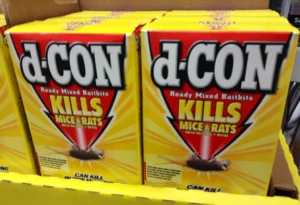
d-CON has made rodenticide products containing different active ingredients over the years. Some older d-CON pellet products were canceled and phased out following EPA restrictions, so they shouldn’t be listed as current bromethalin products.
Hot Shot makes several rodenticide products with different active ingredients. Some formulations contain bromethalin, while others use different ingredients, so check the label before identifying a Hot Shot product as bromethalin-based.
Ramik Rat and Mouse Bars are available in formulations with different active ingredients. Some Ramik products contain diphacinone rather than bromethalin, so the specific product label should be checked.
Just One Bite II products contain bromadiolone, not bromethalin. They are available in solid bait forms, including bars and chunks.
Assault Rat & Mouse Bait is a professional rodenticide product, but the specific formulation should be checked to confirm its active ingredient.
Always check the label to confirm the active ingredient. Some brands make multiple products with different active ingredients. Tomcat, for example, makes some products with bromethalin and others with different rodenticides.
Identifying Bromethalin Products
If you find rat poison and need to know if it contains bromethalin, here’s how to identify it.
Check the label first and foremost. Look for the “Active Ingredient” section, usually near the front of the label. If it lists “bromethalin” with a percentage (typically 0.01%), that’s your answer.
If there’s no label, color can give you clues but isn’t definitive. Bromethalin products are often dark green, brown, tan, or grayish rather than bright blue or red. But color varies by brand and can’t be relied on alone.
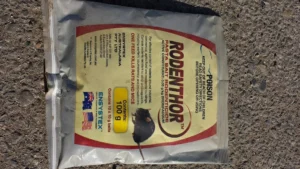
Bromethalin baits don’t have the distinctive smell that some other poisons have. They smell like their base ingredients (grain, wax) without strong chemical odors.
The form can provide hints. Bromethalin is commonly sold as bait blocks (solid chunks or bars) or pellets. It’s less commonly found as tracking powder or liquid.
Brand name recognition helps. If you see Tomcat, d-CON, Hot Shot, or Just One Bite II packaging, there’s a good chance it contains bromethalin, though these brands also make anticoagulant products.
Professional-grade products in large quantities might be bromethalin, especially newer formulations designed to overcome anticoagulant resistance.
When in doubt, don’t guess. Treat unknown rat poison as potentially containing bromethalin and handle it with full precautions.
Secondary Poisoning Risk with Bromethalin
One question people ask is whether bromethalin causes secondary poisoning to pets or wildlife that eat poisoned rats.
The answer is yes, bromethalin can cause secondary poisoning, though it’s somewhat less likely than with second-generation anticoagulants.
Bromethalin doesn’t accumulate in the liver for weeks like brodifacoum does. It’s metabolized and starts being eliminated relatively quickly. This reduces but doesn’t eliminate secondary poisoning risk.
A cat or owl that eats a rat that just consumed bromethalin bait can be poisoned. The poison is still in the rat’s digestive system and tissues.
If a rat ate bromethalin several days ago and is now sick or dying, some poison is still present in its body. A predator eating that rat can be exposed.
The risk decreases over time as the poison is metabolized and eliminated. A rat that died from bromethalin a week ago is much less likely to poison a predator than a rat that died yesterday.
Still, secondary poisoning from bromethalin is documented. Wildlife rehabilitation centers treat owls, hawks, and other raptors with bromethalin poisoning from eating contaminated prey.
Domestic pets are also at risk. Outdoor cats that hunt mice and rats can be poisoned by eating bromethalin-poisoned rodents.
The risk is lower than with second-generation anticoagulants but it’s not zero. If you want to truly eliminate secondary poisoning risk, don’t use poison at all. Use traps instead.
Comparing Bromethalin to Anticoagulants
Understanding how bromethalin differs from anticoagulant poisons helps you make informed choices.
Speed of action: Bromethalin works faster (2-4 days) than most first-generation anticoagulants (5-7+ days). It’s similar in speed to second-generation anticoagulants.
Feeding requirement: Bromethalin can kill with a single feeding. First-generation anticoagulants require multiple feedings over days. Second-generation anticoagulants can also kill with single feedings.
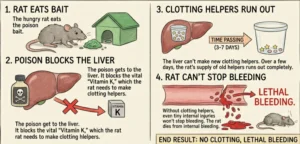
Antidote: Anticoagulant poisoning is treated with Vitamin K1, which is highly effective. Bromethalin has no antidote. This makes bromethalin poisoning more dangerous to pets.
Resistance: Rats can be resistant to anticoagulants but not to bromethalin. This makes bromethalin useful in areas with resistant rat populations.
Secondary poisoning: Second-generation anticoagulants pose high secondary poisoning risk. Bromethalin poses moderate risk. First-generation anticoagulants pose lower risk.
Symptoms: Anticoagulants cause bleeding symptoms. Bromethalin causes neurological symptoms. They’re completely different.
Treatment difficulty: Anticoagulant poisoning is relatively straightforward to treat if caught early. Bromethalin poisoning is much harder to treat and often results in death or permanent damage.
Environmental persistence: Second-generation anticoagulants persist for weeks in dead rats. Bromethalin breaks down faster but still poses risks for days.
For pet owners, anticoagulant poisons (especially first-generation) are generally safer because they have an antidote. For areas with resistant rats, bromethalin might be the only effective option.
Safe Use of Bromethalin Products
If you choose to use bromethalin rat poison, following safety protocols is absolutely critical because of the lack of an antidote.
Always use tamper-resistant bait stations, never loose bait. Stations should be locked and truly prevent access by children and pets.
Check bait stations daily. If a station is damaged or broken, repair or replace it immediately and check for any missing bait that might have been scattered.
Place stations only in areas where children and pets absolutely cannot access them. Locked sheds, secured attics, or fenced-off outdoor areas work. Never use in open garages or yards where pets roam.
Use the minimum amount of bait needed. More isn’t better. It just creates more opportunity for accidental exposure.
Keep detailed records of where every bait station is located. If a pet gets poisoned, you need to tell the vet exactly what product was used.
Remove all bait stations as soon as your rat problem is solved. Don’t leave them out indefinitely.
Store unused bromethalin poison in a locked cabinet in its original container. The label information is critical for medical treatment if someone is exposed.
Never use bromethalin if you have outdoor pets that hunt rodents. The secondary poisoning risk is too high.
Consider whether you really need to use poison at all. Bromethalin is particularly unforgiving if something goes wrong. Traps don’t have these risks.
Regulations and Restrictions on Bromethalin
Bromethalin faces fewer restrictions than second-generation anticoagulants in most areas, but regulations are evolving.
The EPA regulates rodenticides in the US. Currently, bromethalin is approved for both consumer and professional use, unlike second-generation anticoagulants which are restricted to professionals in most cases.
This means you can buy bromethalin products at hardware stores and use them yourself, whereas brodifacoum products are harder to find for consumer purchase.
Some states and localities have additional restrictions. California, for example, is considering broader restrictions on multiple rodenticide types including bromethalin due to wildlife impacts.
Canada has similar regulations to the US, with bromethalin products available for both consumer and professional use.
The European Union has stricter regulations on all rodenticides. Bromethalin products are available but use is more restricted than in the US.
Professional pest control operators must be licensed to use any rodenticides in most states, including bromethalin. Training requirements help ensure proper use.
Some wildlife conservation groups are pushing for restrictions on bromethalin similar to those on second-generation anticoagulants because of documented wildlife deaths.
Regulations could change as more data emerges about bromethalin’s impact on non-target species. What’s legal to buy today might be restricted tomorrow.
Alternatives to Bromethalin
If you’re concerned about the risks of bromethalin but need to control rats, alternatives exist.
First-generation anticoagulants (diphacinone, chlorophacinone, warfarin) have the advantage of an antidote. They’re safer for pets though they require rats to feed multiple times.
Snap traps kill rats instantly without poison. Modern snap traps are much more effective than old wooden traps. They’re completely safe for non-target animals when used properly.
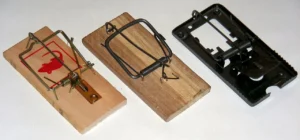
Electronic traps deliver a high-voltage shock that kills in seconds. They’re enclosed and reusable. No poison, no secondary poisoning risk.
Live traps catch rats without killing them. You release them far away or euthanize humanely. This takes more effort but eliminates poison risks.
Exclusion is the best long-term solution. Seal all entry points to prevent rats from getting in. Use steel wool, copper mesh, or hardware cloth for gaps and holes.
Remove attractants. Secure garbage, don’t leave pet food out, clean up spills, and eliminate water sources. Rats go where food is easy.
Natural predators provide free pest control. Barn owls, hawks, and snakes all eat rats. Support these predators instead of poisoning their food supply.
If you have anticoagulant-resistant rats and must use poison, consider working with a professional pest control company that can assess resistance and choose appropriate products rather than DIY bromethalin use.
Conclusion
Common bromethalin rat poisons include Tomcat products, d-CON Bait Pellets, Hot Shot MaxAttrax, Ramik Bars, Just One Bite II, and Assault Bait. These are typically dark green, brown, or tan colored and list “bromethalin 0.01%” on the active ingredient label.
Bromethalin is a neurotoxin that causes brain swelling and has no antidote, making it more dangerous to pets than anticoagulant poisons. It works on resistant rat populations but poses secondary poisoning risks to wildlife.
If using bromethalin products, always use locked tamper-resistant bait stations, check them daily, and remove them when the rat problem is solved. Better yet, consider snap traps or exclusion methods that don’t involve poison.
If a pet ingests bromethalin, get to a veterinarian immediately. Time is critical and even with fast treatment, prognosis is often poor.

Hi, my name is Ezra Mushala, i have been interested animals all my life. I am the main author and editor here at snakeinformer.com.