
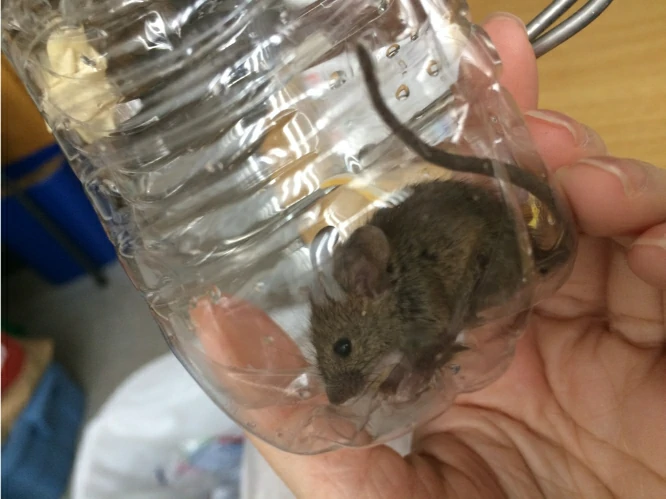
A toilet paper roll is the last thing most people would call a mouse trap, but it’s a surprisingly popular DIY trick. So how do you make homemade mouse traps with a toilet paper roll?
Flatten a toilet paper roll into a tunnel and balance it on the edge of a table over a tall bucket, with peanut butter at the far end. When a mouse walks in, the tube tips and the mouse drops into the bucket.
That’s the classic version, but it isn’t the only one. You can also use rolls for a ramp trap, a spinning roller, or a tunnel that guides mice onto a snap trap.
Below, you’ll find how to build each one, why the plain roll sometimes fails, and what to do with a mouse once you catch it (the part most videos skip).
Can a Toilet Paper Roll Really Catch a Mouse?
Yes, but only a mouse, and only if you set it up the right way. A toilet paper roll can’t hold anything on its own, so the trap depends on balance and a drop into a tall bucket.
The idea is simple: you flatten the tube a little, put peanut butter at one end, and let that end hang over the edge of a table.
When a mouse walks in, its weight tips the tube, and the mouse falls into the bucket below. It’s a live-catch trap, so you’ll still have a mouse to deal with afterward (we’ll cover that near the end).
This isn’t a trap for rats, since an adult rat is too heavy for a cardboard tube, too wary of new objects, and strong enough to jump out of a bucket this size.
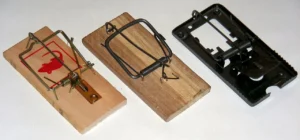
Snap traps are still the fastest and most proven way to deal with mice, so keep that in mind as you read.
Why Do Mice Walk Into Cardboard Tubes?
Mice love tight, covered spaces, so they run along walls, squeeze through gaps as small as a quarter inch, and feel safest when something is over their heads.
A cardboard tube looks like a perfect hallway to a mouse, since it’s dark, narrow, and leads straight to food.
Mice also don’t see well, so they find their way mostly by smell and by touch (with their whiskers). The smell of peanut butter can pull one down a tube without a second thought.
That’s why tube traps work better on mice than on rats. Mice are usually much more willing to walk into a new object, while rats can ignore one for days.
Mice are also athletes in their own way, since a mouse can jump about 18 inches straight up, which matters a lot when you pick your bucket.
What Do You Need Before You Build a Toilet Paper Roll Trap?
You don’t need much, and most of it’s already in your house, but the bucket is the part to get right.
You’ll need one to three empty toilet paper rolls, masking tape or duct tape, peanut butter, and a tall, smooth-sided container. A kitchen trash can or a 32-gallon bin works well.
Aim for at least 20 inches deep, because a standard 5-gallon bucket is only about 14 to 15 inches tall and a mouse that jumps 18 inches could hop right out. That’s why height matters.
If a 5-gallon bucket is all you have, rub a little cooking oil or petroleum jelly around the top few inches of the inside. That makes the walls too slick for a mouse to grip.
Keep the bottom of the container empty and dry, since anything a mouse can climb on, like a pile of paper, gives it a way out.
How to Make the Classic Tipping Tube Trap Over a Tall Bucket
This is the original toilet paper roll trap, and it takes about five minutes. You’ll need a table or counter with a tall bucket right beside it.
First, press the roll gently on both sides and crease two lines along it, so it turns into a tunnel with flat sides, then pinch one end partway shut.
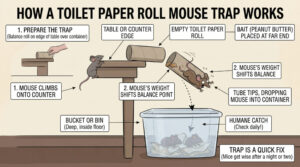
Put a dab of peanut butter on the inside of that pinched end (a small piece of cracker pressed into it helps). Keep it at the very end, so a mouse has to walk the whole tube.
Now set the tube on the edge of the table, with the baited end hanging out over the bucket. Start with about a third of the tube hanging over, and adjust from there.
Use a small piece of tape so the tube doesn’t slide off by itself. A mouse’s weight will pull it loose, but a draft or a bump shouldn’t. Then walk away and let it work.
Place the bucket right under the baited end, a few inches from the wall. Lean a folded piece of cardboard or a book against the table leg to make a ramp, so the mouse can climb up.
How to Make a Longer Tube From Two Toilet Paper Rolls
Here’s something most videos leave out: a single toilet paper roll is very short, so it often tips too early or doesn’t tip at all.
The back half of the tube acts as a counterweight. If it’s too short, the whole thing slides off the table before a mouse is even inside.
The fix is to make the tube longer, so flatten two or three rolls, slide the end of one slightly into the next, and tape the seam all the way around.
A tube about 8 to 12 inches long works much better. It sits more steadily on the table, and it tips smoothly when a mouse reaches the end.
If you have a paper towel roll, you can cut it down and use it instead. It’s sturdier and already long enough, so it’s a great backup.
Can You Make a Toilet Paper Roll Trap Without a Table?
Yes, and it uses a ramp instead, so it works anywhere you have a tall container and a piece of cardboard (a garage or a basement, for example).
Lean a folded piece of stiff cardboard (or a plank) against the container to make a ramp up to the rim. Then lay the tube across the rim, with a third of it hanging over the inside.
Put peanut butter at the hanging end, and the mouse climbs the ramp, walks into the tube, and tips it into the container.
Tape the tube lightly to the rim so it doesn’t slide, and make sure the container can’t wobble. A little putty or a rolled-up towel around the base works well.
Smooth-sided containers help here too, since cardboard ramps are easy for mice to climb but a slick wall inside the bucket keeps them from climbing back out.
How to Build a Spinning Toilet Paper Roll Trap
This one needs a few more steps, but it’s the most fun to build. The roll acts like a log that spins under the mouse, and it drops into the bucket.
You’ll need a roll, a thin rod such as a pencil or a bamboo skewer, some cardboard, tape, and peanut butter. You’ll also need a bucket with a lip wide enough to rest the rod across.
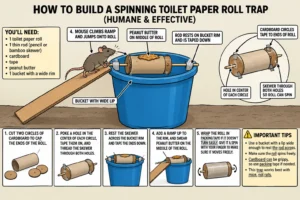
Cut two circles of cardboard to cap the ends of the roll. Poke a small hole in the center of each one, tape them on, and thread the skewer through both holes so the roll can spin around it.
Rest the skewer across the bucket’s rim, and tape the ends down so it can’t roll off. Then smear peanut butter on the middle of the roll.
Add a ramp up to the rim, and a mouse will climb up, jump onto the roll, and drop in when the roll spins.
Cardboard is a bit grippy, so wrap the roll in a layer of smooth packing tape if it doesn’t turn easily. Give it a spin with your finger before you set it, and make sure it moves freely.
How to Use Toilet Paper Rolls to Guide Mice Onto a Snap Trap
This design isn’t a live-catch trap, since it uses the rolls as a hallway that leads mice onto a store-bought snap trap (mice love tunnels).
Tape three or four flattened rolls end to end to make a tube about 12 inches long. Then set a mouse-sized snap trap at the open end, with the trigger facing the tube.
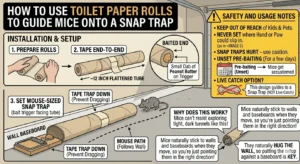
Put a little peanut butter on the trigger, and place the whole thing against a wall where you’ve seen droppings. A mouse that follows the wall will walk into the tunnel and step onto the trigger.
Keep it out of reach of kids and pets, and never set it where a hand or paw could slip in. A snap trap hurts, even a small one.
Tape the trap down so a mouse can’t drag it away. Also pre-bait the unset trap for a few days, so mice get used to it before you set it.
Why Do Mice Ignore Your Toilet Paper Roll Trap (And How Do You Fix It)?
Most failed tube traps have one of a few simple problems. The good news is that each one is easy to fix.
The tube might be rolling or sliding, so tape it down lightly and use a longer tube so the back end is heavy enough to hold it.
The bait might be too easy to reach, because a mouse that can lick it from the edge never has to walk in. Keep the bait at the very end and use a thin smear.
The bucket might be too short or too wobbly. A mouse that jumps 18 inches can escape a shallow one, and a wobbly one scares a mouse off.
The trap might be in the wrong spot, because mice follow walls and a table far from any wall gets skipped, so put yours next to a wall where you’ve found droppings.
The bait might be stale, since peanut butter dries out and loses its smell in a day or two.
Finally, the mice may have plenty of other food, and if crumbs, pet food, or open bags are around, a mouse has no reason to risk a strange tube. Clean up and store food in sealed containers.
What Bait Works Best on a Toilet Paper Roll Trap?
Peanut butter is the go-to, because it’s sticky, strongly scented, and hard for a mouse to eat in one lick. A thin smear works much better than a big glob.
A bit of cracker pressed into the peanut butter adds texture and keeps the bait in place. Chocolate spread, bacon grease, oats, and small pieces of nuts also work.
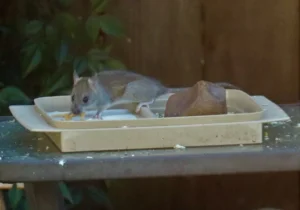
Whatever you pick, put it at the very end of the tube and press it in. You want a mouse to have to reach the end to get any of it.
Change the bait every day or two, because old bait loses its smell and a trap that smells like nothing gets ignored.
Where Should You Put a Toilet Paper Roll Trap?
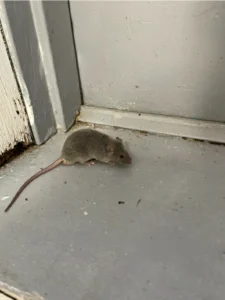
Mice stick close to walls, so the best spot is a table, counter, or ramp next to a wall where you’ve found droppings. Mouse droppings are small, about 1/8 to 1/4 inch long, and look like dark grains of rice.
Common hot spots include behind the stove, under the sink, inside a pantry, along a garage wall, and beside a basement shelf. Anywhere that has food and a quiet corner is a good bet.
Set the trap on a steady surface where it can’t get bumped. Wedge the bucket against a wall or a heavy box so it can’t tip.
Use more than one trap if you can, since two or three in different spots catch more mice than one trap in a single spot.
Keep traps away from doors and busy walkways, so kids, pets, and your own feet stay clear.
How Can You Keep Kids and Pets Safe Around These Traps?
Homemade traps don’t come with warning labels, so safety is up to you, and the biggest risks are curious kids and pets.
A tall bucket can be risky for small children, even when it’s dry, so keep it out of reach (a closed-off pantry or garage works well).
Cats love to knock things off tables, and a balanced tube is an open invitation. Plan for that. Set the trap where pets can’t get to it, or use it only in a room you can close.
A snap trap in a cardboard tunnel still has a hard-hitting bar, so keep that version well out of reach.
Check your traps every morning and evening, since a mouse left in a bucket for too long gets stressed, thirsty, and hungry.
What Should You Do With a Mouse Once You’ve Caught It?
Catching a mouse alive is only half the job, and what you do next matters for the mouse and for your own health.
Don’t handle it with bare hands, since mice can carry diseases like salmonella and some wild mice (such as deer mice) carry hantavirus. The CDC says people can catch hantavirus by breathing in dust from dried droppings, urine, or nests.
Many people release mice far from home, often a mile or more away. However, a house mouse dropped in the wild often struggles, and rules about moving wildlife vary, so check yours first.
Another option is to take the mouse to a vet, an animal shelter, or a pest control company, which can euthanize it humanely. Drowning isn’t an acceptable method, according to animal welfare guidelines.
Then clean up the right way: wear rubber or plastic gloves, and don’t sweep or vacuum, since that throws dust into the air.
Instead, spray the droppings, the nest, and the area around the trap with a bleach mix of 1 part bleach to 9 parts water (that’s 1½ cups of bleach in a gallon).
Let it soak for about 5 minutes, then wipe it up with paper towels. Seal everything in a plastic bag and put that bag inside a second bag, then wash your hands with soap and warm water.
Should You Skip Homemade Mouse Traps and Use a Snap Trap Instead?
Honestly, for many people, yes, since a snap trap is cheap, fast, and more proven than any toilet paper roll trap. These homemade traps are best for small problems, or for people who want to catch a mouse alive.
However, traps alone won’t fix a mouse problem. If mice have food and a way in, new ones will take the place of the ones you catch.

Mice can squeeze through a gap as small as a quarter inch, so seal any hole bigger than a pencil with steel wool or ¼-inch hardware cloth. Mice chew through caulk and plastic, so use metal instead.
Store food in glass or hard plastic containers, wipe up crumbs, and keep pet food off the floor at night. A tidy kitchen gives mice much less to come for.
If you still see signs after a couple of weeks of steady trapping, call a licensed pest professional.
Conclusion
You can make homemade mouse traps with a toilet paper roll, and the classic tipping tube over a tall bucket is a good place to start.
A longer tube, a ramp, and a spinning roller give you three more ways to do it.
The biggest keys are a tall, smooth bucket, a tube that’s long enough to tip smoothly, and bait at the very end.
Mice are curious but cautious, so tape the tube lightly, set it next to a wall, and refresh the bait often. Start small and adjust as you go.
Whichever design you pick, plan for what happens after the catch. Wear gloves, check the trap morning and evening, and clean up with bleach.
A few smart traps and a sealed, tidy home can finish what you started.

Hi, my name is Ezra Mushala, i have been interested animals all my life. I am the main author and editor here at snakeinformer.com.