
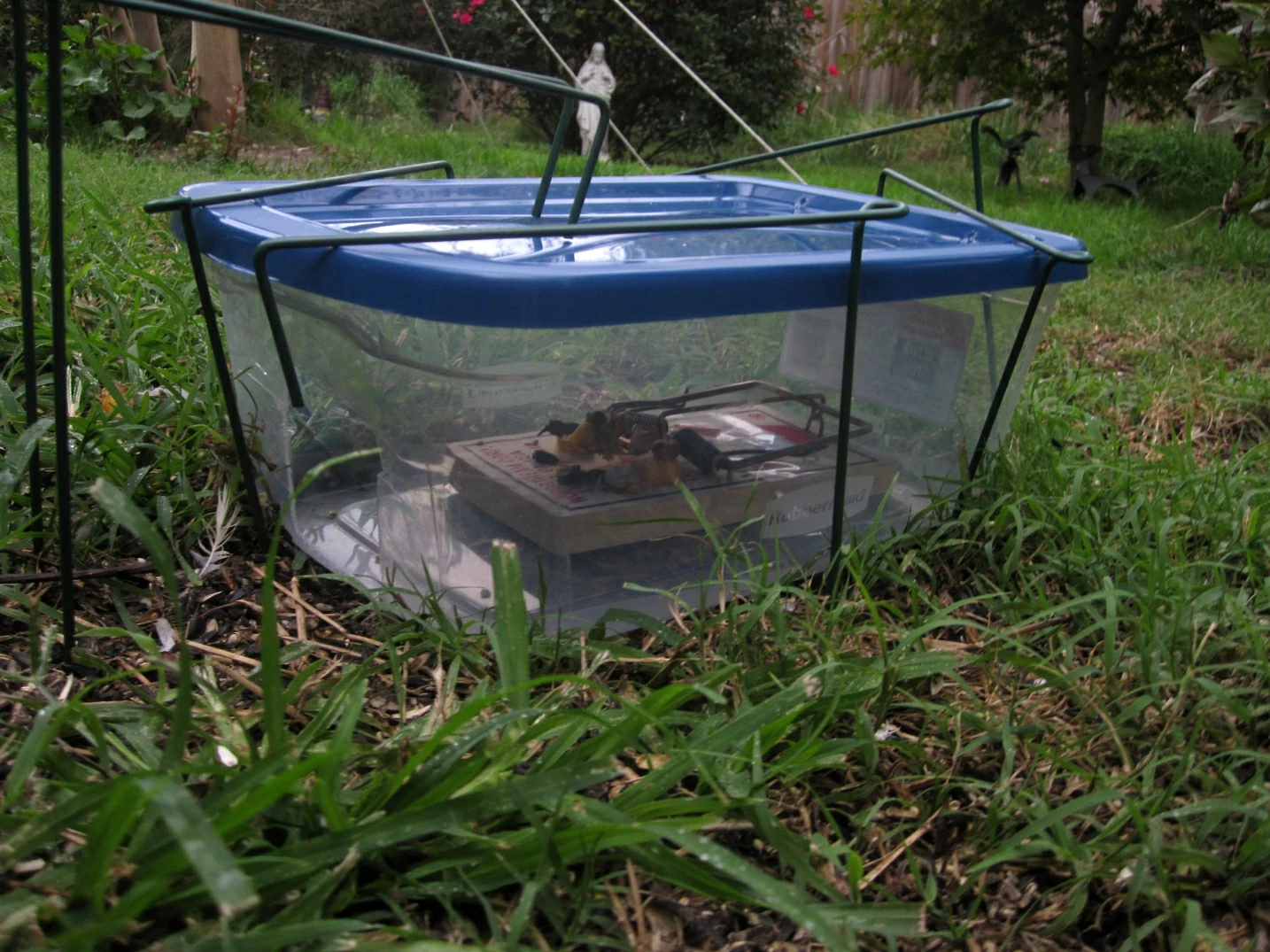
A rat will chew through cardboard, push past a flimsy door, and jump out of a shallow bin, so a box trap has to be built tougher than it looks. So how do you make a homemade rat trap box?
Build a sturdy wooden box with an entrance at one end, bait at the back, and a door that closes once the rat is inside. Use screws, metal on the door, and a box at least 20 inches long so a full-grown rat fits.
The four main ways to do it are a drop-door box, a one-way swing-door box, a lidded storage tote, and a box that holds a snap trap. Each one suits a different skill level and a different goal.
Below, you’ll find how to build each one, what rats can do to beat a weak box, and how to stay safe.
What Is a Homemade Rat Trap Box, and How Does It Work?
A rat trap box is a closed, dark container with a small entrance, a bit of bait inside, and something that shuts the door or triggers the trap.
Rats like tight, dark spaces, and a box looks a lot like a burrow or a hole in the ground.
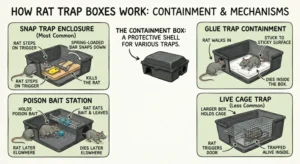
Most boxes are live-catch traps. The rat walks in after the bait, a door drops or swings shut behind it, and you’re left with a trapped animal to deal with (we’ll cover that near the end).
One design, the snap trap box, is different. It doesn’t hold a rat alive. It just wraps a store-bought snap trap in a box so kids and pets can’t reach it.
Snap traps are still the fastest and most proven way to deal with rats, so keep that in mind as you read.
What Can Rats Do That Changes How You Build a Box?
Rats are far stronger than they look, and every weak spot in a box is a spot they’ll test.
An adult Norway rat can jump about 3 feet straight up, climb rough surfaces, and squeeze through a gap about half an inch wide. It can also gnaw through wood, plastic, and even aluminum.

Size matters too. A big Norway rat is 8 to 10 inches long without the tail, and the tail adds another 6 to 8 inches.
That tells you what the box needs: tight seams, a solid lid, and a door a rat can’t push or lift open.
It also has to be at least 20 inches long, so the rat is fully inside before the door falls.
What Materials Should You Use for a Rat Trap Box?
The material you pick matters more than the design. Rats chew, so anything soft or thin becomes a doorway.
Pine boards work well for the main box, because the dark, natural wood feels like a hollow to a rat. Use 1 by 6 boards, which are about 5½ inches wide, and fasten everything with screws instead of nails.
For the door, use galvanized sheet metal or thick plywood lined with metal. For windows or vents, use ½-inch galvanized hardware cloth in 16 to 19 gauge, since it’s stiff enough to hold up to chewing.
Skip cardboard and thin plastic for anything a rat touches for long, since they hold up for a night at most.
Keep every gap smaller than ¼ inch, because a rat only needs half an inch and a mouse can slip through even less.
How to Make a Wooden Drop-Door Box Trap for Rats
This is the classic box trap, and it’s the one that works best on adult rats. A door slides down when the rat trips a trigger, and the dark box keeps the animal calm.
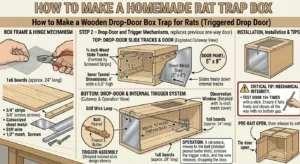
You’ll need four 1 by 6 boards about 24 inches long, two strips of ¾-inch wood for door tracks, a piece of galvanized sheet metal for the door, screws, a drill, and some stiff wire.
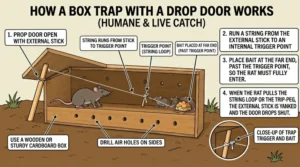
Start with the base. Screw the two side boards to the long edges of the bottom board, then add the top board, so you have a tunnel about 4 inches wide and 5½ inches tall inside.
Next, screw on a solid back panel. Then cut a small window in the top near the back and cover it with ½-inch hardware cloth, so you can check the trap without opening it.
Now build the door tracks. Screw one strip on each side of the entrance, leaving a slot just wider than your door so it slides without binding.
Cut the door about 5 inches wide and 8 inches tall. Attach a stiff wire loop to the top, then run it to a trigger inside the box so the door stays up until a rat disturbs it.
The trigger is the tricky part, and designs vary. Put it deep inside, about halfway back, so the rat is fully in the box when the door drops.
Test the door at least ten times with a stick before you bait it. It should fall freely, close all the way, and leave no gap along the bottom.
Put bait at the back of the box, behind the trigger. A rat that enters has to cross the trigger to reach the food.
How to Make a Simple Box Trap With a One-Way Swing Door
This version skips the trigger, so it’s much easier to build. A door swings inward but can’t swing back out, like a pet flap that only opens one way.
Build the same wooden box as before, but leave the front open.
Then cut a door about an inch bigger than the opening on every side, and hang it from the top edge inside the box with a small metal hinge.
Because the door is larger than the opening, it can swing inward but stops against the frame if a rat pushes outward.
Line the bottom edge with a strip of metal, and add a small washer to the bottom so it falls shut on its own.
For the first 5 to 7 days, tie the door open so rats can walk in and out freely. Put bait at the back, and set the trap only after they’re feeding.
The downside is that rats are good climbers and strong pushers, so a loose door can be lifted unless the hinge is tight and the fit is snug.
How to Build a Rat Trap Box From a Plastic Storage Tote
If you don’t have wood tools, a storage tote is the easiest starting point. It’s smooth inside, so rats can’t grip the walls, and the lid stops them from jumping out.
You’ll need a tall tote with a lid (at least 20 inches deep is best), a box cutter, tape, and a small weight.
You’ll also need a thin board or stiff plastic for the flap, plus a skewer or screw for a pivot.
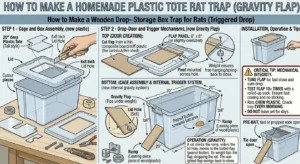
Cut a hole about 6 by 8 inches in the lid.
Then make a flap from the board, mount it on the pivot across the hole, and add a weight so it springs back.
Smear peanut butter on the far end of the flap, and lean a ramp against the tote so a rat can climb to the lid.
When the rat steps on the bait, the flap tips, the rat drops in, and the flap swings back over the hole.
This one takes tuning. If the flap sticks or doesn’t close fast enough, a strong rat can jump back out, so test it with a rolled-up sock before you bait it.
Rats chew plastic, so check the tote every morning and don’t leave it set for days.
How to Make a Safe Snap Trap Box for Rats
This one doesn’t catch anything on its own, since it’s a wooden box that holds a store-bought snap trap so rats can get in but kids, pets, and birds can’t reach the trap.
Build a box about 20 inches long, 5½ inches wide, and 5½ inches tall from 1 by 6 boards. Cut a hole about 2 inches wide near the bottom at each end, so rats can walk straight through.
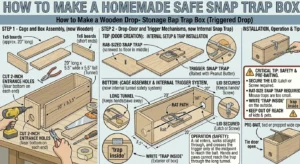
Screw a rat-sized snap trap to the floor in the middle of the box. A mouse trap is too small for a rat, so check the box before you buy.
Put a little peanut butter on the trigger, and set the trap with the trigger toward the entrance. Close the lid and secure it with a screw or a latch so nobody can open it by accident.
Write “trap inside” on the outside of the box, and keep it out of reach of kids and pets. The long tunnel keeps hands and paws well away from the bar.
As with every trap, put it out unset for about 5 days with bait on the trigger, then set it once rats are feeding.
Can You Make a Rat Trap From a Cardboard Box?
You’ll see videos where a cardboard box is propped up with a stick, and the person pulls a string when a rat walks under. It looks easy, but it’s a poor choice for rats.
First, the trap needs you to sit there and watch, and rats are very cautious and won’t come out while you’re in the room.
Second, a cardboard box won’t hold a rat, since rats chew through cardboard easily and a trapped one will be out before you wake up.
If you want to use cardboard, use it for a dark pre-bait shelter. Put a bit of food inside, leave it for a week, and let rats get used to the shape before you replace it with a sturdier trap.
Rat Trap Box Comparison: Which Design Fits Your Skills and Your Rats?
Here’s a quick look at how the four designs compare:
| Design | How it catches | Skill level | Main downside |
|---|---|---|---|
| Wooden drop-door box | Alive, in the box | Advanced | The trigger takes careful building and testing |
| One-way swing-door box | Alive, in the box | Easy | A loose door can be pushed open |
| Plastic tote with a tipping flap | Alive, in the tote | Medium | Needs tuning, and rats can chew the plastic |
| Snap trap box | Quick kill from the snap trap | Easy | Needs a store-bought rat trap |
If you only remember one thing from the table, make it this. The one-way door box is the best starting point for most people, and the snap trap box is the safest around kids and pets.
How Do You Bait and Pre-Bait a Rat Trap Box?
Rats are very careful around new objects, and a shiny new box that shows up overnight makes them nervous. Pre-baiting gives them time to relax.
Put the box out with the door tied open or the trap unset, and place bait inside every day for 5 to 7 days.
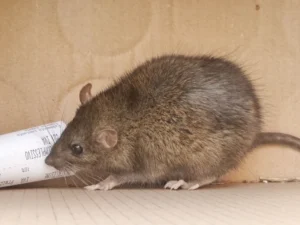
When rats are eating the bait, set the trap and cut the bait down to a small amount.
Peanut butter is the go-to because it sticks and smells strong. Bacon, nuts, dried fruit, and candy also work, so try more than one.
Put the bait at the back of the box so the rat has to go all the way in. Change it every day or two so it stays fresh and smelly.
Where Should You Put a Rat Trap Box?
Rats stick close to walls and use the same paths every night. So the best spot is a straight edge where you’ve found droppings (behind appliances, along a garage wall, or beside a stack of boxes).
Point the entrance along the wall so the rat walks straight into it. Wedge the box with bricks or a heavy board so it can’t tip.
Rats like cover, so a box tucked into a dark corner often works better than one in the open. A piece of cardboard draped over the top makes it feel even safer.
Roof rats travel off the ground, along fences, pipes, and beams. A heavy box won’t fit there, so use the snap trap box on a ledge or beam instead.
Keep every box away from doors and walkways. That protects kids, pets, and your own feet.
Common Mistakes That Make Rat Trap Boxes Fail (And Easy Fixes)
Most rat trap boxes that catch nothing share the same few problems, and each one has an easy fix.
- The box is too short: a rat needs to be fully inside before the door falls, so make the box at least 20 inches long.
- The material is too weak: rats chew cardboard, thin plastic, and soft wood, so use pine with screws and metal on the door.
- There are gaps in the seams: a rat only needs half an inch, so seal every gap tight.
- The door sticks: a door that binds won’t close, so test it ten times before you set it.
- You skipped pre-baiting: rats avoid new objects, so give them a week to get used to the box.
- The box is in the open: rats hug walls, so a box in the middle of a floor gets skipped.
- Nobody checks it: a trapped rat will chew and thrash, so check it every morning.
How Can You Keep Kids and Pets Safe Around a Rat Trap Box?
Homemade traps don’t come with warning labels, so safety is up to you. The biggest risks are curious kids, dogs, and cats.
A live rat in a box can bite, and a dog or cat may try to get at it. Keep the box where pets can’t reach, such as behind appliances or in a closed room.

Snap traps are the hardest on fingers and paws. The snap trap box helps by covering the trap, but latch the lid and keep it out of reach.
Put outdoor traps out at night and bring them in each morning. That keeps birds and other wildlife out of harm’s way.
What Should You Do With a Rat Once You’ve Caught It?
This is the part most plans skip, but catching a rat alive is only half the job.
Never open the box with bare hands, since a scared rat will bite and rats can spread diseases. Carry the whole box, with the rat inside, wearing thick gloves.
Releasing it isn’t a good fix. UK rat-control guidance published with the journal Animal Welfare says it isn’t recommended because an unfamiliar place can cause suffering, and in the UK it could even be against the law.
Rules vary, so check yours first. A vet, an animal shelter, or a pest control company can humanely put the rat down, and drowning isn’t an acceptable method.
Then comes the cleanup, and this part is important. The CDC says some rodents carry hantavirus, which people can catch by breathing in dust from dried droppings, urine, or nests.
So wear rubber or plastic gloves, and don’t sweep or vacuum, since that throws dust into the air.
Spray the droppings, the nest, and the box with a bleach mix of 1 part bleach to 9 parts water (that’s 1½ cups of bleach in a gallon).
Let it soak for about 5 minutes, then wipe it up with paper towels. Seal the towels in a plastic bag and put that bag inside a second bag, then wash your hands with soap and warm water.
Should You Build a Rat Trap Box or Buy One?
Honestly, for most people, buying is easier. A store-bought rat cage trap or snap trap is cheaper than the lumber, faster to set up, and tested on real rats.
Building has its place, though, since a homemade box can be sized for the rats you actually have and the snap trap box protects kids and pets better than most store versions.

However, traps alone won’t fix a rat problem. If rats have food and a way in, new ones will take the place of the ones you catch.
Seal any gap bigger than half an inch with steel wool or hardware cloth, since rats chew through caulk and plastic.
Store pet food in containers rodents can’t get into, and trim tree limbs that sit within 3 feet of your roof.
If you still see signs after a couple of weeks of steady trapping, call a licensed pest professional.
Conclusion
A homemade rat trap box has to be built tougher than most plans suggest.
Rats jump 3 feet, chew wood and plastic, and squeeze through half-inch gaps, so the box needs screws, metal on the door, and a length of at least 20 inches.
The one-way swing-door box is the easiest live-catch build, and the drop-door box is the strongest. A snap trap box keeps kids and pets safe, and a plastic tote works in a pinch if you tune it.
Whichever you build, pre-bait for about a week, set it along a wall, and check it every morning. Then plan for what happens after the catch, wearing gloves and cleaning up with bleach.
A few smart traps and a sealed house can finish what you started.

Hi, my name is Ezra Mushala, i have been interested animals all my life. I am the main author and editor here at snakeinformer.com.