
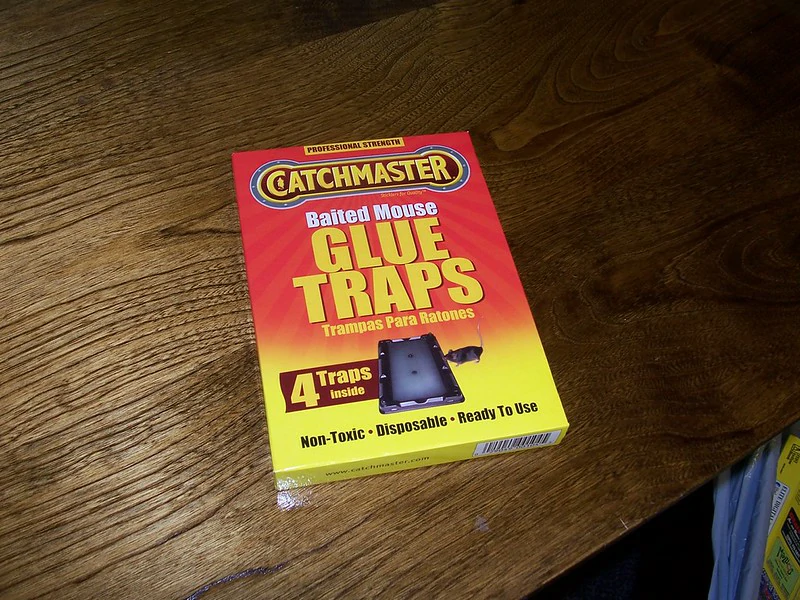
Glue traps are flat boards with a sticky coating that holds a mouse in place, and many people don’t know what happens once a mouse steps on one. So, do mice suffer on glue traps?
Yes, mice suffer on glue traps. A stuck mouse panics, hurts itself trying to break free, and can survive for two to four days until it dies of dehydration. An expert group that advised the Scottish government concluded that glue traps can’t be used without causing suffering.
That’s a strong answer, so this post shows where it comes from and what a mouse goes through on a board. It also covers what to do if you find one and what you can use instead.
Can a Mouse Really Feel Pain and Fear?
If you’re wondering whether a mouse feels pain, it does. Mice are mammals with a nervous system a lot like ours, so they feel fear and stress too.
Scientists take that so seriously that they’ve built a way to read pain on a mouse’s face.
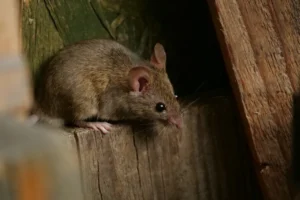
It’s called the mouse grimace scale, and it looks at things like squinting eyes, bulging cheeks and nose, and ears that flatten or pull back. Labs use it to tell when a mouse is hurting and needs help.
Mice also explore their surroundings, hide when they’re scared, and run from danger. A mouse that’s stuck can’t do any of that, which is a big part of what makes a glue trap so stressful.
Pest controllers and animal welfare groups don’t agree on everything, but they do agree on this point. Everyone who gave advice to the Scottish government’s review of glue traps accepted that trapped animals suffer.
Do Mice Feel Less Pain Than Other Animals?
Some people assume a pest must feel less than a pet, but science doesn’t back that up. A mouse’s body handles pain in much the same way that a hamster’s or a rabbit’s does.
Animal welfare experts say the label pest shouldn’t change how we think about suffering. An animal’s ability to feel fear and pain doesn’t depend on whether we like having it around.
The BC SPCA makes a similar point, noting that mice and rats have about the same capacity to suffer as other animals.
That doesn’t mean you can never control mice. It means the way you do it matters, and quick methods are much kinder than slow ones.
Most people feel differently about a mouse stuck on a board once they picture a kitten or a bird in the same spot. The glue treats them all exactly the same.
What Happens in the First Minutes After a Mouse Steps on a Glue Trap?
If you’ve ever seen a mouse dart along a wall, you know how close to the edge it stays. That habit is exactly how many of them end up on a glue board.
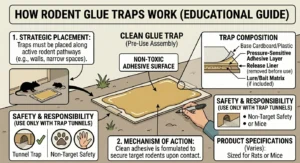
Once a mouse steps on the board, its feet stick right away. It can’t get away, so it pulls, twists, and tries to run.
Every struggle makes things worse, because other parts of its body touch the glue and stick too. Soon the belly, tail, and sometimes the face are stuck down.
A review of three experiments on rodents caught on glue boards found the same pattern each time: the animals ended up stuck by their feet, bodies, and heads.
In some of them, the animals’ suffered facial injuries while trying to chew their way free. One experiment also found damaged eyes and raw patches of skin where fur had been torn away.
Frightened mice often urinate and defecate, and that showed up in two of the experiments. A stuck mouse can end up lying in its own mess, which adds to its distress.
Mice Can Hurt Themselves Badly Trying to Break Free
A mouse on a glue trap will do almost anything to get loose, and that effort can cause serious injuries.
The RSPCA (the UK’s biggest animal welfare charity) says trapped animals may rip out patches of fur, and even break bones.
Injuries like that happen because pain and panic keep the animal fighting, even when the struggle only makes things worse. Scientists who study trap welfare have noted the same thing, including cases where animals hurt themselves.
Torn skin can bleed, and a mouse that’s already weak can lose strength fast. Even small wounds can get worse over many hours when the animal has no way to rest or clean itself.
That’s why vets who’ve seen glue trap victims describe them as weak, dehydrated, and badly frightened. In severe cases, a vet has to put the animal to sleep to end its suffering.
The Slow Part: Hours of Stress and Days of Thirst
Glue traps aren’t built to kill; they’re built to hold. That means a mouse doesn’t die quickly, and it can stay stuck for hours before anyone checks the trap.
The RSPCA notes that after three to five hours, some trapped animals have been found covered in their own urine and droppings. Many keep struggling the whole time.
Left alone, a mouse can survive until it dies of dehydration, and that usually takes about two to four days.
RSPCA Australia points out that glue boards are often left for 24 hours before anyone checks them, and sometimes much longer.
Even the pest control industry’s own advice is to check every 12 hours. A Scottish government science agency told the review that 24 hours between checks is far too long.
Compare that with the standard some animal welfare groups use for a humane method, which is going unconscious or dying in about a minute or less.
Can a Mouse Suffocate on a Glue Trap?
Yes, it can happen. If the mouse’s nose or mouth ends up stuck to the glue, breathing gets hard, and some animals die that way.
A mouse’s own weight and its struggling can press its face or chest into the glue. Once that happens, it can be very hard for the animal to pull free.
A vet who treated a trapped mouse described it as stuck by the side of its face and belly, so it couldn’t move or breathe well. The mouse was weak, dehydrated, and clearly terrified.
Not every mouse dies this way. Many die slowly from stress, injury, thirst, and hunger instead, which isn’t any gentler.
How Do Scientists and Vets Decide If a Trap Is Humane?
If you want to judge a trap yourself, ask how fast it kills, how much pain and fear it causes, and how reliably it works.
The BC SPCA, an animal welfare charity in Canada, uses a checklist like that. It wants the animal to die or go unconscious in roughly a minute or less, with low pain and low distress.
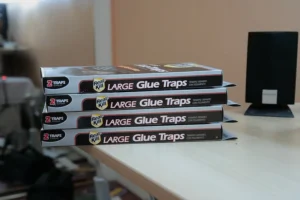
Glue traps fail those tests. UFAW, a UK charity that studies animal welfare, says the harm from glue traps is severe, and it calls suffering from them nearly guaranteed.
UFAW also points out that snap traps kill fast when they work properly, which makes them a more humane choice when rodents have to be caught and killed.
A scientific review by Mason and Littin that many experts cite compared rodent control methods. It said glue traps seem to share the same big welfare costs as leghold traps (metal traps that clamp onto an animal’s leg).
That’s a serious comparison, since leghold traps are already restricted or banned in many places.
Why Do Some Pest Controllers Still Use Glue Traps?
If you’re wondering why anyone still uses them, supporters say glue traps fit in tight spaces, don’t use poison, and are easy to use. Some pest controllers also use them to check whether mice are around.
Industry groups in the UK have described glue traps as a last resort for trained professionals, in places like food factories and hospitals, where rodents can spread disease.
That argument has a real basis, because a serious rodent problem in a hospital or food plant is a big deal. However, the Scottish review wasn’t convinced that glue traps are really the only option left in those places.
It also noted that nobody had shown glue traps are used only as a last resort. Some operators probably use them much more freely.
Even with frequent checks and a quick end for the animal, the review said real welfare concerns remain.
New Zealand’s animal welfare committee added that its pest control industry appeared to adapt well once glue boards were restricted.
What People Do With a Live Mouse Can Make Things Worse
A glue trap catches a mouse alive, and that leaves the person who set it with a hard question: what now? Many people don’t know the answer, and the packaging rarely helps.
A UK poll ordered by an animal welfare charity found that over half of people either didn’t know what to do or suggested something illegal.
Some people said they’d drown the mouse. A few said they’d leave it to die or throw the whole trap away with the mouse still alive.
Those choices can mean more pain and fear for the animal, and some of them are illegal in places with animal cruelty laws.
Hitting a mouse with a heavy object is another common idea, but it takes skill to do quickly, and fear or nerves can make people miss.
That’s why many experts think there’s no kind way to use one.
Do Glue Traps Hurt Other Animals Too?
Yes, and that’s one of the biggest complaints about them. If you have pets, keep in mind that a glue board can’t tell a mouse from a bird, a snake, or a curious cat.
In England and Wales, the RSPCA got 243 reports about glue traps between 2015 and 2019. More than 73 percent involved pets or wild animals that weren’t the target.
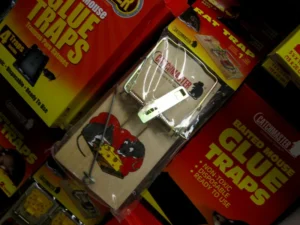
Those reports included 13 cats and seven pet snakes, along with dogs, pigeons, owls, ferrets, and even a parrot.
North America sees the same thing. A university wildlife clinic in the US once treated two garter snakes (small, harmless snakes) that were stuck on the same trap.
In Massachusetts, two out of three licensed wildlife rehabilitators who answered a questionnaire had treated an animal caught on one, including songbirds, snakes, and chipmunks.
That’s a good reason to think hard before you set a glue board anywhere birds or pets can reach.
Why Governments Have Banned or Limited Glue Traps
Because of all this, a growing number of places have stepped in. New Zealand banned glue boards for rodents on January 1, 2015, with narrow exceptions that need government approval.
That approach made a big difference: approvals to sell or use glue boards dropped from 24 in 2015 to two in 2020.
Sales under approval fell too, from about 24,500 boards to just 48. That suggests pest controllers found other ways to do the job.
The Australian state of Victoria went further in 2019 with an outright ban on selling, setting, and using glue traps, including by professional pest controllers.
Ireland doesn’t list glue traps as approved traps, so having or selling them is an offense there, and England banned public use under a law passed in 2022.
The Netherlands and Belgium’s Flanders region have tight limits too.
In the US and Canada, glue traps are still legal in most places, though a few cities and some stores have moved away from them.
What Should You Do If You Find a Live Mouse on a Glue Trap?
Don’t throw the trap in the trash with the mouse still alive, and don’t try to drown it. Both can cause even more suffering, and both can break animal cruelty laws in some places.
Instead, call a vet, a wildlife rescue, animal control, or a pest control company right away and ask what they can do.
Some vets will help for little or no charge, and a rescue can tell you who nearby will.
Wear thick gloves while you wait, since a frightened mouse can bite and carry germs. Put the board somewhere dark, quiet, and out of reach of pets and kids.
Oil can loosen the glue, but handling a weak, frightened mouse safely is hard, so call an expert.
Once the mouse has been taken care of, wash your hands well and clean the area with a disinfectant (a cleaner that kills germs). Then take any other glue boards out of the house.
What Should You Use Instead of a Glue Trap?
A snap trap is the usual choice, because it kills quickly when it’s set right. That’s much kinder than hours stuck on a board.
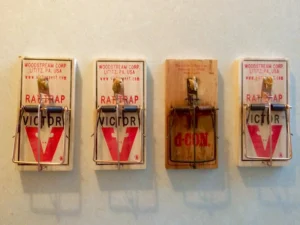
Place traps along walls where mice run, set several at once, and use a small dab of peanut butter, about the size of a pea, as bait.
Check traps every day, wear gloves, and wash your hands afterward. Wiping the area with a disinfectant helps too.
Enclosed trap stations (small boxes with a snap trap inside) keep pets and kids away from the trap. They’re a smart pick for homes with curious dogs, cats, or toddlers.
Electronic traps are another option, since they kill quickly and keep the mouse inside a closed box.
If you’d rather not kill the mouse, a live trap works. Just check it often and release the mouse far from your home where local rules allow.
A mouse that’s released far from home may not survive in unfamiliar territory, so prevention is the kindest answer over time.
How to Make Your Home Less Attractive to Mice
Mice get in through gaps you’d never notice, since a mouse can squeeze through a hole about a quarter inch wide (roughly 6 mm). Walk around your home and look for holes around pipes, vents, doors, and the foundation.
Stuff small holes with steel wool and seal over it with caulk, and use metal mesh or a concrete patch for bigger ones. Mice can chew through foam and plastic, but steel is a tough one for them.
Add door sweeps (strips that close the gap under a door) and fix torn window or vent screens. A tiny gap under a garage door is often all a mouse needs.
Store food in glass, metal, or thick plastic containers with tight lids, including pet food and birdseed. Wipe up crumbs, and don’t leave dirty dishes out overnight.
Use trash cans with tight lids, and take garbage out before it piles up. Clean under and behind the stove and fridge, where crumbs build up.
Outside, keep firewood and clutter away from your walls, trim bushes back from the house, and fix leaky pipes and sprinklers. Mice look for food, water, and shelter, and you can take away all three.
Give prevention a few weeks, and keep checking for droppings, gnaw marks, and greasy streaks along walls. If the signs keep showing up, call a licensed pest controller who starts with prevention.
Conclusion
So, do mice suffer on glue traps? Yes, and experts who study animal welfare agree that the suffering is serious and can last for days.
A stuck mouse panics, hurts itself trying to get free, and slowly weakens from stress, thirst, and hunger. Some animals suffocate when the glue covers their nose and mouth.
Glue traps also catch birds, snakes, and pets that were never the target. That’s one reason many places have banned or limited them.
If you find a mouse stuck on one, call a vet, a wildlife rescue, or a pest control company instead of guessing.
The kindest way to deal with mice is to shut them out first and use snap traps if you need a trap, and you can skip glue completely.

Hi, my name is Ezra Mushala, i have been interested animals all my life. I am the main author and editor here at snakeinformer.com.