
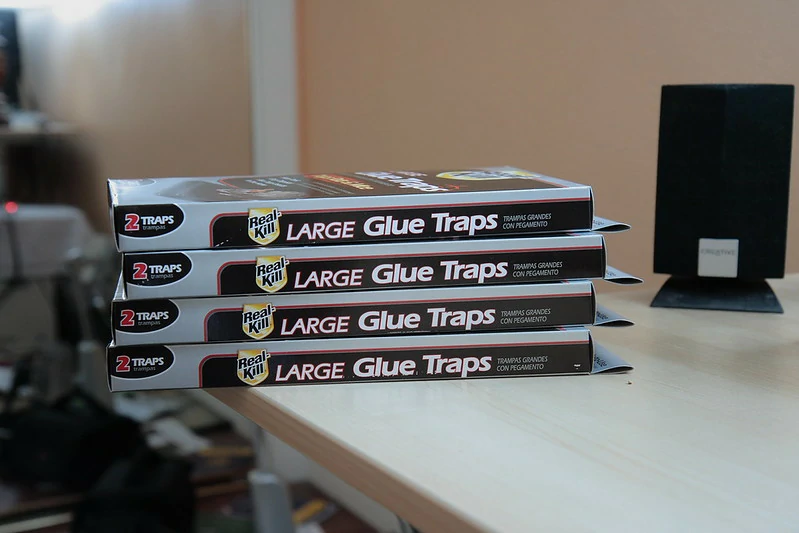
Mice and rats love Massachusetts’s old brick buildings and triple-deckers, and plenty of people reach for glue traps when they show up. So, are glue traps legal or illegal in Massachusetts?
Glue traps are legal in Massachusetts. There’s no statewide law that bans them, though your city or town may have its own rules.
That doesn’t make them a good idea, since health agencies advise against them and they catch pets and wildlife by accident. Here’s how the rules work and what to use instead.
Glue Traps Are Legal Under Massachusetts State Law
Massachusetts has no statewide law banning glue traps, so you can buy and use them without breaking a state law.
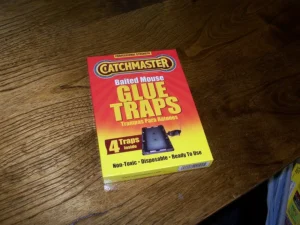
That goes for homeowners, renters, landlords, and pest control companies, though local rules may add limits.
A glue trap (also called a glue board) is a flat piece of cardboard or plastic covered in very sticky glue. A mouse or rat steps on it and gets stuck.
Laws can change, so it’s smart to check Mass.gov and your city or town’s website for the current rules.
Has Massachusetts Ever Tried To Ban Glue Traps?
Yes, lawmakers have tried several times. A bill to ban glue traps for rodents was filed in 2015, again in 2019, and again in 2021.
Each version said that no person could use glue or other sticky traps to control rats, mice, or other rodents.
The 2019 version proposed a fine of up to $50, to be enforced by the officers who handle the state’s wildlife laws.
The Judiciary Committee scheduled a public hearing for each bill.
After the hearings, each bill was sent to a study order (a way of setting a bill aside for more review), and none of them became law.
Bills like these can be filed again in future sessions, so the rules could change.
Does Your City or Town in Massachusetts Have Its Own Rules?
Massachusetts has 351 cities and towns, and each one has its own local government and board of health.
A board of health is the local agency that handles public health rules, including pest problems in housing.
Some local rules can go further than state law, so a trap that’s fine in one town may be limited in the next.
Before you buy glue traps, call your local board of health or check your town’s website.
That’s especially smart if you own a rental property or run a business, since health inspectors may have their own expectations.
What the State Sanitary Code Says About Mice and Rats
Massachusetts has housing health rules called the State Sanitary Code, and part of it deals with mice, rats, and other pests.
In a building with two or more units, the owner must keep pests out of the building and its grounds and is responsible for getting rid of them.
In a single-family home, the owner is responsible if gaps or damage in the building let pests in.
People who live in a home have a job too, since they must keep their space clean enough that it doesn’t attract pests.
Owners also have to check each unit for pests before a new tenant moves in.
Local boards of health enforce these rules, so that’s who to call if a landlord won’t deal with a rodent problem.
Pest control inside a home also has to follow the state’s pesticide rules. The Massachusetts Department of Agricultural Resources (MDAR) oversees those.
Who Handles Mice and Rats in a Massachusetts Triple-Decker?
Triple-deckers (three-family houses with one unit on each floor) are all over Boston and other Massachusetts cities, and they’re a classic spot for mice to spread.
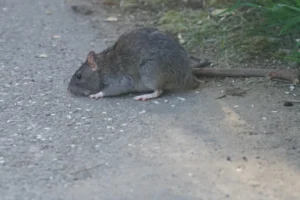
Mice don’t care about unit lines. They travel through walls, pipes, and shared basements, so one unit’s problem quickly becomes everyone’s.
Under the sanitary code, the owner of a building with two or more units is responsible for getting rid of pests.
That means the owner, not one tenant, is the one who has to deal with a building-wide mouse problem.
If you’re a tenant, put your complaint in writing and keep a copy. If nothing happens, ask your local board of health to inspect.
If you’re an owner, sealing gaps and setting snap traps in every unit is a better plan than relying on glue boards.
Is There a Federal Law Against Glue Traps?
No. There’s no federal law banning glue traps, so the rules come from states, cities, and towns.
Congress has looked at the idea. In 2024, Representative Ted Lieu introduced the Glue Trap Prohibition Act, which would have banned selling and using glue traps for rodents.
It proposed fines of up to $1,000 for individuals and up to $5,000 for businesses, but it didn’t become law.
Which Places in the US Have Banned Glue Traps?
Most glue trap bans in the US have come from cities, not states. West Hollywood, California was the first, in 2023, and Ojai, California followed in 2024.
Florida’s wildlife commission approved a rule that bans glue traps outdoors from December 31, 2026, though they’re allowed inside enclosed buildings.
Lawmakers in New York and New Hampshire have also looked at statewide bills, and outside the US, England, Wales, and Scotland have banned or restricted glue traps too.
Why the CDC Tells People Not To Use Glue Traps
The CDC says not to use glue traps for rodent control at home.
A frightened mouse stuck on a board can urinate, which spreads germs around your home and makes cleanup harder.
Its advice is to use snap traps, and to save poison or bait stations for infestations that don’t go away.
The CDC’s plan is simple: seal up, trap up, and clean up.
Picture finding a live mouse stuck to a board in your pantry, right next to your cereal. You’d have to deal with the mouse and the mess at the same time.
Do Glue Traps Work as Well as Snap Traps?
Usually not. University extension guides tend to call snap traps the better choice for homes, and they treat glue boards as a backup.
A University of Nebraska study from 2018 compared them. Snap traps caught mice about 56% of the time, while glue traps caught only about 8%.
Glue boards also lose their stickiness in dusty places like garages, basements, and attics.
Rats are another problem, because they’re bigger, stronger, and very cautious around anything new, so a glue board in their path may be ignored for days.
What Glue Traps Do to Mice and Rats
A mouse that touches a glue board gets stuck by its feet. The harder it struggles, the more of its body sticks.
An animal stuck for hours can die of thirst, hunger, or exhaustion. Some hurt themselves badly while trying to get loose.
Many people never plan for that part. You set the board expecting a quick fix, and you come home to a live animal that’s scared and hurt.
A snap trap is a much quicker option if you want to avoid that moment.
Glue Traps Can Catch Massachusetts Wildlife and Pets
A glue trap can’t tell a mouse from anything else, so birds, chipmunks, squirrels, and snakes have all been caught on them in the US.
Think about the spots where people set them: garages, sheds, porches, and basements. All of them are places a curious cat or a wandering chipmunk can end up.
A chickadee hopping into an open shed looking for a snack is a perfect example, because one step onto the board and it’s in serious trouble.
Dogs and cats get stuck too, usually on a paw, a nose, or a patch of fur.
You can’t control what walks across the board, and that’s the main reason wildlife groups push for bans.
What To Do if an Animal Gets Stuck on a Glue Trap in Massachusetts
If a wild animal is stuck, don’t try to pull it off, because that can tear skin, fur, or feathers.
Get it to a licensed wildlife rehabilitator as soon as you can. MassWildlife (the state’s wildlife agency) keeps a list of them on its website.
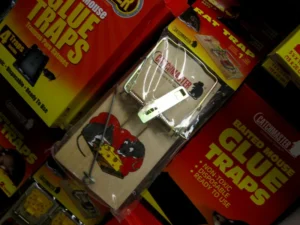
While you wait, put the animal in a box with air holes and keep it warm, dark, and quiet.
If you can’t get help right away, wear gloves and gently work a little cooking oil into the glue where it touches the animal. Use as little as you can.
If it’s a snake and you don’t know what kind, don’t touch it. Call a wildlife rehabilitator or animal control.
If it’s your own pet, call your vet right away, since they can remove the glue safely and check for injuries you can’t see.
Which Rodents Cause Trouble in Massachusetts Homes?
Three kinds show up most often: Norway rats, house mice, and white-footed mice.
Norway rats are heavy, brown, and common in cities, and they dig burrows near foundations and drains and love old buildings with gaps.
House mice are the most common indoor visitors, and they can live year-round in homes, apartments, and restaurants.
White-footed mice are more common in wooded suburbs and country homes. They’re also one of the animals that young ticks feed on, which is another good reason to keep them out of your home.
Knowing which one you’ve got changes your plan, because a mouse trap is too small for a rat.
Why Do Mice Move Into Massachusetts Homes in the Fall?
When the weather turns cold, mice look for a warm, safe place with food, and your home checks every box.
A female house mouse can have 5 to 10 litters a year, with about 5 or 6 babies in each one.
That’s how a small problem can turn into a big one by winter.
A mouse can squeeze through a hole about 1/4 inch wide (roughly the width of a pencil). A rat needs a gap around 1/2 inch.
So the first cold snap is often when you hear scratching in the walls at night.
How To Set Snap Traps the Right Way
Set each trap perpendicular to the wall, with the trigger end touching it, since mice and rats run along edges.
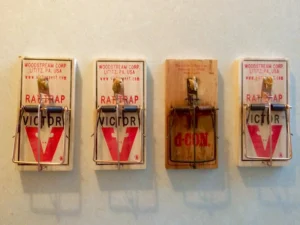
Use a pea-sized dab of chunky peanut butter as bait, and press it into the trigger so the animal has to work at it.
Set traps in pairs, in spots where you’ve seen droppings, gnaw marks, or nesting material.
For rats, use rat-sized traps, and try pre-baiting (putting bait on the trap without setting it) for a few days, since rats are cautious.
Check traps every day. Wear gloves when you handle them, and wash your hands afterward.
What About Poison Baits and Bait Stations in Massachusetts?
Poison is a last resort, and the CDC says to save it for infestations that don’t go away.
The danger is that pets, kids, and wildlife can get sick from the bait or from eating a rodent that ate it.
Owls and hawks that hunt rodents in Massachusetts can be hurt this way too.
If you do use bait, choose tamper-resistant bait stations, which are built so kids and pets can’t reach the bait, and follow the label exactly.
Poison can also send a mouse off to die inside a wall, and the smell can last for weeks.
How To Seal an Older Massachusetts Home Against Mice and Rats
Older homes with brick or stone foundations and damp basements often have more gaps than newer ones.
Walk around the outside in early fall. Check around the foundation, pipes, dryer vents, utility lines, and basement windows.
Fill small gaps with steel wool or copper mesh, then seal over it with caulk, since rodents chew through foam and plastic.
In a triple-decker or a row house, check shared basements, porch steps, and the spots where pipes go through walls.
Add a rubber seal along the bottom of doors if you can see daylight under them.
What Attracts Mice and Rats to Massachusetts Homes?
Food, water, and shelter are what they’re after, so take away as many as you can.
Store pet food, birdseed, and grass seed in hard containers with tight lids.
Use trash cans with tight lids, and clean up spilled birdseed under feeders, since seeds on the ground are a free meal for mice and rats.
Stack firewood off the ground and away from the house, and clear out clutter along your walls.
Fix leaky pipes and outdoor taps, because rodents need water as much as food.
How To Clean Up Safely After Mice or Rats
Mice and rats leave droppings and urine, and you shouldn’t clean them up like normal dust.
The CDC says not to sweep or vacuum dry droppings, because that can send tiny particles into the air.
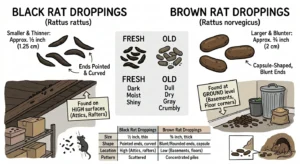
Air out the room first, then put on gloves, spray the droppings with a disinfectant, and let it soak before you wipe it up with paper towels.
Seal the paper towels and any dead mice in a bag, and put it in your outside trash. Then wash your gloves and your hands with soap and water.
If the mess is big, or it’s in a crawl space or attic, it may be smarter to hire a professional.
What To Look For When You Hire a Pest Control Company in Massachusetts
Ask what methods the company plans to use, including whether they use glue boards. You’re allowed to say no.
Pesticide use in Massachusetts is regulated by MDAR, so a company that uses poison should be properly licensed. Ask to see the license.
Ask whether they’ll find and seal the entry points, since a company that only sets traps will likely be back next month.
Tell them about any pets, kids, or wildlife around your home so they can pick the safest options.
If you’re a landlord, remember that your pest control plan has to meet the sanitary code. Some local boards of health also require a licensed exterminator when an owner is cited.
Get the plan, the number of visits, and the price in writing before you agree to anything.
Could Massachusetts Ban Glue Traps in the Future?
It’s possible, since the idea has come up several times in the State House.
Lawmakers filed bills to ban glue traps in 2015, 2019, and 2021, and each one was sent to study without becoming law.
Other places have moved ahead. West Hollywood and Ojai banned them, Florida has an outdoor rule, and England, Wales, and Scotland have all acted.
If you want to follow it, check the Massachusetts Legislature’s website at malegislature.gov, because bills can return in any new session.
Conclusion
Glue traps are legal in Massachusetts, and there’s no statewide law against them.
But your city or town may have its own rules, and the State Sanitary Code makes owners responsible for pest control in buildings with two or more units.
Legal doesn’t mean it’s the best choice. Health agencies advise against glue traps, they catch pets and wildlife by accident, and they don’t work as well as snap traps.
If you’ve got mice or rats, set snap traps the right way, seal the gaps, and clean up food and clutter.
If an animal gets stuck on a glue trap, don’t pull it off. Get it to a vet or a wildlife rehabilitator as soon as you can.
Rules can change, so check your local rules and Mass.gov before you buy a glue trap.

Hi, my name is Ezra Mushala, i have been interested animals all my life. I am the main author and editor here at snakeinformer.com.