
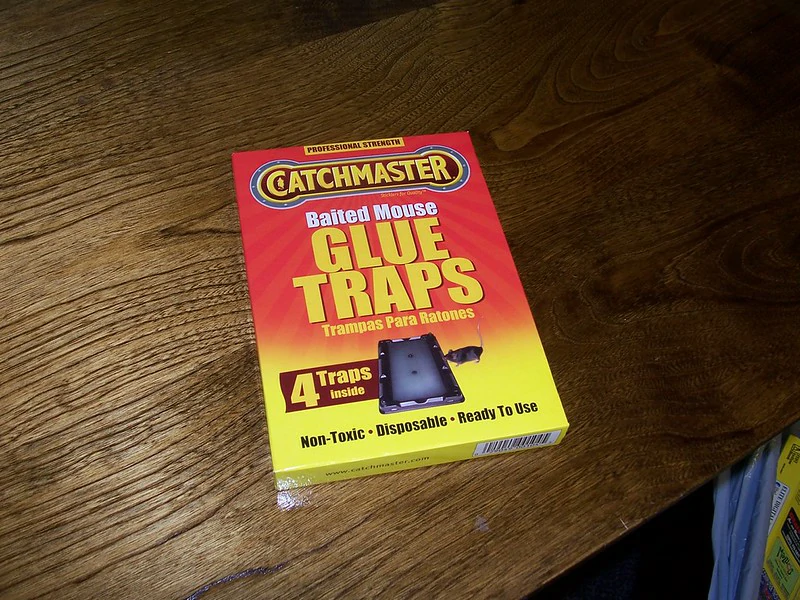
Glue traps look like the easy answer to a rat problem, since they’re cheap, they don’t use poison, and you just set one down and walk away.
But rats aren’t mice, and what works on a small mouse often fails on a strong, wary rat. So are glue traps effective for rats?
No, glue traps aren’t very effective for rats. A big, strong rat can pull free or drag the board away, and the ones that do get stuck often suffer for hours. Snap traps and sealing entry holes work much better.
Glue traps do catch some rats, mostly the young and small ones, but plenty of big ones get away and the suffering along the way is real.
In this guide, you’ll see how glue traps work, why adult rats beat them, and what to use instead.
Why Glue Traps Look Like a Smart Fix for Rats
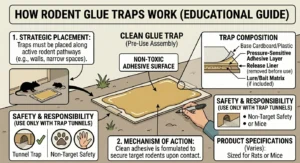
A glue trap (also called a glue board or sticky board) is a flat piece of cardboard, plastic, or wood covered in a very sticky adhesive.
The rat walks across it, its feet stick, and the board holds it in place until you come along.
The appeal is easy to see. A pack costs a few dollars, and there’s no spring to set and no poison to handle.
You also don’t have to worry about a rat dying inside a wall, which can happen with poison baits. That’s a real problem, and it’s a fair reason to look for another option.
The packaging doesn’t help much either, since it usually promises a quick, clean fix and rarely mentions what you’ll find when you check the board.
The whole idea depends on one thing, which is that the rat has to stay stuck.
With a mouse, that mostly works, but with a big rat, it’s where the plan starts to fall apart.
How Do Glue Traps Work on Rats?
The adhesive grabs the rat’s feet and fur as soon as it steps on the board, and struggling only spreads the glue.
Rat boards are bigger than mouse boards and carry more glue. However, even the companies that sell them admit rats escape more often than mice.
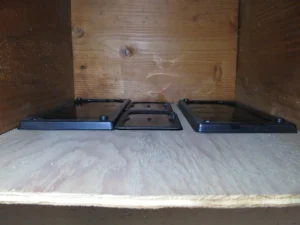
That’s especially true when a rat doesn’t land all four feet on the board, which happens a lot.
Rats rarely stroll onto the middle of a board. They sniff, test, and step carefully, so one or two feet may stick while the others stay free.
Glue also needs the right conditions to work, and boards do best in dry, clean spots without dust.
Most places where rats live (basements, garages, sheds, and crawl spaces) are dusty, and a thin layer of dust can weaken the grip.
So a board that looked fine when you set it down may be much less sticky by the next night.
Can a Big Rat Pull Itself Off a Glue Trap?
Yes, and that’s the main reason glue traps struggle with adult rats, since a full-grown Norway rat weighs 7 to 18 ounces (about 200 to 500 grams).
Its body is 7 to 10 inches long, and it can jump about 3 feet straight up. That’s a lot of muscle for a thin layer of glue.
If only one or two feet stick, the rat pushes off with the others, and it can rip a foot loose and leave some fur behind.
It can also just drag the whole board across the floor, which is a very common problem.
A rat dragging a board can wedge itself under a shelf or behind a freezer, where it may sit for days.
Rats also chew, and a panicked one will bite anything that gets close, including your fingers.
Glue boards work better on young and small rats, like half-grown Norway rats or lighter roof rats (5 to 10 ounces).
The strongest adult is usually the one that gets away, and that’s the rat you were trying to catch in the first place.
Why Rats Often Avoid Glue Traps Completely
Before a rat can get stuck, it has to walk onto the board, and that’s harder than it sounds because rats are very wary of anything new.
Scientists call this neophobia (a fear of new things), and Norway rats have plenty of it. That’s why a new trap can sit untouched for days.
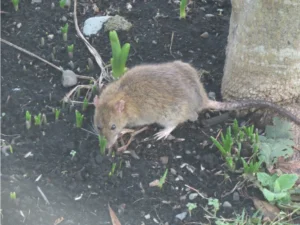
Rats also rely heavily on touch and smell to get around, and they learn their routes by memory.
So a sticky board dropped onto a familiar path can feel wrong right away, and the rat will often step around it.
Rats also don’t like open floors, since they run along walls and edges. A board in the middle of a room often gets ignored.
With snap traps, you can pre-bait (set the trap out unarmed so the rat gets used to it). That’s much harder with a sticky board.
So you can end up with a board that rats simply walk around, while they keep eating whatever food you left within reach.
What Happens to a Rat Stuck on a Glue Trap?
A glue trap doesn’t kill, which means it holds the rat in place until someone deals with it, and that can take hours or even a full day.
A review of glue boards used on rats found that the suffering lasts for hours and rated it as extreme.
The rat is panicked, it struggles, and it can’t eat or drink, and some wear themselves out completely before anyone checks.
Then you show up with your morning coffee and find a live, frightened rat stuck to a board.
Most homeowners have no plan for that moment, and no training either.
Pest control professionals are trained to handle it quickly and humanely, and even they find it hard.
If you find a live rat on a glue board, wear thick gloves and keep kids and pets away. Then call a pest control company, animal control, or a vet.
Don’t try to pull it free with bare hands, because a scared rat bites and rats can carry germs like leptospirosis, salmonella, and rat bite fever.
Do Glue Traps Work Better on Roof Rats or Norway Rats?
Neither one, really, but they fail in different ways.
Roof rats are lighter (5 to 10 ounces) and sleeker than Norway rats, so a glue board can hold one a little better.
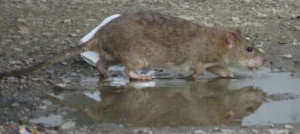
However, roof rats are great climbers that run along beams, wires, pipes, and fence tops, and they rarely walk across a floor.
A board on the floor misses them completely, and one up on a beam can fall or get dragged by a struggling rat.
Norway rats stay low, in basements and along walls, so a board fits their path better.
But they’re big and strong, so they pull free more often, and the heavy adults are the hardest to hold.
Each rat beats the glue trap in its own way. So match the trap to the rat, with snap traps on the floor for Norway rats and up high for roof rats.
Glue Traps Also Catch Birds, Lizards, and Pets
A glue trap can’t tell a rat from anything else that steps on it, and that’s a big problem.
Birds are common victims, especially sparrows and wrens that land on a patio or in a shed.
Lizards like geckos and anoles get stuck too, along with small snakes, frogs, and chipmunks.
Your own pets are at risk too. A curious cat or small dog can end up with a paw stuck to a board.
Animal welfare groups point out another problem. A dead animal on a discarded board can attract scavengers, and then they get stuck too.
Glue gets on people too, so kids, adults, and even your hair can end up stuck. It takes patience to get off.
If you use a board anyway, keep it indoors in a spot only rats can reach, and never put one outside where wildlife can walk onto it.
Are Glue Traps Legal Where You Live?
It depends on where you are. In the US and Canada, glue traps are still sold in most places, but the rules vary by state, province, and city.
Other countries have gone further, and England banned glue traps for the public in 2022 (only licensed users can still use them).
Ireland, New Zealand, the Australian state of Victoria, and Iceland have outlawed them too.
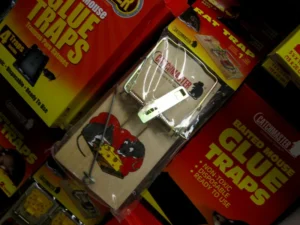
If you’re in the UK or Australia, check your local rules before you buy anything, because you could face a fine.
Even where they’re legal, many vets and animal welfare groups oppose them, since the suffering is long and hard to prevent.
That pressure is why more stores and pest companies are dropping them, and it’s fair to ask if you want to rely on one.
Do Glue Traps Ever Make Sense for Rats?
Rarely, but pest professionals sometimes use them in places where poison is risky or banned, like food storage rooms and commercial kitchens.
They may also use them when rats ignore bait because there’s so much other food around, and a trained person checks the boards at least twice a day.
That’s very different from a homeowner who sets one out and checks it tomorrow.
The first approach is a tool in a bigger plan, while the second is a gamble with an animal’s life.
For most homes, glue boards aren’t worth it. You’ll spend money on boards that catch a few young rats while the big ones stay in your attic.
Ask yourself one simple question: could you handle a live, panicking rat on a board at dawn, every time, for as long as the problem lasts?
If the answer is no, pick a different method, because there are better options and they work faster.
Why Catching One Rat Doesn’t Fix a Rat Problem
Even a perfect trap only solves a small part of the problem, because rats breed fast.
A female Norway rat can have 3 to 6 litters a year, with 8 to 12 pups in each one.
That means one missed pair can turn into a full colony in just a few months.
Glue traps don’t touch the real causes, which are food, water, and a way inside.
If your trash is open and your attic has a hole, new rats will move in as fast as you catch the old ones.
That’s why animal welfare experts point out that glue boards don’t solve the problem, since they don’t stop rats from reaching food.
A good plan removes the reasons rats came in the first place, and then uses traps to clean up what’s left.
How Can You Tell You Really Have Rats?
Before you buy any trap, make sure rats are really the problem, since mice leave some of the same clues.
Droppings are the easiest sign. Norway rat droppings are about 3/4 inch long with blunt ends, while roof rat droppings are about 1/2 inch long with pointed ends.
Mouse droppings are much smaller, around 1/4 inch.
Look for greasy rub marks along walls, where rats brush past again and again, and for gnawed holes in wood, plastic, and bags of food.
Rats also dig burrows along foundations, under trash, and in woodpiles (Norway rats), or nest in trees and attics (roof rats).
At night, you might hear scratching or scurrying in the walls or ceiling.
If you see a rat in daylight, the problem is often big, since rats prefer to stay hidden.
Knowing which rat you have helps you pick the right trap, and it tells you where to put it.
What Works Better Than Glue Traps for Rats?
Snap traps are still the safest, most effective, and cheapest way to trap rats, as long as you use a real rat trap and not a mouse trap.
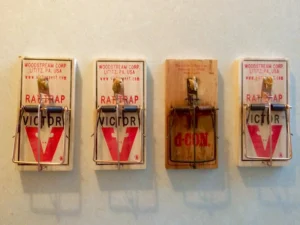
A mouse trap’s spring is too weak for a big rat, and a half-hit can hurt it and make it trap-shy.
Set the traps against walls, behind boxes, and in dark corners, since Norway rats run along edges.
For roof rats, go up high, on ledges, pipes, beams, and fence rails, because they rarely stay on the ground.
Pre-bait first by putting a dab of peanut butter on the unset trap for a few days, then set it once the bait keeps disappearing.
Keep traps away from kids and pets by putting them inside a sturdy box or behind furniture, and check them every day.
Sealing your home does even more than trapping, because a rat can squeeze through a 1/2 inch (1.3 cm) gap.
Close every hole bigger than that with metal, since rats chew through foam and plastic. Steel wool packed in tight and sealed with caulk works well.
Cut off their food too by storing pet food and bird seed in metal bins, keeping trash lids shut, and clearing out clutter and woodpiles near your walls.
Trim tree branches so they sit at least 3 feet from your roof, since roof rats use branches like bridges.
And skip poison baits indoors, because a poisoned rat can die inside a wall and the smell can last for weeks.
If you’ve got a big infestation, call a pest control company, since they can find where the rats are getting in.
How Can You Use a Glue Trap More Safely If You Must?
If you decide to use one anyway, a few steps can cut down the harm, though none of them make it a good option.
Use a board made for rats, because a small mouse board can’t hold a big rat and will just get dragged away.
Place it along a wall indoors in a dry, clean spot, then tape or staple it down so the rat can’t drag it under a shelf.
Keep it far from pets and kids, and never put it outside.
Check it at least twice a day, early in the morning and again in the evening.
Have a plan before you set it, which means knowing who you’ll call and deciding that you won’t leave a live rat stuck overnight.
Also, use it only as a short-term tool while you seal holes, and remove it as soon as the rat activity stops.
How Do You Throw Away a Used Glue Trap Safely?
Wear gloves and slide the whole board into a sturdy plastic bag, then seal it and put that bag inside a second one.
Put it in your outdoor trash with the lid shut, because scavengers and pets can find anything left in the open.
If glue gets on your skin or floor, cooking oil helps loosen it. Wipe it off, then wash with warm, soapy water.
Wash your hands well after any contact, even if you wore gloves, since rats carry germs and it only takes one touch of your mouth or eyes.
Conclusion
Glue traps aren’t very effective for rats, since adult rats are strong enough to pull free or drag boards away, and the ones that get stuck often suffer for hours.
They also catch birds, lizards, and pets, and in places like England, Ireland, New Zealand, and Victoria, they’re banned or tightly limited.
A much better plan is to use snap traps along walls (or up high for roof rats), seal every gap bigger than 1/2 inch, and cut off food and shelter.
That combination solves the problem for good, and it doesn’t leave you alone with a frightened animal at dawn.
If the problem is too big, a pest control professional can take it from there.

Hi, my name is Ezra Mushala, i have been interested animals all my life. I am the main author and editor here at snakeinformer.com.