
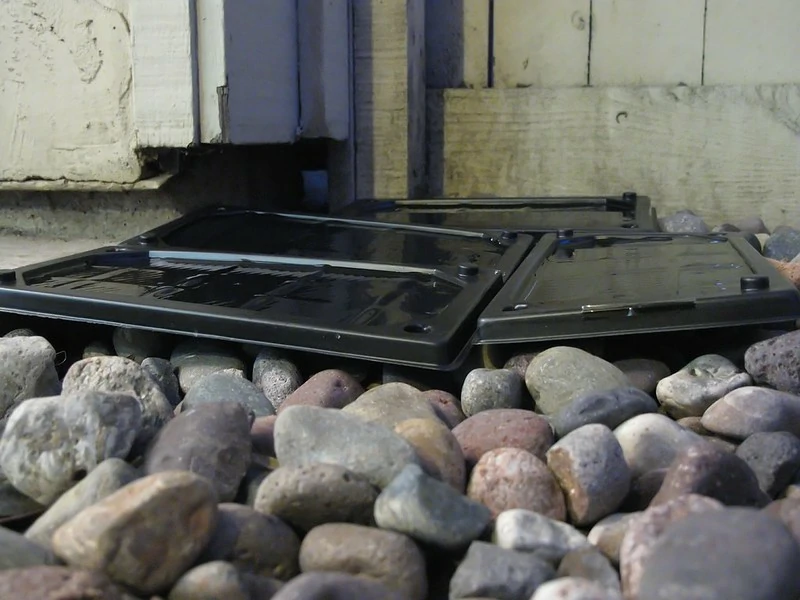
Glue boards are one of the most controversial rodent tools, but plenty of people still use them in homemade setups. So how do you make homemade rat traps that work with glue boards?
You can build a rat trap around a glue board in three ways: a covered tunnel box, a wall run with a cardboard roof, or a board fixed on a plank for roof rats. Check your local laws first, since glue boards are banned or limited in the UK and Ireland.
Each setup uses a store-bought glue board plus cardboard, wood, or tape to make it safer for kids, pets, and wildlife. None of them is a gentle option, which is why this guide starts with the rules.
Below, you’ll find where glue boards are legal, how to build each setup, and what to do when something gets stuck (the hardest part of using them).
Are Glue Boards Legal Where You Live?
Before you build anything, check the rules, because the laws changed fast in the last few years.
In England, it’s been illegal for the public to use glue traps on rodents since 31 July 2024, unless a licensed pest controller does it. Wales and Scotland have banned them too, and so have Ireland, Iceland, and New Zealand.
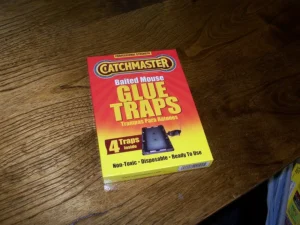
In Australia, the state of Victoria limits sales to registered pest controllers. Parts of the US have local bans as well, including West Hollywood and Ojai in California, and a federal bill to ban them was introduced in 2024.
In most of the US and Canada, glue boards are still legal to buy and use. However, rules vary by city, province, and state, so look up your local law before you go any further.
If you live in one of the places above, skip this method and use a snap trap or cage trap instead.
Why Are Glue Boards So Controversial?
Glue boards don’t kill anything, so a rat that steps on one stays stuck, and the more it struggles, the more fur and skin ends up in the glue.
Animals can be stuck for hours or even days, depending on how often you check. Some injure themselves trying to pull free, and many die slowly of stress, thirst, or exhaustion.
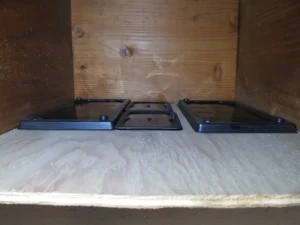
They also catch the wrong animals, and birds, bats, hedgehogs, lizards, and even pet cats have all ended up on glue boards.
Veterinary groups, humane societies, and many wildlife rescue centers want them banned. The pest control industry still uses them, but its own codes of practice say they should be a last resort with strict checks.
That doesn’t mean you can never use one, but it does mean you should know what you’re signing up for before you set it.
Can a Glue Board Even Catch a Rat?
Sometimes, but rats are much harder to catch than mice, since most store-bought boards are made for mice and a full-grown Norway rat can weigh a pound or more.
Rats are also very suspicious of new objects. A flat sheet of glue that shows up overnight in their path is something they avoid for days.
Mice are usually more willing to walk onto a new board. That’s why glue boards seem to work better on mice than on rats.
If you want to try one on rats, buy a board sized for rats, and be ready to anchor it. A strong rat can drag a lightweight board across the floor, and then it’s stuck to something else.
Glue boards also stop working when they get dusty, wet, or cold. Most work best between about 50°F and 110°F, so a dusty garage in winter is a poor spot.
What Can Rats Do to Beat a Glue Board?
Rats are athletes, and an adult Norway rat can jump about 3 feet straight up, climb wires and rough walls, and squeeze through a half-inch gap.
It can also swim, tread water for a long time, and chew through aluminum, wood, and plastic (extension guides list all of it).
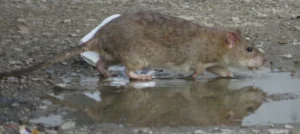
That affects how you use a glue board, since rats can hop over a board, jump onto a box next to it, or use another surface to get around.
So the board has to sit where a rat has no choice but to walk across it, like a narrow path against a wall. A board in an open room is easy to skip.
Rats also drag things, so a board taped or screwed to something heavy stays put, while a loose one ends up under a washing machine.
How Do You Pick the Right Glue Board for Rats?
Not every glue board is made for rats, and picking the wrong one is the fastest way to waste a week. Most boards on store shelves are sized for mice, so look for one labeled for rats.
A rat board is bigger and has more glue, because a full-grown Norway rat is 8 to 10 inches long without the tail. A small board can’t hold that much weight for long.
Check the label for the temperature range too, since most boards work well between about 50°F and 110°F (a cold basement or a hot attic can make the glue stiff or runny).
Skip boards made for insects, since they’re too small and the glue is too weak. Store spares flat in a cool, dry place, because heat and dust ruin the glue.
Wear gloves whenever you handle a board, since the glue is hard to wash off skin, and a little vegetable oil is the fix if you do get it on your hands.
How to Build a Covered Tunnel Box for a Glue Board
This is the safest way to use a glue board, and it’s the one to try first. The box keeps pets, kids, and birds off the glue while a rat can still walk through.
You’ll need a sturdy cardboard box or a few pieces of thin plywood, a glue board sized for rats, strong tape, and a box cutter.
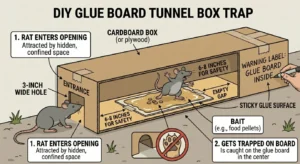
First, measure your board so you know how big to make the box. Make it 2 inches wider than the board and 4 inches tall, so the glue doesn’t touch the walls.
Next, cut a hole about 3 inches wide in each end, near the bottom. A rat can squeeze through easily, and the holes work like doors on both sides.
Tape the board to the floor of the box with strong tape or double-sided tape, and set it in the middle. That keeps it at least 6 to 8 inches from each opening, so a cat’s paw can’t reach it.
Close the lid and tape it shut, then write “glue board inside” on the outside so nobody opens it by accident.
Place the box tight against a wall, with the holes along the path rats walk. Pre-bait first by putting the box out for 5 to 7 days with food inside and no board.
How to Make a Cardboard Box Enclosure With A Baited Roof
Take an ordinary cardboard box and cut the bottom off, so you’re left with an open sided tunnel with four walls and a top.
Cut a small entry hole in one end and an exit hole in the opposite end, low enough for a rat to walk through comfortably.
Place a standard glue trap on the floor inside the box, roughly in the middle, between the two openings.
Cut a small flap out of the cardboard above the glue trap and fold it down so it hangs just above the sticky surface, then smear peanut butter on the underside of that flap.
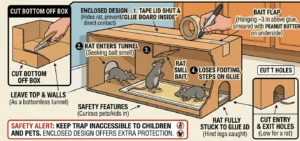
A rat enters the tunnel, smells the bait, and reaches up or stretches toward the flap to get at it. In doing that, it loses its footing and steps down onto the glue trap below.
The enclosed design means you never have to see or touch the rat directly. It also keeps curious pets and kids from ever reaching the glue trap itself.
How to Make a Wall Run With a Cardboard Roof
This one is quicker and uses fewer materials, but it’s less safe. It works best indoors in a closed room where pets and kids can’t go.
Rats run along walls, so lay the board flat against the wall in a spot where you’ve seen droppings. Then build a roof over it with a piece of stiff cardboard.
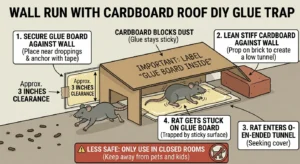
Lean the cardboard against the wall and prop the other edge on a brick or a stack of books, so it makes a low tent. Leave both ends open so a rat can walk straight through.
Anchor the board to the floor with tape, and keep the roof about 3 inches above it. A rat is more likely to walk under a roof than across a bare floor.
The roof also blocks dust, which keeps the glue sticky longer. And it hides the board from you too, so label it and check it often.
How to Fix a Glue Board on a Plank for Roof Rats
Roof rats travel along fences, pipes, and beams instead of the floor. A board on the ground does nothing for them, so you need to meet them on their path.
Cut a plank a little wider than your board, and screw or staple the board to it so it can’t slide. Then lay the plank across the beam, ledge, or shelf where you’ve seen droppings.
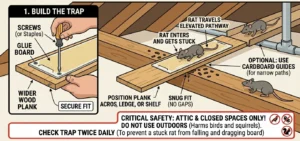
Make the plank snug against the surface, with no gaps a rat can use to go around. If it’s on a pipe or narrow beam, wrap a strip of cardboard around the edges to guide rats onto it.
This one belongs in an attic or other closed space, because outdoors, birds and squirrels will find it and wildlife that gets stuck can’t be freed easily.
Check it twice a day, because a roof rat stuck on a beam can fall and drag the board with it.
How to Funnel Rats Onto a Glue Board With Cardboard Guides
Sometimes the board is fine and the placement is the problem. Guides turn a wide path into a narrow one, so a rat has to cross the glue.
Find a spot where rats already squeeze through, such as between a stack of boxes and a wall. Place the board across the gap, then add two strips of cardboard on either side to close off the sides.
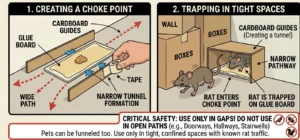
This works because rats like tight spaces and hug walls, so a rat that walks the same path every night will walk right onto the board.
Don’t use this in a doorway, a hallway, or anywhere a pet might walk, since a guide that funnels rats will funnel a cat.
Glue Board Setup Comparison: Tunnel, Wall Run, Plank, and Guides
Here’s a quick look at how the four setups compare:
| Setup | Best for | Safety | Main downside |
|---|---|---|---|
| Covered tunnel box | Indoor rat paths | Best of the four | Rats may avoid a new box |
| Wall run with a cardboard roof | Closed rooms | Fair, if pets are kept out | Board is hidden, so it’s easy to forget |
| Board on a plank | Roof rats in attics | Fair, in closed spaces only | A struggling rat can drag the plank |
| Cardboard guides | Narrow rat paths | Lowest of the four | Funnels pets and wildlife too |
If you only remember one thing from the table, make it this. The covered tunnel is the setup that protects the most animals and people, so start there.
Can You Make Your Own Glue for a Homemade Glue Board?
You’ll find recipes online that use corn syrup or flour, but they’re a bad idea. Homemade glue is usually weaker than the store-bought kind, so a rat can end up half stuck, which is worse for the animal.
It also dries out, picks up dust, and makes a mess on floors. Commercial boards are made for this job, so if you decide to use glue, buy a rat-sized board.
That’s why every setup in this guide builds around a store-bought board. The homemade part is the box, the roof, or the plank, and not the glue itself.
Where Should You Put a Glue Board?
Rats run along walls and use the same paths every night. So the best spot is a narrow path next to a wall where you’ve found droppings (behind a fridge or along a garage wall).
Stay indoors, because outdoor boards catch birds, squirrels, and neighborhood cats, and those animals are hard to free.
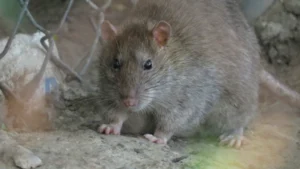
Keep boards away from kids and pets, since a closed room, a crawl space, or an attic with the door shut is far safer than an open hallway.
Keep the board dry and clear of dust, since a cardboard roof helps and so does staying away from vents, fans, and open windows.
Use as few boards as you can. Two or three in the right spots work better than ten scattered around, and you’ll have less to check.
Should You Put Bait on a Glue Board?
Most glue boards are sold pre-scented with a peanut butter smell, so you often don’t need to add anything. Anything you put on top of the glue also makes it grip less.
If you want extra pull, place a little bait on a small card next to the board, or at the far end of the tunnel box. That way the rat steps on the glue while it reaches for the food.
Peanut butter, bacon grease, and nuts all work, but keep the bait small and change it every day or two so it stays fresh.
Pre-baiting matters for rats more than for mice, so put the tunnel box out without a board for about a week, then add the board once rats are feeding.
Common Mistakes That Make Glue Board Traps Fail (And Easy Fixes)
Most glue boards that catch nothing share the same few problems, and each one has an easy fix.
- The board is too small: a mouse-sized board can’t hold a rat, so buy one labeled for rats.
- The board isn’t anchored: a strong rat can drag a loose board, so tape or screw it down.
- The path is wide open: a rat can walk around a board in an open room, so use a wall, a tunnel, or guides.
- The glue is dusty: dust and dirt ruin the grip, so use a roof or cover and replace old boards.
- You skipped pre-baiting: rats avoid new objects, so put out the tunnel without glue for about a week.
- Nobody checks it: a stuck rat suffers every hour, so check morning and evening or don’t set one.
- It’s outdoors: birds, squirrels, and pets get caught, so keep boards inside, away from wildlife.
How Often Should You Check a Glue Board?
More often than you’d like. Pest control codes say at least once every 12 hours, and veterinary groups recommend far more often, with some saying at least once an hour.
For you, that means setting a glue board only when you can check it in the morning and again in the evening. Don’t set one before a trip, a weekend away, or a long shift.
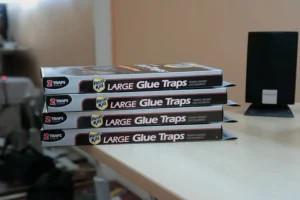
Every hour it sits there, a trapped rat suffers more, so if you can’t commit to checking, use a different trap.
Wear gloves whenever you handle a board, and remove it as soon as the job is done. Leaving a forgotten board behind is one of the most common ways pets and wildlife get caught.
What Should You Do If a Pet or Wild Animal Gets Stuck?
Stay calm and act fast, because most glue boards come with the same advice: use plain vegetable oil or mineral oil to loosen the glue.
Gently work a little oil around the stuck fur or feet, and slowly peel the animal free. For a pet, a vet can help if it’s stuck badly or has swallowed any glue.
For a wild animal, wear thick gloves and keep a towel handy, since a scared animal can bite. If it’s a bird, bat, or anything unusual, call a wildlife rescue center or a vet.
Free animals should only be released where you found them, and only if they’re unharmed. If an animal looks hurt, take it to a vet or rehabber instead.
If you ever catch a pet or a protected animal on one of these, treat it as a sign that your setup isn’t safe enough, and take the board away.
What Should You Do With a Rat Stuck on a Glue Board?
This is the part most guides skip, and it’s the hardest. A rat on a glue board is alive, frightened, and in distress, and it needs a quick end.
Don’t leave it to die, and don’t throw the board away with the rat still on it. Humane groups also say not to drown it, since that causes suffering as well.
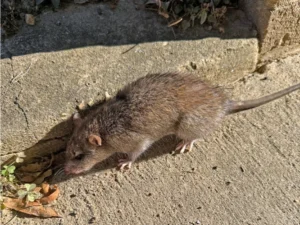
Wear thick gloves, cover the board with a towel to calm the rat, and put the whole thing in a box. A vet, an animal shelter, or a pest control company can euthanize it quickly and humanely.
Then comes the cleanup, and the CDC says some rodents carry hantavirus, which people can catch by breathing in dust from dried droppings, urine, or nests.
So don’t sweep or vacuum. Spray the area with a bleach mix of 1 part bleach to 9 parts water (that’s 1½ cups of bleach in a gallon).
Let it soak for about 5 minutes, then wipe it up with paper towels.
Seal everything in a plastic bag, put that bag inside a second bag, and then wash your hands with soap and warm water.
Should You Use Something Else Instead of Glue Boards?
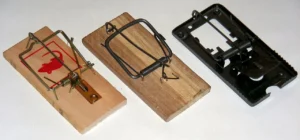
For most people, yes. A good snap trap kills quickly, costs less than a pair of glue boards, and doesn’t leave you with a suffering animal.
A cage trap with a one-way door is another option, since a vet or pest pro can euthanize a rat from it right away.
Even better, stop new rats from getting in by sealing any gap bigger than half an inch with steel wool or hardware cloth (rats chew through caulk and plastic).
Store pet food in containers rodents can’t get into, trim tree limbs within 3 feet of your roof, and keep trash lids tight.
If you’ve been trapping for a couple of weeks and still see signs, call a licensed pest professional, since a big or long-running problem usually needs one.
Conclusion
You can build homemade rat traps that work with glue boards, but they come with serious legal and welfare strings.
Check your local laws first, since glue boards are banned or restricted in the UK, Ireland, New Zealand, and parts of the US.
If they’re legal where you live, the covered tunnel box is the safest setup. Rats are suspicious of new objects, so pre-bait for about a week before you add the board.
Check the board every 12 hours at the very least, wear gloves, and have a plan for what to do if something gets stuck. A pet, a bird, or the rat itself shouldn’t be left on the glue.
Finally, think about whether a snap trap would do the job faster and kinder. For most homes, it will.
Seal the holes, store food well, and the rats will have fewer reasons to come back.

Hi, my name is Ezra Mushala, i have been interested animals all my life. I am the main author and editor here at snakeinformer.com.