
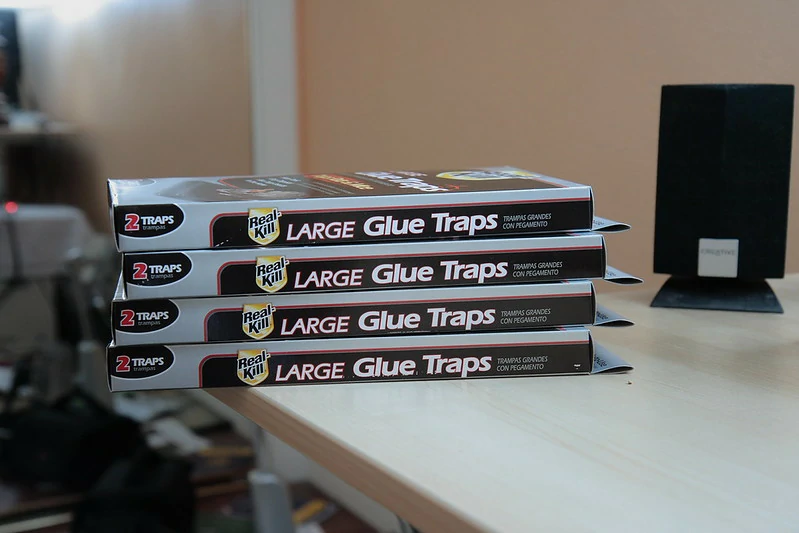
If you’ve got a mouse problem, you’ve probably come across glue traps at some point. They’re the flat boards or trays covered in a thick, sticky adhesive that pest control stores sell right next to the snap traps.
Some people call them glue boards. Others just call them sticky traps.
But with all the talk online about glue traps being cruel or even outlawed in some places, you might be wondering, are glue traps illegal in Canada?
No, glue traps aren’t illegal in Canada. There’s no federal law or nationwide ban against making, selling, or using them. You can walk into most hardware or pest control stores across the country and buy one right now, no restrictions involved.
That said, the topic isn’t as simple as it might seem. Canada doesn’t have a ban, but there’s a real, growing push to get one passed, especially in British Columbia.
Some major retailers have also pulled glue traps off their shelves on their own, even though nothing legally forces them to.
How Glue Traps Actually Work
Before getting into the legal side of things, it helps to know what a glue trap actually is.
A glue trap, sometimes called a glue board or sticky board, is really just a flat surface, usually cardboard or plastic, coated in a thick, non-drying adhesive. Some are open trays. Others come as a small enclosed box with an opening on the side.
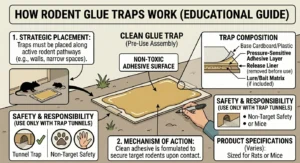
The idea is simple. A mouse, rat, or insect walks across the surface, and its feet get stuck. The more it struggles, the more of its body ends up glued down too.
This isn’t a new invention, either. Sticky trapping methods go back thousands of years, with early versions used in ancient Rome, Greece, and Egypt.
Those early traps relied on natural tree resin and sap instead of manufactured adhesive, but the basic idea was the same: something sticky, placed somewhere an animal is likely to walk.
Modern glue traps didn’t show up until the 20th century, once synthetic adhesives became cheap and easy to manufacture. That’s when glue traps became the small, mass-produced product you’d recognize from a hardware store shelf today.
Glue Traps Are Legal in Every Province Right Now
As of right now, there isn’t a single province or territory in Canada with a law banning glue traps. Not Ontario, not Quebec, not Alberta, not anywhere.
This means you can legally buy, sell, and use glue boards or sticky traps for mice, rats, or insects no matter where you live in the country. There’s no license needed, no permit, and no age restriction on the packaging.
If you’ve read that Ontario has specific rules against them, that’s not accurate. In Ontario, there’s nothing on the books that stops a homeowner from using a glue trap inside their house.
The same goes for the rest of the country.
Why Are Glue Traps Still Legal in Canada?
This is really where things get interesting. Glue traps aren’t classified the same way a lot of people assume they are.
In British Columbia, for example, pesticides are regulated under a law called the Integrated Pest Management Act. But glue traps, along with snap traps and pheromone traps, are specifically left out of the definition of a pesticide under that law.
That means the ministry in charge of regulating pest control products in BC has said they don’t actually have the legal authority to ban glue traps, even if they wanted to.
It’s not that they’ve reviewed the traps and decided they’re fine. It’s that the traps fall outside the type of product the law was built to control in the first place.
This is a pretty common pattern with animal welfare issues. The tool causes harm, but it doesn’t fit neatly into the box a law was written for, so nothing happens until a new, more specific law gets passed.
British Columbia Is the Closest Any Province Has Come to a Ban
If any part of Canada bans glue traps first, it’s probably going to be British Columbia.
In 2024, the Union of British Columbia Municipalities passed a resolution asking the provincial government to ban the sale, purchase, and use of glue traps across the whole province.
This wasn’t just one town complaining. It was municipalities across BC agreeing that something needed to change.
The push came from the Saanich and View Royal municipal councils, working alongside the BC SPCA. Their argument was pretty direct: glue traps don’t actually solve rodent problems at the source, since they don’t deal with the food or shelter drawing rodents in.
On top of that, they cause a lot of unnecessary suffering to any animal unlucky enough to get stuck.
So far, the BC government has acknowledged that glue traps can cause suffering, but they’ve stopped short of actually passing a ban. As of now, it’s still just a resolution asking for change, not a law.
Is There a Federal Push to Ban Glue Traps in Canada?
Yes, but it also hasn’t turned into a law yet.
There’s a federal petition, known as Petition e-4596, calling for a nationwide ban on both the use and sale of glue traps in Canada.
If it eventually leads to legislation, Canada would join a growing list of countries that have already restricted or banned them. That list includes Iceland, Ireland, New Zealand, and England (though England only requires a license for use, sale is still allowed there).
Petitions like this are a normal part of how change gets pushed forward in Canada, but signing one doesn’t create a law by itself. It puts pressure on lawmakers to actually bring the issue to the House of Commons for debate.
Until that happens, and until an actual bill gets passed, glue traps remain fully legal everywhere in the country.
It’s worth knowing that Canada isn’t alone in dealing with this. In the United States, a bill called the Glue Trap Prohibition Act has also been introduced at the federal level, aiming to stop the sale and use of glue traps for catching rodents.
Like the Canadian petition, it’s a sign of where public opinion is heading, but it hasn’t become law either. For now, both countries are in a similar spot: plenty of pressure to change the rules, but no federal law actually in place yet.
Are Glue Traps Banned in Canada by Any Retailers?
This is where things get a little confusing for people searching this topic, so it’s worth clearing up.
While there’s no government ban, some of Canada’s biggest retailers have voluntarily stopped selling glue traps on their own.
Dollarama, Canada’s largest dollar store chain, confirmed it pulled glue traps from all of its more than 1,600 stores after pressure from animal welfare groups.
Dollar Tree and Family Dollar’s Canadian stores did the same thing, removing glue traps from more than 8,000 locations combined. A smaller chain, Buck or Two Plus, also agreed to stop selling them.
None of this happened because of a law. It happened because these companies decided, on their own, that they didn’t want to keep selling the product after hearing from customers and advocacy groups.
So if you notice a store no longer carries glue traps, that’s a business decision, not a legal requirement.
Why Do Groups Want Glue Traps Banned in the First Place?
To really understand the push behind this, it helps to know what actually happens to an animal caught on a glue trap.
Glue traps work through a strong adhesive that immobilizes anything that walks across it. It’s not built to kill quickly like a snap trap. Instead, the animal gets stuck and stays stuck, sometimes for days.
Veterinary groups, including the Canadian Veterinary Medical Association, have spoken out against glue traps for this exact reason.
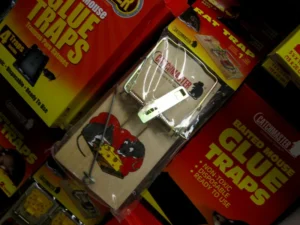
Their position is that the traps don’t meet the basic standard of what’s considered a humane way to kill a vertebrate animal, mainly because of how long and how painful the process usually is.
Animals caught in the glue often panic and struggle, which only pulls them in deeper. In a lot of cases, fur, feathers, or skin get torn off in the process. Some animals have been documented chewing at their own limbs trying to break free.
There’s also the issue of who actually gets caught. Glue traps aren’t picky. Birds, bats, small reptiles, squirrels, and even someone’s pet cat or small dog can end up stuck on one just as easily as a mouse.
This is really the core of the complaint from wildlife groups. A glue trap can’t tell the difference between the mouse it’s meant for and a curious chickadee that lands on it, or a garter snake moving along a baseboard.
Once something is stuck, getting it free without hurting it is difficult even for someone experienced with animals.
There’s also the disposal side of things, which doesn’t get talked about as much. Packaging on most glue traps tells you to simply throw the trap away once you’ve caught something, which usually means the animal is still alive when it goes into the garbage.
For a lot of people who oppose the traps, that’s just as troubling as the trapping process itself.
Are Glue Traps for Mice Different From Glue Traps for Insects?
Not really, at least not in terms of how the adhesive works. The main difference is size and placement.
Mouse-sized glue traps (sometimes labeled as glue boards or rodent glue traps) are bigger, flatter, and built to hold the weight of a mouse or small rat.
Insect glue traps, sometimes called sticky traps, are smaller and usually meant to catch crawling or flying bugs like cockroaches, spiders, or fruit flies.
Both work the same basic way. Something touches the sticky surface, and it can’t get free.
This matters for the legal question too, since none of the laws or proposed bans in Canada draw a real distinction between insect glue traps and rodent glue traps.
If a ban does eventually pass, it would most likely cover glue traps as a category, not just the ones marketed for mice.
What Are the Alternatives to Glue Traps in Canada?
If you’re dealing with a mouse or rat problem and want to avoid glue traps, whether for legal reasons down the road or just personal preference, there are other options worth knowing about.
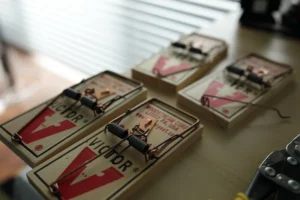
Groups like the BC SPCA actually recommend a few of them. Snap traps are one, considered a faster, more humane option by most veterinary and animal welfare groups, since they’re built to kill quickly rather than trap an animal alive.
Electronic traps are another option. These deliver a quick, high-voltage shock meant to kill the rodent almost instantly, and many models are marketed as a more humane alternative to both snap and glue traps.
Sealing up entry points around your home is also a big part of actually solving a rodent problem long term. Mice can squeeze through gaps as small as a quarter of an inch.
Closing off cracks, gaps around pipes, and holes in walls goes a long way toward keeping them from getting in to begin with.
Some homeowners also use live-catch traps, which let you release the animal outside instead of killing it. These take more effort since you have to actually relocate the animal, but they avoid the issue of the animal suffering entirely.
What Happens If You Use a Glue Trap in Canada Right Now?
Since there’s no law against it, using a glue trap in Canada today doesn’t put you at any legal risk. You won’t get fined, and there’s no enforcement agency checking homes for glue boards.
This is true whether you’re using one indoors for mice, in a garage for rats, or a small sticky trap for insects in your kitchen.
General animal cruelty laws in Canada do exist and could theoretically apply in extreme cases of intentional cruelty. But that’s a different thing from a law aimed specifically at glue traps.
Using a store-bought glue trap for pest control, even though animal welfare groups strongly object to it, isn’t currently treated as a criminal act anywhere in the country.
Should You Still Avoid Glue Traps, Even Though They’re Legal?
That’s really a personal decision, but it’s worth knowing both sides before you decide.
On one hand, glue traps are cheap, easy to find, and don’t require any setup beyond placing them where you’ve seen activity. For a lot of people dealing with a sudden mouse problem, that simplicity is appealing.
On the other hand, if the goal is actually getting rid of a rodent problem, glue traps have a mixed track record. They don’t address why the rodents showed up in the first place.
Animals that manage to escape, which does happen, are often injured in the process. Veterinary groups and animal welfare organizations across Canada have taken a clear stance against them for this reason.
Given that legal changes may eventually catch up in provinces like BC, it’s worth thinking about whether a snap trap, electronic trap, or simply sealing up your home might be a better long-term choice.
There’s also a practical reason to think twice, beyond the animal welfare side. If you do end up with a non-target catch, like a bird or a small pet, freeing it without causing injury is genuinely hard to do on your own.
That alone is enough reason for a lot of people to skip glue traps entirely and go with something built to work quickly instead.
Conclusion
Glue traps, also known as glue boards or sticky traps, are legal across all of Canada right now. There’s no federal law and no provincial law currently banning their sale or use, including in Ontario, BC, or anywhere else.
That said, the pressure to change this is real and growing. British Columbia has come the closest to an actual ban, with municipalities and the BC SPCA pushing hard for one, and a federal petition is asking for the same change nationwide.
Several major Canadian retailers have already pulled glue traps from their shelves on their own, even without being legally required to.
So if you’re asking whether glue traps are banned in Canada, the honest answer right now is no, not yet. But given how much momentum has built up around the issue, especially in BC, that answer could realistically change in the coming years.
Until then, using one is completely legal, even if a growing number of Canadians, veterinarians, and animal welfare groups think it shouldn’t be.

Hi, my name is Ezra Mushala, i have been interested animals all my life. I am the main author and editor here at snakeinformer.com.