
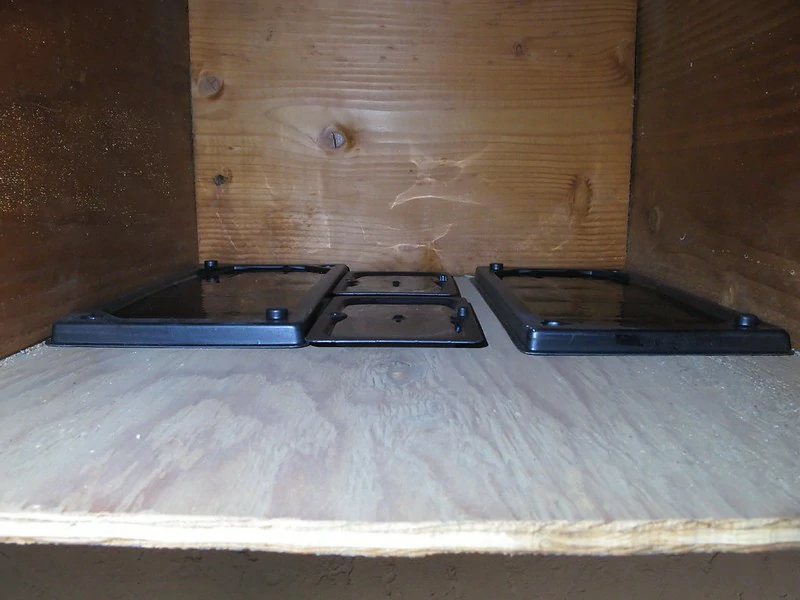
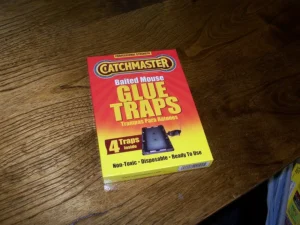
Glue traps are the flat sticky boards that sit next to the mousetraps at most hardware stores, and plenty of people grab them first because they’re cheap and ready to use. But are glue traps good for catching mice?
Not really. Glue traps catch some mice, but snap traps catch far more of them, and a mouse stuck on glue can suffer for hours. Most pest experts and health agencies point people toward snap traps instead.
That doesn’t mean a glue trap never works. It just works less often than most people think, and the cost to the mouse (and sometimes to you) is higher than it looks.
How Glue Traps Catch a Mouse
A glue trap is a sheet of cardboard or plastic covered in very sticky glue. You set it flat on the floor (or fold it into a little tunnel) and wait.
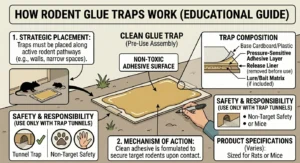
Some come with a smell added, such as peanut oil, to pull mice in, and the idea is that a mouse runs across the board, gets stuck, and can’t pull itself loose.
There’s no spring, no trigger, and no bait cup to fill. That’s why a lot of people see glue traps as the easy option.
However, easy to set doesn’t always mean easy to live with, because once a mouse is stuck you’re dealing with a scared animal that’s still very much alive.
Mice are also curious about anything new in their paths. They sniff around, they test things out, and they run the same routes night after night.
That curiosity matters a lot when it comes to how well glue traps work, and it’s also the reason mice sometimes learn to stay away from them.
Do Glue Traps Work on Mice?
They can, but not very well. A field study from Purdue University tested glue traps against wild house mice in barns and warehouses over three years.
In one overnight test, snap traps caught 54 mice (there were two snap traps for every glue trap). The glue traps caught only 4.
The researcher also found that many mice were repelled by the glue, and they either learned to avoid it or figured out a way to make it harmless.
That probably sounds familiar if you’ve tried glue traps at home. You put a board down, find droppings right next to it, and the board is still empty.
Still, glue traps do catch mice sometimes. They tend to work best on a busy path along a wall, where a mouse is running fast and doesn’t stop to check the floor.
So the honest answer is “sometimes.” If you want mice gone quickly, “sometimes” really isn’t good enough.
Mice Can Learn to Avoid Glue Traps
A mouse’s whiskers are very sensitive (they can stick out about an inch in front of its nose), and mice use them to feel their way around in the dark.
That means a sticky board can grab those whiskers before the mouse’s body touches the glue. A mouse that gets a bad surprise like that usually remembers it.
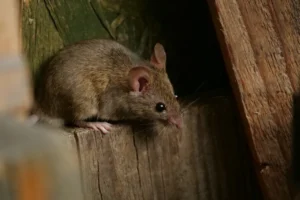
Next time, it may jump over the trap or steer clear of that spot completely, and some may never go near a board again.
Other mice get creative. The researcher watched mice cover glue boards with cardboard, paper, foam insulation, and even dirt.
One mouse made about 100 trips back and forth, dropping pieces of cardboard on a single trap until it was nearly covered, and after that other mice walked right across it.
So a glue trap that catches a mouse on night one may catch nothing on night three. That’s a big reason why glue traps seem to “stop working” for so many people.
Why Glue Traps Mostly Catch Young Mice
In that same research, most of the mice stuck on glue were young ones. That makes sense when you think about how mice grow up.
Young mice haven’t had much time to learn what’s dangerous, and they also play and chase each other a lot, which makes them less careful.
Sometimes three to five young mice from the same litter ended up on a single board. They follow each other around, and they follow the scent trails their mother leaves.
That might sound like a win, but it creates a problem, since the older and more careful mice are still running around your house.
A female mouse can have a new litter every month or so, with five or six pups in each one. So if a glue trap only catches the careless ones, the nest keeps growing.
Glue Traps Don’t Kill Mice Quickly
This is the biggest complaint about glue traps, since a mouse stuck on glue doesn’t die right away.
The RSPCA (a major animal welfare group in the UK and Australia) points to a review of glue boards used on rats. It found that the suffering lasted for hours and was considered extreme.
Mice are smaller than rats, but there’s no reason to think they have it easier. They fight the glue, wear themselves out, and may go many hours without water.
Some mice only get a tail or one foot stuck, and in the Purdue tests a few of them dragged the whole trap away.
That means you might find an empty spot on the floor and a missing trap. The mouse could be stuck behind a wall or under a cabinet, and you’d only find out from the smell later.
Even when the trap stays put, a mouse can sit there for hours if you don’t check it. That’s why so many people feel awful after they set one, and you probably would too.
Can Glue Traps Make Your Home Less Safe?
They can, and not just because of the mess. Mice carry germs, and a scared mouse often pees, which spreads those germs onto the board and the floor around it.
Public health groups know this. The California Department of Public Health tells people to use snap traps and skip sticky traps to help prevent hantavirus (a virus some mice carry that can cause a serious lung illness).
Deer mice are the main hantavirus carriers in the US. It’s hard to tell them apart from other mice when you first see one, so it’s safest to treat every mouse as a possible carrier.
You usually get exposed by breathing in dust from dried urine and droppings. That’s why you should never sweep or vacuum up mouse droppings.
Also, mice leave droppings and urine wherever they run, and a glue trap does nothing about that. It only catches some of the mice.
If you do catch one, wear rubber or plastic gloves. Spray the mouse and the trap with disinfectant (or a mix of one part bleach to nine parts water) and let it soak for about 5 to 10 minutes.
Then seal it in a bag, put that bag inside a second bag, and throw it out. Wash your hands well afterward, even if you wore gloves.
What Else Can Get Stuck on a Glue Trap?
Glue traps can’t tell a mouse from anything else, so whatever steps on the board gets stuck.
Humane groups have reported wild birds, bats, hedgehogs, fox cubs, and even pet cats caught on glue boards. Here in North America, that can also mean lizards (such as geckos, anoles, and skinks), small snakes, and songbirds.
Garages, basements, and porches are the usual trouble spots, since animals wander in and out of those places all the time.
Pets are another worry, since a curious cat or a small dog can end up with glue on its paws or fur, and getting it off is hard and stressful for everyone.
Kids are curious, too. A crawling toddler could easily end up with glue on their hands or knees.
A dead animal left on a board can even draw in other animals, which then become the next victims.
If you have pets, kids, or a lot of wildlife around your home, that’s a good reason to skip glue traps completely.
Dust, Heat, and Garages Make Glue Traps Fail
Glue traps need a clean, dry surface to work. A thin layer of dust can cover the glue in a few hours or days, depending on how dirty the area is.
That’s a big problem in places where mice love to hide, such as garages, sheds, basements, and attics. All of those spots are dusty.
Dirt on a mouse’s feet can help it escape, too. Even a thin film of dust, grease, or moisture can give a mouse the edge it needs to pull free.
Heat is another issue, since the glue can soften and run in a hot attic or garage during summer.
Very cold places can also make the glue less sticky, and fur or droppings from earlier mice can cover it up as well.
So you end up checking and replacing boards all the time, which kind of defeats the whole “set it and forget it” idea.
Do Glue Traps Solve a Mouse Problem for Good?
No, and that’s one of their biggest weaknesses. A glue trap catches a mouse that’s already inside, but it does nothing to stop the next one from coming in.
Animal welfare groups make the same point. Glue boards don’t keep rodents from getting to food, so as long as there’s food and a way in, more mice will show up.
Mice don’t need much of a way in, either. They can squeeze through a gap about as wide as a pencil.
That means a small crack around a pipe, a gap under a door, or a hole in the foundation is plenty.
Mice also tend to move indoors when the weather turns cold, so fall is when many people first notice them.
How to Tell You Have Mice Before You Pick a Trap
Before you set any trap, make sure you’re really dealing with mice. The signs are easy to spot once you know what to look for.
Droppings are the most common clue. Mouse droppings are small, dark, and pointed at the ends, about the size of a grain of rice.
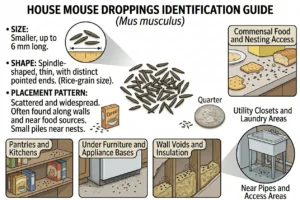
You may also see gnaw marks on food packages (such as cereal boxes and bread bags), shredded paper or fabric used for nests, and greasy smudges along the walls.
Scratching or scurrying noises at night (especially in walls or ceilings) are another giveaway. So is a musky, stale smell in closed-in spaces.
Where you find these signs tells you where to put traps. Mice stay close to their nests and food, so the busiest spots are usually near walls, behind appliances, and inside cabinets.
If you find droppings in several rooms, you probably have more than a couple of mice. That’s when you’ll want lots of traps and a plan to seal up the entry points.
How Glue Traps Compare to Other Mouse Traps
Here’s a quick look at how the main trap types stack up.
| Trap Type | How It Works | How Fast | Can You Reuse It? | Biggest Downside |
|---|---|---|---|---|
| Glue trap | Mouse gets stuck on sticky glue | Slow (hours) | No | Suffering, and it catches other animals |
| Snap trap | A spring bar snaps shut | Usually fast | Yes | You have to place and bait it well |
| Electronic trap | Gives a shock when a mouse goes in | Fast | Yes | Costs more and needs batteries |
| Live trap | Mouse goes in and can’t get out | Not lethal | Yes | You have to check it often and deal with a live mouse |
Every trap has trade-offs, but glue traps are the only one where a mouse can suffer for hours. That’s the part people don’t think about when they pick one up at the store.
Snap traps and electronic traps usually kill fast when they’re set right. Live traps are the gentlest, but you still have to check them often and decide what to do with the mouse.
When Glue Traps Can Still Make Sense
Glue traps aren’t always a bad choice, and there are a few situations where they’re more useful.
Pest control pros sometimes use boards to check for activity, since even an empty board can show fur or droppings from mice passing by.
Glue boards can also fit in tight spots where a snap trap won’t, such as behind a fridge or in a narrow gap.
If you decide to use one, set it flat against a wall where you’ve seen droppings. Pick a clean, dry spot with no dust, and keep it far from pets and kids.
Check it often, at least once in the morning and once at night, and if there’s a mouse on it, deal with it right away.
Keep a few supplies close by, such as gloves, a bag, and some cooking oil. Also check your local rules before you buy, because some places have banned them.
How to Use Snap Traps the Right Way
There’s a reason pest pros reach for snap traps first. They kill fast, you can use them again, and the research favors them.
Set each trap against a wall, with the trigger end close to the wall. Mice like to run along walls, so that’s where they’ll bump into it.
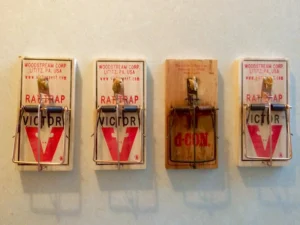
Use a tiny smudge of peanut butter on the trigger (about the size of a pea or smaller). A big blob lets a mouse lick it off without setting the trap.
Set more traps than you think you need. A National Park Service cleanup guide lists about 10 snap traps for a 12 by 12 foot room.
Two traps side by side along a busy path work well, since mice often check out a new object before they go for it. Check them every day, and wear gloves when you handle them.
Then fix the cause. Seal holes with steel wool and caulk, and store food in glass or metal containers.
Traps alone won’t solve the problem if mice can keep walking in.
What Should You Do If a Mouse Is Stuck on a Glue Trap?
Start by putting on gloves and staying calm. A stuck mouse is very scared, and it may bite.
If it’s a pet, a bird, or any wild animal that isn’t a mouse, treat it as an emergency. Get it to a vet or a wildlife rehabilitator (a person trained to care for hurt wild animals) as fast as you can.
Humane Society International says people without training can easily hurt an animal while freeing it. If you have to try, they suggest rubbing a little warm cooking oil gently into the glue.
Cover the animal’s head with a towel to keep it calm. Then keep working the oil in, a little at a time, until the glue lets go.
Oil can mess up the fur or feathers of a wild animal, so it still needs a checkup after. Don’t just let it go.
If it’s a pest mouse and you can’t free it, ending its suffering quickly is the kindest choice. Drowning isn’t humane, and pest control pros and scientists agree on that.
Your local vet or animal control office can tell you the quickest way. Don’t leave it on the board and hope it works out.
Glue Traps Are Getting Banned in More Places
Not everyone can use glue traps anymore. England made them illegal for most people (only licensed users can use them) after a law passed in 2022.
Ireland, New Zealand, Iceland, and the Australian state of Victoria have outlawed them too.
In the US and Canada, glue traps are still on store shelves in many areas. However, some cities have banned them, and lawmakers in several states have pushed bills to do the same.
Rules can change fast, so check your city, county, state, or province before you buy.
If you hire a pest control company, ask what kind of traps they use. Many pros stick with snap traps and sealing up entry points.
Conclusion
Glue traps can catch mice, but they don’t catch them well. In the Purdue tests, snap traps caught far more mice, and many mice learned to avoid the glue.
They also cause real suffering, they can catch animals you never meant to catch, and they can make cleanup riskier. A mouse that’s stuck and scared spreads germs.
Snap traps, a clean home, and sealed entry points will usually do a better job. If you still use a glue trap, put it in a clean, dry spot, keep it away from pets, and check it often.
Whatever you pick, the real fix is keeping mice out. Seal the gaps, store your food, and the traps become a small part of the job.

Hi, my name is Ezra Mushala, i have been interested animals all my life. I am the main author and editor here at snakeinformer.com.