
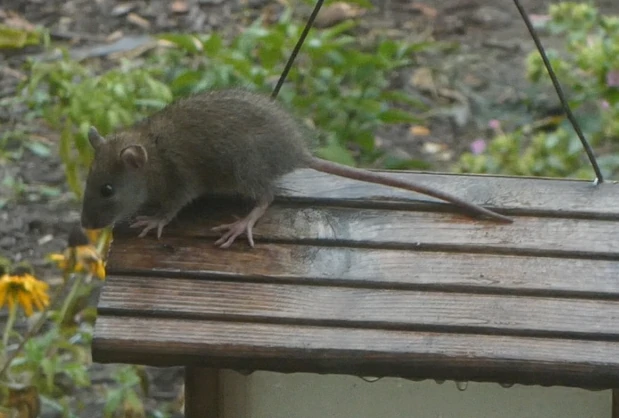
Wire mesh is one of the few homemade trap materials that rats can’t chew through easily, so it’s worth a close look. So how do you make homemade rat traps that work with wire mesh?
You can make a rat trap with wire mesh three ways: a cage with a one-way door, a funnel trap, or a mesh tunnel that holds a snap trap. Use galvanized hardware cloth, not chicken wire.
Each design uses the mesh in a different way. Two of them catch a rat alive, and one just makes a store-bought snap trap safer around kids and pets.
Below, you’ll find how to build each one, what rats can do to beat a weak trap, and how to avoid the sharp edges that hurt people and animals.
Which Wire Mesh Works for Rat Traps (And Which Doesn’t)?
The mesh you buy matters more than the design you pick, because a rat will test every wire in the trap. Most failures come from thin or wide mesh.
Chicken wtrapire is the wrong choice, since it’s thin, the hexagon openings are large, and a determined animal can bend or tear it.
You want hardware cloth, which is a stiff grid of welded steel wire. Look for galvanized steel, which means it has a zinc coating that stops rust.

For adult rats, forest service guidance calls for ½-inch mesh in 16 to 19 gauge (a lower number means thicker wire). Light-gauge cloth isn’t fully safe against aggressive rats.
If you’re also dealing with mice, go with ¼-inch mesh in 19 gauge or heavier, since mice can squeeze through a quarter-inch gap. For a rat cage, ½ inch is fine and much easier to cut and bend.
Why Can Rats Beat a Weak Wire Trap?
Rats are far stronger than they look, and a cage that would hold a mouse can fail badly against a rat.
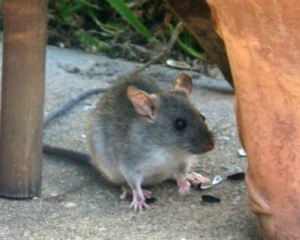
An adult Norway rat can jump about 3 feet straight up, climb wires and rough surfaces, and squeeze through a half-inch gap. It can also gnaw through aluminum, lead, and even cinder block.

That tells you what the trap needs: tight seams, a solid lid, and a door a rat can’t push or lift open.
Rats are also good climbers, so mesh walls won’t stop one from scaling the outside of a cage, though they will keep it from chewing its way out.
Size matters too. A big Norway rat is 8 to 10 inches long without the tail and can weigh a pound or more, so build the cage roomy enough that it won’t panic and thrash.
How to Make a Hardware Cloth Cage Trap With a One-Way Door
This is the simplest cage to build, and it uses a door that swings in but can’t swing back out. It works much like a pet flap that only opens one way.
You’ll need about 3 feet of ½-inch galvanized hardware cloth (16 to 19 gauge), tin snips or wire cutters, pliers, and gloves. You’ll also need some stiff wire for tying things together (skip zip ties, since rats chew them).
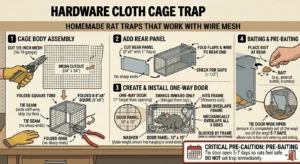
First, cut a piece of mesh about 34 inches long and 24 inches wide, then fold it along the wires into a square tube 8 inches wide and 8 inches tall.
Overlap the extra inch where the edges meet and tie the seam every 2 inches with wire. Fold the cut edges over so no sharp wire ends stick out.
Next, cut an 8 by 8 inch back panel with an extra inch on each edge, fold those flaps, and wire it onto one end. Make sure no gaps wider than ½ inch are left anywhere.
Now make the door by cutting a piece a full inch larger than the opening on every side, and hang it inside the cage from the top edge with wire loops.
Because the door is bigger than the opening, it can swing inward but hits the frame if a rat pushes outward. If it sticks, add a small washer to the bottom edge so it falls shut.
Put bait at the back, plus a few crumbs leading in.
For the first 5 to 7 days, tie the door open with a bit of wire so rats can walk in and out freely, then free the door to set the trap.
How to Build a Wire Mesh Funnel Trap Rats Can’t Back Out Of
A funnel trap swaps the door for a cone that points inward. It’s easy to walk in and hard to walk back out, and there’s nothing for the rat to push or latch.
Build the same cage as before, but leave the front end open.
Then cut a piece of mesh about 12 inches by 10 inches and roll it into a cone, with a wide mouth of about 6 inches and a tip of about 3 inches.
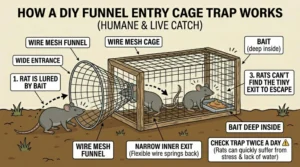
Wire the seam shut and bend every cut wire end flat so nothing sharp points toward the animal. Then fit the cone into the front opening with the narrow tip pointing into the cage.
The tip is the tricky part. About 3 inches is a tight fit for an adult rat, and if rats keep sniffing around without going in, you can widen it a little at a time.
Put bait at the far end so a rat has to pass the cone to reach it. A few crumbs near the wide mouth help lead it in.
Keep in mind that rats are good climbers, so a funnel leaks more than a one-way door does, and you’ll want to check it every morning.
Pre-bait this one too. Use the cage with the cone left out, so rats get used to walking in for a free meal before you add the funnel.
How to Make a Wire Mesh Tunnel for a Snap Trap
This design doesn’t catch anything on its own. It’s a box with mesh ends that holds a store-bought snap trap, so kids, pets, and birds can’t reach it while a rat still can.
Cut four boards about 20 inches long to make a box that’s roughly 5½ inches wide and tall (scrap 1 by 6 lumber works). Nail the bottom and sides together first, then add the lid.
Staple mesh over the front end, then cut a hole about 2 inches wide in the middle with wire cutters. A rat slips through easily, but a dog’s nose or a child’s hand can’t reach the trap.
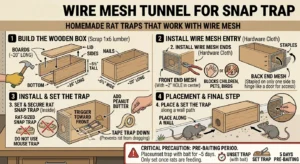
Next, staple mesh over the back end on only one side so it hinges like a door. That’s how you reach in to set the trap.
Set a rat-sized snap trap inside with the trigger toward the front, and put a little peanut butter on it. Then close the back and place the tunnel along a wall.
A mouse trap is too small for a rat, so check the box before you buy. Also tape the trap down so a rat can’t drag it into a corner.
As with every trap, put it out unset for about 5 days with bait on the trigger, then set it once rats are feeding.
Wire Mesh Trap Comparison: Cage, Funnel, and Snap Trap Tunnel
Here’s a quick look at how the three designs compare:
| Design | How it catches | Best for | Main downside |
|---|---|---|---|
| Cage with a one-way door | Alive, in the cage | Rats that are already feeding | Needs careful sizing so the door can’t be pushed out |
| Funnel trap | Alive, in the cage | Homes with several rats | Rats can climb back out of a loose funnel |
| Snap trap tunnel | Quick kill from the snap trap | Homes with kids and pets | Needs a store-bought rat trap |
If you only remember one thing from the table, make it this. The cage and funnel leave you with a live rat, while the tunnel gives you a quick result and the safest setup around kids.
How Do You Bait and Pre-Bait a Wire Mesh Trap?
Rats are very careful around new objects, and a shiny cage that shows up overnight makes them nervous, which is why pre-baiting matters here more than with almost any other trap.
Tie the door open, put bait inside, and leave it for 5 to 7 days. When rats are eating the bait regularly, free the door and cut the bait down to a small amount.
Peanut butter is the classic choice because it sticks and smells strong. Bacon, nuts, dried fruit, and candy also work, so try more than one.
Smear the bait on the back wall or press it into the mesh so a rat has to work at it, and change it every day or two so it stays fresh and smelly.
Use a small amount once the trap is set. A big blob lets a rat eat from the edge without ever going all the way in.
Where Should You Set a Wire Mesh Trap?
Rats stick close to walls and use the same paths every night. So the best spot is a straight edge where you’ve found droppings (behind appliances, along a garage wall, or beside a stack of boxes).

Point the open end of a cage or funnel trap along the path rats travel, and drape cardboard over the top to make it feel dark.
Set the trap on a flat, steady spot, because a cage that wobbles will scare rats off, and wedge it with bricks if the floor is uneven.
Roof rats are the exception, since they travel along fences, pipes, and beams. A heavy cage won’t work up there, so use the tunnel with a snap trap on a ledge or beam.
Keep every trap away from doors and walkways. That protects kids, pets, and your own feet.
Common Mistakes That Make Wire Mesh Traps Fail (And Easy Fixes)
Most mesh traps that catch nothing share the same few problems, and each one has an easy fix.
- You used chicken wire: it’s too thin and the openings are too wide, so switch to galvanized hardware cloth.
- There’s a gap at the bottom edge: a rat only needs ½ inch, so wire the whole bottom edge tight to the base.
- You skipped pre-baiting: rats avoid new objects, so tie the door open and give them a week.
- The door sticks or swings out: make it an inch bigger than the opening, and add a small washer so it falls shut.
- The trap sits in the open: rats hug walls, so a cage in the middle of the floor gets skipped.
- There’s too much bait: a big blob lets a rat eat from the edge, so use a small amount once the trap is set.
- Nobody checks it: a trapped rat will chew, thrash, and suffer, so check it every morning.
How Can You Handle Wire Mesh and Sharp Edges Safely?
Cut mesh is full of sharp points, and they hurt people just as easily as they hurt animals. A few habits keep everybody safe.
Wear thick gloves and safety glasses whenever you cut or bend mesh. Tin snips or wire cutters are much safer than bending a wire back and forth until it snaps.
Fold every cut edge over, and bend any loose wire end flat. A rat that thrashes inside a cage can cut its face or paws on exposed wire.
File down any rough spots you can’t fold. Run a gloved hand along the inside of the cage before you set it, and fix anything that catches.
Keep scraps off the floor and away from kids and pets, since a bit of cut mesh in a garage can cause a nasty injury.
How Can You Keep Kids and Pets Safe Around Wire Mesh Traps?
Homemade traps don’t come with warning labels, so safety is up to you. The biggest risks are curious kids, dogs, and cats.
A live rat in a cage is a bite risk, and a dog or cat may try to get at it. Keep the trap where pets can’t reach, such as behind appliances or in a closed room.

Snap traps are the hardest on fingers and paws. That’s where the mesh tunnel earns its place, since the long, narrow entrance keeps hands and paws out.
Put outdoor traps out at night and bring them in each morning. That keeps birds and other wildlife out of harm’s way.
What Should You Do With a Rat Once You’ve Caught It?
This is the part most plans skip, but catching a rat alive is only half the job.
Never reach into a cage with bare hands, since a scared rat will bite and rats can spread diseases. Carry the whole cage, with the rat inside, wearing thick gloves.
Releasing it isn’t a good fix. UK rat-control guidance published with the journal Animal Welfare says it isn’t recommended because an unfamiliar place can cause suffering, and in the UK it could even be against the law.
Rules vary, so check yours first. A vet, an animal shelter, or a pest control company can humanely put the rat down, and drowning isn’t an acceptable method.
Then comes the cleanup, and this part is important. The CDC says some rodents carry hantavirus, which people can catch by breathing in dust from dried droppings, urine, or nests.
So wear rubber or plastic gloves, and don’t sweep or vacuum, since that just throws dust into the air.
Instead, spray the droppings, the nest, and the cage with a bleach mix of 1 part bleach to 9 parts water (that’s 1½ cups of bleach in a gallon).
Let it soak for about 5 minutes, then wipe it up with paper towels.
Seal the towels in a plastic bag and put that bag inside a second bag before it goes in the trash. Then wash your gloved hands, take the gloves off, and wash your hands again with soap and warm water.
Should You Use Wire Mesh to Keep Rats Out Instead?
In many homes, yes. Mesh does more good as a barrier than as a trap, because rats can only get in through holes you haven’t closed.
Rats squeeze through gaps about half an inch wide, so seal anything bigger. Cover vents, pipe gaps, and holes under sheds with ½-inch hardware cloth and screw it down tight.
Rats chew through caulk, foam, and plastic, so use metal instead (hardware cloth, steel wool, and sheet metal all hold up much better).
Rats can also dig, so a barrier at ground level needs to go down into the soil, and burying hardware cloth a foot or so along a shed foundation stops many of them.
Keep pet food in containers rodents can’t get into, and trim tree limbs that sit within 3 feet of your roof. Traps catch the rats that are already inside, but a sealed home stops new ones.
Should You Skip DIY Wire Traps and Use a Store-Bought Trap Instead?
Honestly, for most people, a standard snap trap is the better choice, since it’s cheaper, faster, and more proven than anything you’ll build.
Wire mesh traps do have a place, though. They work well for live capture, they hold up to chewing, and the tunnel makes a snap trap safe around kids and pets.
However, traps alone won’t fix a rat problem. If rats have food and a way in, new ones will take the place of the ones you catch.
Skip homemade poison stations, too. Rats that eat poison can die inside your walls, which makes a terrible smell, and kids or pets can reach a homemade station.
If you’re still seeing signs after a couple of weeks of steady trapping, call a licensed pest professional, since a big or long-running problem usually needs one.
Conclusion
You can make homemade rat traps that work with wire mesh, but only if you pick the right mesh. Galvanized hardware cloth in ½-inch squares and a heavy gauge will hold up, and chicken wire won’t.
A cage with a one-way door and a funnel trap both catch rats alive, and a mesh tunnel makes a snap trap safe for kids and pets. Any of them works best when you pre-bait first.
Whichever you build, remember what rats can do. They jump 3 feet, climb, chew, and squeeze through half-inch gaps, so build tight, check every morning, and seal the holes they use to get in.
Finally, plan for what happens after the catch. Wear gloves, clean up with bleach, and never reach in with bare hands.
A few good traps and a sealed house can finish what you started.

Hi, my name is Ezra Mushala, i have been interested animals all my life. I am the main author and editor here at snakeinformer.com.