
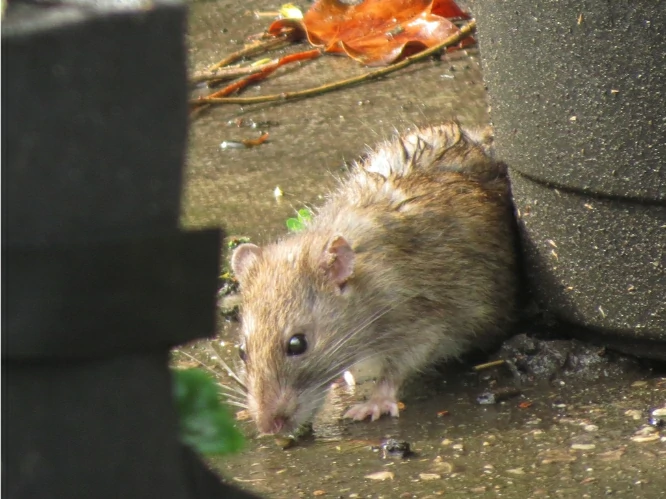
A soda can looks too small to catch anything bigger than a mouse, and that’s mostly true. So how do you make homemade rat traps that work with soda cans?
A soda can is too small to hold a rat, but it makes a great spinning bait roller. Mount it on a wire over a tall container, and the rat falls in when it steps on the can.
That spinning can is the heart of most soda can traps, and there are a few ways to build it. Some need a drill, some don’t, and one just uses the edge of a shelf.
Below, you’ll find how each design works, what rats can do to beat it, and how to stay safe while you build it (the safety part matters more than you’d think).
Can a Soda Can Really Catch a Rat?
Not by itself, and that’s the first thing to understand.
A standard soda can is only about 5 inches tall and 2½ inches wide, while a full-grown Norway rat is 8 to 10 inches long without the tail.

So the can isn’t really the cage, since it’s just a moving part.
Here’s the idea: you hang the can on a wire over a deep container, smear it with something tasty, and let the rat do the rest. The can spins under its weight, and down it goes.
However, that only works if the container is built for rats, and most online versions are built for mice.
You also won’t find much scientific testing of homemade can traps. Snap traps are still the safest, most effective, and cheapest way to trap rats, so keep that in mind as you read.
How Does a Spinning Soda Can Trap Work (And Why Do Rats Fall for It)?
A rat finds the peanut butter by smell, walks up the ramp, and steps onto the can to reach it.
The can sits on a wire, so it spins the moment the rat puts its weight on it.
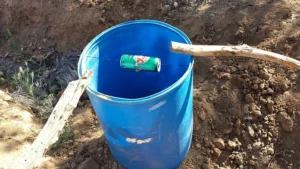
Rats are great climbers, so they don’t lose their balance easily. However, a smooth, round can gives their claws nothing to grip, and once it spins, they drop straight down.
That’s why the can has to move freely, because a stiff can just becomes a bridge and a rat will walk right across it.
It also helps if the can doesn’t look scary. Rats get nervous around anything new, so you’ll want to let them get used to it first (more on that in a moment).
Why Can’t You Use the Same Soda Can Trap for Rats and Mice?
Rats and mice look like big and small versions of the same animal, but their bodies work very differently, and that changes how you build the trap.
The most importand thing to know is what an adult Norway rat can do.
It can jump about 3 feet straight up (some guides say 2 feet from a standstill), reach about 13 inches up a smooth wall, and squeeze through a half-inch gap.
It can also gnaw through aluminum (so yes, even a soda can), swim half a mile, and tread water for days.
Mice can’t do most of that, since they jump about 18 inches at best, squeeze through a quarter-inch gap, and are much weaker.
That’s why a regular 5-gallon bucket, which stands only 14 to 15 inches tall, often holds mice but fails with adult rats. A rat that drops in can simply jump back out.
Some people add water to the bucket to fix this. However, rats can tread water for a long time, and animal welfare guidelines say drowning isn’t an acceptable way to kill a rat.
A dry, tall, slick container is the better answer, and the builds below all use one.
How to Make the Classic Spinning Soda Can Trap for Rats
You’ll need an empty soda can, a stiff wire (a straightened wire coat hanger works), a drill, a long plank, and some peanut butter.
You’ll also need a tall container, since a regular bucket is too short for rats. A 32-gallon trash can (about 2½ feet tall) or a 55-gallon drum (about 3 feet) works best.
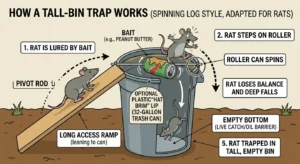
First, rinse the can and let it dry. Then poke a small hole through the center of the bottom with a nail or a Phillips screwdriver.
Next, drill a hole just below the rim of the container, then drill a second hole straight across from it.
Push the wire in through the hole in the can’s bottom and out through the pop-top opening. Then thread each end of the wire through the holes in the container and bend the ends so the wire can’t slip.
Slide the can to the middle and give it a spin. It should turn with one light touch, and if it drags, widen the hole in the bottom.
Finally, lean the plank against the container so the top end touches the can, and smear peanut butter all the way around the can.
Here’s how it works: a rat runs up the plank, steps onto the can, and the can spins. The rat drops into the container with nothing to grab.
Before you set it, rub oil or petroleum jelly around the upper inside walls, and keep the bottom empty.
For big or stubborn rats, you can also tape a ring of stiff plastic inside the rim so it sticks inward like a hat brim.
For the first 5 to 7 nights, tape the can so it can’t spin and let the rats feed. Then free the can, use a very small bit of bait, and check the trap first thing every morning.
Can You Make a Soda Can Trap Without Drilling Holes?
Yes, and it’s easier than you’d think. Instead of wire, you slide a smooth, sturdy dowel (about ½ inch thick) through the can and rest both ends across the rim.
Push the dowel in through the bottom hole and out the pop-top opening, just like the wire. Then tape each end to the rim so the whole thing can’t roll off.
Smear on the peanut butter, lean a plank against the container, and you’re done. The can spins on the dowel exactly like it would on a wire.
The catch is strength, since a big Norway rat can weigh a pound or more and a thin dowel might bend (a bent dowel makes the can stick).
There’s also a handy twist if you don’t want to poke holes in the can. Cut both ends off the can (wear gloves, since the edges are razor sharp) and slide the open tube over the dowel.
Because the dowel doesn’t touch the can’s ends, the tube spins very freely. Wrap the cut edges with duct tape before you use it, and put a ring of peanut butter around the middle.
How to Make a Ledge-Drop Soda Can Trap
This is the simplest of the three, since it needs no wire or dowel at all. You balance a baited can on the edge of a shelf or workbench, right over a deep container, and wait.
Here’s how to set it up. Put the container right next to a sturdy shelf about 2 to 3 feet high, then lay the can on its side at the edge so half of it hangs over.
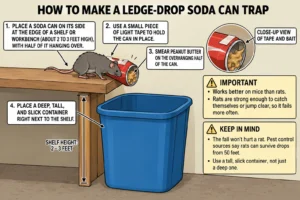
Use a small piece of light tape so a rat’s weight pulls the can free. Smear peanut butter on the overhanging half.
When a rat climbs onto the can to reach the bait, the can rolls off the edge and takes the rat with it.
However, this one works better on mice than on rats. A rat is strong enough to catch itself on the edge or jump clear, so it fails more often.
The fall also won’t hurt a rat, since pest control sources say rats can survive drops from 50 feet, so the container has to be tall and slick, not just deep.
How to Use Soda Cans to Find Where Rats Travel Before You Set a Trap
This one isn’t a trap, but it can save you a lot of time. Soda cans make a cheap alarm that shows you where rats run.
Stack three or four empty cans on a ledge, or lean them against a wall where you’ve seen droppings. In the morning, check whether any got knocked over.
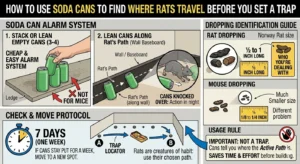
It’s not scientific, but it costs nothing, and the cans that fall tell you which path to put your trap on.
Droppings help too. Rat droppings are about ½ to 1 inch long, while mouse droppings are only 1/8 to 1/4 inch, so you can tell who you’re dealing with before you build anything.
If the cans stay put for a week, move them to a new spot. Rats stick to the same paths, so the right location usually shows up fast.
Soda Can Trap Comparison: Which Design Fits Rats or Mice?
Here’s a quick look at how the designs compare:
| Design | Needs a drill? | Best for | Main downside |
|---|---|---|---|
| Spinning can on a wire | Yes | Rats (in a tall container) and mice | Can must spin freely; takes careful setup |
| Dowel through the can | No | Mice, or rats with a sturdy dowel | A thin dowel can bend or roll |
| Ledge-drop can | No | Mostly mice | Rats can catch themselves on the edge |
| Can alarm | No | Finding rat paths | Doesn’t catch anything |
If you only remember one thing from the table, make it this. The spinning can on a wire is the most reliable design for rats, as long as the container is tall and slick.
Where Should You Put a Soda Can Trap?
Rats stay close to walls and use the same paths again and again, so the best spot is a straight edge where you’ve already found droppings.
With a spinning can trap, push the container flat against the wall and lean the plank against it from the rats’ side.

Good places include behind a water heater, along a garage wall, or next to a stack of stored boxes. A corner with food nearby, such as a bag of pet food, is even better.
Roof rats are different, since they travel off the ground along fences, pipes, and beams. A heavy trash can won’t work up there, so you’ll want a different trap for them.
Set the trap on a flat, steady spot, because a wobbly container can tip over when a rat jumps onto the plank. Wedge it with bricks or a few heavy boxes if you need to.
Keep it away from doors and walkways, so kids, pets, and your own feet stay clear of it.
What Bait Works Best on a Soda Can Trap?
Peanut butter is the go-to, since it sticks to the can and gives off a strong smell. It also makes the rat work to get it, which keeps its weight on the can longer.
Smear it all the way around the can, not just on top, so a rat has to step on it from any side.
A few oats or seeds mixed in add texture, and bacon grease or chocolate spread also work. Whatever you pick, change it every day or two.
Use a thin layer, because a big glob lets a rat eat from the edge without ever stepping on the can.
Common Mistakes That Make Soda Can Traps Fail (And Easy Fixes)
Most soda can traps that catch nothing share the same few problems, and each one has an easy fix.
- The container is too short: an adult rat can jump about 3 feet, so a 14-inch bucket won’t hold it, and a tall, slick container fixes that.
- The can sticks: a small hole or bent wire stops it from turning, so widen the hole and straighten the wire.
- The can slides to one side: a loose can drifts toward the rim, so tape a stopper on each side.
- You skipped pre-baiting: rats are wary of new things, so a new trap often gets ignored (for example, a shiny can in their path).
- There’s too much bait: a big blob of peanut butter lets a rat eat from the edge, so use a pea-sized amount once the trap is set.
- The trap sits in the open: rats hug walls, so a trap in the middle of the floor gets skipped.
- Nobody checks it: aluminum and plastic don’t hold a rat for long, and a live rat left for days suffers, so check daily.
- There’s antifreeze in the bucket: some forums suggest it for winter, but antifreeze is poisonous to pets and wildlife, so skip it.
How Can You Cut and Handle Soda Cans Safely?
Soda cans are easy to find, but cut aluminum is razor sharp, so a little care goes a long way.
Wear gloves whenever you cut or bend a can, and if you cut the ends off, wrap the edges with duct tape before you use it.
Poking a hole is much safer than cutting, since a nail or a Phillips screwdriver works fine and you’ll avoid sharp edges altogether.
Rinse the can well and let it dry before you use it. Leftover soda attracts ants, and you don’t want them taking over your trap.
Keep scraps and loose cans away from kids and pets, and put them straight in the recycling when you’re done (a cut can left on the floor is an easy way to get hurt).
How Can You Keep Kids and Pets Safe Around Soda Can Traps?
Homemade traps don’t come with warning labels, so safety is up to you. The biggest risks are curious kids, dogs, and cats.
A deep container can be risky for small children, even when it’s dry, so keep it out of reach (a closed-off basement works well).

Dogs and cats may knock over the trap or go after the peanut butter, so set it where pets can’t reach (behind appliances or in a closed room, for example).
Put outdoor traps out at night and pick them up in the morning. That also keeps birds and other wildlife out of harm’s way.
What Should You Do With a Rat Once You’ve Caught It?
This is the part most videos skip, but catching a rat alive is only half the job.
Never reach in with bare hands, since rats can spread diseases and a scared rat will bite.
Releasing it isn’t a good fix either. UK rat-control guidance published with the journal Animal Welfare says it isn’t recommended because an unfamiliar place can cause suffering, and in the UK it could even be against the law.
Rules vary, so check yours first. A vet, an animal shelter, or a pest control company can humanely put the rat down, and drowning isn’t an acceptable method.
Then comes the cleanup, and this part is important. The CDC says some rodents carry hantavirus, which people can catch by breathing in dust from dried droppings, urine, or nests.
So wear rubber or plastic gloves, and don’t sweep or vacuum, since that just throws dust into the air.
Instead, spray the rat, the droppings, and the trap with a bleach mix of 1 part bleach to 9 parts water (that’s 1½ cups of bleach in a gallon). Let it soak for about 5 minutes.
Wipe it up with paper towels, then seal the rat and towels in a plastic bag and put that bag inside a second bag before it goes in the trash.
Finally, wash your gloved hands, take the gloves off, and wash your hands again with soap and warm water. Disinfect the container before you reuse it.
Should You Use a Soda Can Trap or Something Else?
Honestly, for most people, a snap trap is the better choice, since it’s cheaper, faster, and more proven than a soda can trap.
Soda can traps do have a place, though. They’re cheap, they catch rats alive, and they can be a good fit if you’re dealing with mice or a small problem.
However, traps alone won’t fix a rat problem. If rats have food and a way in, new ones will take the place of the ones you catch.
Rats can squeeze through a gap about half an inch wide, so seal anything bigger, and since they chew through caulk and plastic, use steel wool or metal flashing instead.
Keep pet food in containers rodents can’t get into, and trim tree limbs that sit within 3 feet of your roof.
If you’re still seeing signs after a couple of weeks of steady trapping, call a licensed pest professional, since a big or long-running problem usually needs one.
Conclusion
A soda can can’t hold a rat, but it can be the part that catches one. A spinning can on a wire over a tall, slick container is the most reliable design for rats.
The dowel version skips the drilling, and the ledge-drop can works best on mice. And a row of cans on a ledge can show you where rats run before you set anything.
Whichever you pick, remember what rats can do. They jump 3 feet, chew aluminum, and squeeze through half-inch gaps, so build tall, check every morning, and seal the holes they use to get in.
Finally, plan for what happens after the catch. Wear gloves, clean up with bleach, and never reach in with bare hands.
A few smart traps and a sealed house can finish what you started.

Hi, my name is Ezra Mushala, i have been interested animals all my life. I am the main author and editor here at snakeinformer.com.