
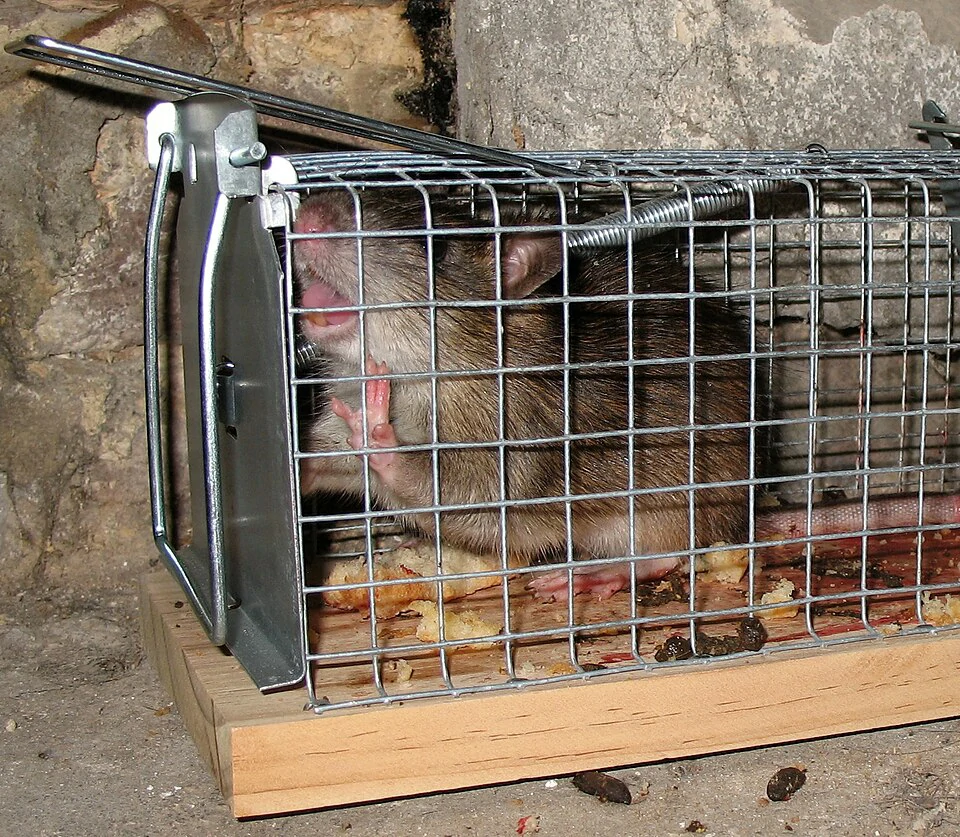
Live rat traps offer a humane way to catch rats without killing them, but if you’ve never used one before, the mechanics might seem confusing.
Understanding how these traps work helps you use them more effectively and increases your chances of actually catching rats. How does a live rat trap work?
Live rat traps work by luring rats inside with bait, then trapping them using a door that closes behind them or a chamber they can’t escape from. Most traps use a trigger mechanism (like a pressure plate) that activates when the rat enters. The rat stays alive inside the trap until you release it.
There are several different designs of live rat traps, and each one works slightly differently. Let’s break down the most common types and how they actually catch rats.
The Basic Principle Behind All Live Traps
All live rat traps share the same basic idea. You put bait inside the trap to attract rats.
The rat enters the trap to get the bait, and once they’re inside, something happens that prevents them from leaving. They’re trapped but unharmed.

The trap keeps the rat contained until you come along to check it. Then you can release the rat far from your home or deal with it however you choose.
The key difference between live traps and kill traps is that live traps don’t use any mechanism that harms the rat. No electricity, no snapping bars, no poison.
Cage Traps with Spring-Loaded Doors
This is the most common type of live rat trap you’ll find in stores. It looks like a small metal or plastic cage with a door on one end.
Inside the trap, there’s a trigger mechanism, usually a metal plate on the floor. When you set the trap, you put bait at the back of the cage.

The rat walks through the open door to get the bait. As soon as it steps on the trigger plate, the door slams shut behind it.
The door is spring-loaded, which means it has a spring that provides the force to close it quickly. Once closed, the door locks in place so the rat can’t push it open.
How the Trigger Mechanism Works
The trigger plate is connected to the door-release mechanism by a rod or lever. When you set the trap, you’re basically creating a delicate balance.
The door is held open by a small hook or catch. This hook is connected to the trigger plate inside the trap.
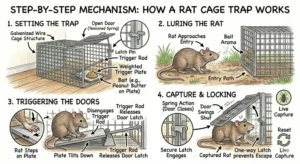
When the rat steps on the trigger plate, the pressure moves the plate downward. This movement releases the hook that’s holding the door open.
The spring immediately pulls the door closed. The whole thing happens in a fraction of a second, fast enough that the rat can’t escape.
One-Way Door Traps
Some live traps use a one-way door instead of a spring-loaded door. These doors swing inward but can’t swing back out.
The rat pushes through the door to get inside the trap. The door swings open easily when pushed from the outside.
But once the rat is inside and tries to push the door from the inside, it won’t budge. The door only swings one direction.
This design is really clever because it doesn’t need a trigger mechanism. The rat traps itself just by entering. These traps can sometimes catch multiple rats before you empty them.
Multi-Catch Trap Designs
Multi-catch traps are designed to catch several rats before you need to empty the trap. They’re useful if you have a serious infestation.
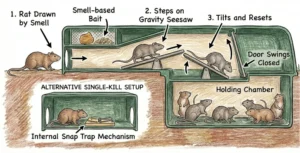
Most multi-catch traps have a one-way door system. Rats can push into the trap but can’t push back out.
Inside the trap, there’s a main chamber where rats collect. This chamber is big enough to hold several rats comfortably.
Some multi-catch traps have ramps or corridors that lead to a drop-off point. The rat walks down the ramp, falls into the main chamber, and can’t climb back up.
Tube-Style Live Traps
Tube traps look like long cylinders or tunnels. Rats naturally like to explore tunnels, so this design uses their natural behavior against them.

Bait is placed at one end of the tube. The rat enters from the other end and walks through the tunnel toward the bait.
When the rat gets far enough inside, a door closes behind it. Some tube traps use a spring mechanism triggered by the rat’s weight.
Others use a tilt mechanism. When the rat’s weight shifts the balance of the tube, a door swings closed automatically.
See-Saw or Tilt Traps
These are some of the simplest live trap designs. They use the rat’s own weight to trap it.
The trap has a platform or board balanced on a pivot point. Bait is placed on one end of the platform.
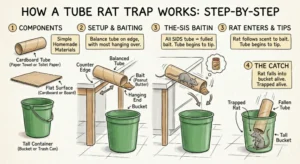
When the rat steps onto the platform to get the bait, its weight causes that end to tilt down. This might trigger a door to close or dump the rat into a container below.
After the rat is caught, the platform resets itself automatically. This makes tilt traps good for catching multiple rats.
Box Traps with Prop Sticks
This is an old-fashioned design that’s been used for hundreds of years. It’s simple but effective.
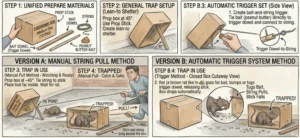
A box is propped up on one edge using a stick. String is tied to the stick and attached to bait inside the box.
When the rat tugs on the bait, it pulls the string. This moves the stick, which makes the box fall down and trap the rat underneath.
This design is less common in modern commercial traps, but some people still make homemade versions because they’re so simple to build.
Electronic Live Traps
Some newer live traps use electronic sensors instead of mechanical triggers. These are more expensive but can be more reliable.
An infrared sensor or weight sensor detects when a rat enters the trap. This triggers an electric motor that closes the door.
Electronic traps often have indicator lights that tell you when a rat has been caught. This means you don’t have to physically check the trap all the time.
The downside is that electronic traps need batteries, and if the batteries die, the trap stops working.
How Bait Attracts Rats to the Trap
The trap itself doesn’t attract rats. The bait does all the work of drawing rats to the trap.
Rats have an excellent sense of smell. They can detect food odors from surprisingly far away, sometimes from across a room.
When you put strong-smelling bait like peanut butter inside the trap, the scent spreads through the air. Rats smell it and come to investigate.
The bait needs to be at the back of the trap so the rat has to fully enter to reach it. If you put bait near the entrance, the rat might grab it without triggering the trap.
Why Do Rats Enter Traps?
You might wonder why rats would walk into an obvious trap. The answer is that it’s not obvious to them.
Rats are curious animals, and they’re always looking for food. When they smell something good, their desire for food often overrides their caution.
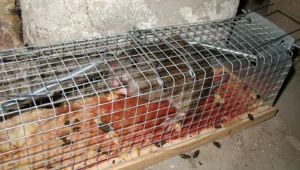
Also, if you place the trap along a wall or in a dark corner where rats already travel, it just looks like part of the environment to them.
Rats that are really hungry or stressed are less cautious. They’ll take more risks to get food, which makes them easier to trap.
The Importance of Trigger Sensitivity
The trigger mechanism needs to be sensitive enough to activate when a rat steps on it, but not so sensitive that it triggers from vibrations or wind.
Most commercial traps come pre-set with the right sensitivity. But if you’re having problems, some traps let you adjust how sensitive the trigger is.
If rats are eating your bait without getting caught, the trigger might not be sensitive enough. Try making it more responsive.
If the trap keeps closing without catching anything, it might be too sensitive. Environmental factors like wind or nearby footsteps could be setting it off.
What Happens After the Door Closes?
Once the door closes, the rat is trapped inside the cage or chamber. It can’t escape because the door won’t open from the inside.
The rat will probably try to escape at first. It might push against the door, chew on the bars, or run around inside the trap.

Most live traps are made from strong metal or thick plastic that rats can’t chew through. The gaps in cage traps are small enough that the rat can’t squeeze out.
The rat will eventually calm down and wait. This is why you need to check traps at least twice a day. You don’t want the rat to suffer from stress, thirst, or heat.
How to Know When a Rat Is Caught
With mechanical traps, you usually have to physically look at the trap to see if there’s a rat inside. You can tell the door is closed if you see it from a distance.
Some traps make noise when they trigger. You might hear the door slam or hear the rat moving around inside.
Electronic traps have indicator lights or alerts. Some can even send notifications to your phone when they catch a rat.
Check your traps on a regular schedule. Morning and evening are good times because rats are most active at dawn and dusk.
Why Do Some Traps Fail to Catch Rats?
Sometimes traps don’t work, and there are several common reasons. The trap might be in the wrong location, somewhere rats aren’t traveling.
The bait might not be appealing enough, or it might have dried out or gone moldy. Fresh bait always works better than old bait.

The trigger might be broken or not set correctly. Test your trap before you use it to make sure the door actually closes when the trigger is activated.
Rats might also be trap-shy. If they’ve seen or heard other rats get caught, they might avoid the trap completely.
Overcoming Trap Shyness
Trap shyness is when rats learn to avoid traps. This happens if they’ve had a bad experience or seen other rats get caught.
You can overcome this by leaving the trap unset with bait inside for a few days. Let rats eat from the trap safely.
This teaches them that the trap is just a food source, not a threat. After a few days of free feeding, set the trap properly.
The rats will be used to going inside and won’t expect the door to close. Your catch rate will improve significantly.
Maintenance Between Catches
After you catch and release a rat, you need to clean the trap before using it again. Rats can smell other rats, and this might make them cautious.
Wash the trap with soap and warm water. Scrub away any droppings, urine, or scent marks.
Rinse the trap thoroughly and let it dry. You don’t want any soap residue left behind because that can also repel rats.
After cleaning, reset the trap with fresh bait. Don’t reuse old bait that a rat has been eating or touching.
How Long Do Live Traps Take to Catch Rats?
There’s no guaranteed timeline for catching rats. Sometimes you’ll catch one the first night, and sometimes it takes a week.
Rats need time to discover the trap, especially if it’s in a new location. They also need to overcome their natural caution about new objects.
If you haven’t caught anything after a week, try moving the trap to a different location or changing your bait.
Patience is important. Don’t give up too quickly just because you don’t catch something immediately.
Multiple Traps vs. Single Traps
If you have several rats, one trap won’t be enough. You’ll be catching and releasing rats one at a time, which takes forever.
Set multiple traps in different locations around your home. Focus on areas where you’ve seen the most rat activity.
Multiple traps increase your odds of catching rats faster. While one rat is figuring out one trap, another rat might walk into a different trap.
Just make sure to check all your traps on the same schedule so no rat sits trapped for too long.
Advantages of Live Traps Over Kill Traps
Live traps don’t harm the rat, which many people prefer for ethical reasons. You have control over what happens to the rat after you catch it.
There’s no mess to clean up. Unlike snap traps or poison, you don’t have to deal with blood or dead bodies.
Live traps can be reused indefinitely. Snap traps can break, and poison needs to be constantly repurchased.
You also know for certain whether you’ve caught the rat. With poison, rats can die inside your walls where you can’t reach them.
Disadvantages of Live Traps
Live traps require more effort than kill traps. You have to check them multiple times per day and deal with live rats.
You need to decide what to do with the rat after catching it. Releasing rats just moves your problem somewhere else.
Live traps can be more expensive upfront than simple snap traps, though they last longer.
Some people find handling live rats stressful or scary, even though the rat is contained in the trap.
Conclusion
Live rat traps work by using bait to lure rats inside, then trapping them with a closing door or one-way entrance they can’t escape from. Most traps use a trigger mechanism activated by the rat’s weight.
Different trap designs use spring-loaded doors, one-way doors, tilt mechanisms, or electronic sensors to catch rats without harming them. The rat stays alive inside the trap until you release it.
For traps to work effectively, you need to place them in areas where rats are active, use fresh and appealing bait, and check the traps at least twice daily.
Understanding how your specific trap works helps you use it correctly and troubleshoot problems if rats aren’t getting caught. With proper use, live traps are an effective and humane way to deal with rat problems.

Hi, my name is Ezra Mushala, i have been interested animals all my life. I am the main author and editor here at snakeinformer.com.