

Many people think living in a high-rise apartment building means they don’t have to worry about mice. After all, you’re 20 or 30 stories up in the air, and mice can’t fly.
But if you’ve spotted a mouse in your apartment or heard stories from neighbors about rodent problems, you might be wondering how this is even possible. So can mice get into high-rise apartments?
Yes, mice can get into high-rise apartments. They don’t climb up the outside of tall buildings, but they travel through the building’s internal systems like plumbing chases, electrical conduits, elevator shafts, and garbage chutes. Mice can live on any floor of a high-rise building and move between floors using these vertical pathways.
Even apartments on the 50th floor aren’t safe from mice if the building has an infestation.
Understanding how mice navigate high-rise buildings can help you protect your apartment.
How Mice Get Into High-Rise Buildings
Before mice can reach your apartment, they need to get into the building itself, and there are several ways they do this.
Ground-level entry points are the most common way mice enter high-rise buildings. Loading docks, parking garages, maintenance entrances, and gaps in the building’s exterior all give mice access at street level.

Deliveries and moving activities bring mice in accidentally. When pallets of supplies, furniture, or boxes are brought into the building, mice can hitch a ride without anyone noticing.
Garbage areas and dumpster rooms are major entry points. These areas attract mice with food smells, and they often have doors that don’t seal properly or gaps that mice can squeeze through.
Utility connections where pipes, cables, and ventilation enter the building from underground can have gaps around them. Mice follow utility lines and use these gaps to get inside.
Ground-floor commercial spaces like restaurants, grocery stores, or shops attract mice with food. Once mice are in these businesses, they can access the building’s internal systems and travel upward.
Gaps in the building’s foundation or exterior walls give mice direct entry. Even new buildings can have small openings that mice can exploit, and older buildings often have deteriorating mortar or weather damage.
How Do Mice Travel Between Floors?
Once mice are inside a high-rise building, they use the building’s infrastructure to move vertically.
Plumbing chases are vertical spaces that run from the basement to the roof, carrying water pipes and drain lines. These chases have plenty of room for mice to climb up and down, and they connect to every floor.
Electrical conduits and utility spaces serve the same purpose as plumbing chases. They provide vertical pathways that mice can follow to reach any floor in the building.

Elevator shafts offer lots of space for mice to travel. There are cables, beams, and ledges that mice can use, and the shaft connects directly to every floor. The gap under elevator doors on each floor can let mice exit onto that level.
Garbage chutes are particularly attractive to mice because they combine vertical travel with food smells. Mice can climb inside garbage chutes and access any floor that has a garbage room.
HVAC ducts and air shafts provide another route. If the building’s ventilation system has gaps or access points on different floors, mice can use these to travel.
Wall cavities and the spaces between walls often connect vertically, especially in older buildings. Mice can travel inside walls from floor to floor.
The space between dropped ceilings and the floor above creates horizontal and sometimes vertical pathways. In many commercial spaces and older apartments, these spaces are interconnected.
Why Some Floors Have More Mice Than Others
You might notice that mice problems seem worse on certain floors of a high-rise building.
Lower floors (especially the first few levels) tend to have more mice because they’re closer to where mice enter the building. It’s easier for mice to reach floors 2-5 than floor 40.
Floors with food-related businesses or amenities attract more mice. If there’s a restaurant, café, or even just vending machines on a particular floor, mice will be drawn there.

Older floors or sections of the building that haven’t been renovated often have more gaps and entry points. Newer construction is usually better sealed against pests.
Floors with poor sanitation see more mouse activity. If residents on a particular floor leave food out, don’t take trash out regularly, or have clutter, mice will prefer those areas.
Vacant apartments or units under renovation give mice undisturbed places to nest. Without human activity to scare them away, mice settle in and breed.
Still, it’s important to know that mice can and do live on upper floors. Once an infestation is established in a building, mice can be found on any level.
Common Entry Points Into Individual Apartments
Even if your building has mice, they still need to find a way from the building’s systems into your specific apartment.
Gaps around pipes under sinks are super common entry points. The holes in your cabinet back or floor where pipes come through often have extra space around them that mice can squeeze through.
Spaces around electrical outlets and switches can connect to wall cavities where mice travel. Mice can come right through these small openings into your apartment.
Gaps under your apartment door let mice walk right in from the hallway. If you can see light under your door or feel a draft, mice can probably get through.
Holes for radiator pipes or heating system connections often have gaps around them. Check where heating pipes come up through your floor or out of walls.
Damaged baseboards or gaps where the baseboard meets the floor give mice access from wall cavities into your living space.
Gaps around utility closets or mechanical spaces in your apartment can be entry points. If you have a closet with a water heater, furnace, or electrical panel, check it for holes.
Balcony doors or windows that don’t seal properly can let mice in, especially on lower floors or if there are nearby ledges or fire escapes.
Signs of Mice in Your High-Rise Apartment
Knowing what to look for helps you catch a mouse problem early before it gets worse.
Mouse droppings are the most obvious sign. These look like small, dark pellets about the size of a rice grain. Check under sinks, behind appliances, in corners, and along walls.
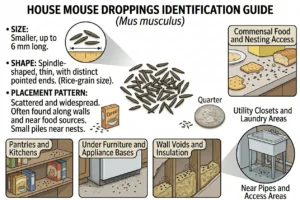
Gnaw marks on food packages, furniture, or walls show where mice have been chewing. Mice need to chew constantly to keep their teeth from getting too long.
Strange scratching or scurrying sounds, especially at night, indicate mice in your walls or ceiling. You might hear them running around or scratching as they move through the building’s systems.
A musty or ammonia-like smell means mouse urine. If you notice a strange odor you can’t identify, it might be mice.
Finding shredded paper, fabric, or insulation means mice are building nests somewhere in or near your apartment. These materials might show up in cupboards, closets, or storage areas.
Greasy rub marks along walls or baseboards appear where mice repeatedly run. Their oily fur leaves dark smudges on surfaces.
Seeing an actual mouse (even just once) means there are probably more. Mice are good at hiding, so if you see one in the open, it usually indicates a larger problem.
How to Keep Mice Out of Your Apartment
Even though you can’t control the entire building, there’s a lot you can do to protect your individual apartment.
Seal all gaps and holes in your apartment. Use steel wool combined with caulk to fill openings around pipes, behind appliances, and anywhere else you find gaps. Check under sinks, behind the stove and refrigerator, and around any utility connections.
Install door sweeps on your apartment door and any interior doors. This blocks mice from walking in from hallways or other rooms.
Store all food in sealed glass or plastic containers. Don’t leave anything in cardboard boxes or plastic bags that mice can chew through.
Take garbage out daily and use trash cans with tight-fitting lids. Don’t let garbage sit in your apartment overnight.
Clean up crumbs and spills immediately. Don’t leave dirty dishes in the sink, and wipe down counters after cooking.
Don’t leave pet food out all day. Feed your pets at specific times and pick up their bowls when they’re done eating.
Reduce clutter in your apartment. The more open and organized your space is, the fewer hiding spots mice have and the easier they are to spot.
Report any signs of mice to your building management immediately. The faster they address the problem building-wide, the better protected your apartment will be.
What to Do If You Find Mice in Your Apartment
If you discover mice in your high-rise apartment, take action quickly.
Document everything. Take photos of droppings, damage, and any entry points you find. This creates a record for your landlord and helps track the problem.

Notify your building management or landlord in writing immediately. They’re responsible for pest control in rental buildings, and written notice protects you legally.
Set traps in your apartment while waiting for professional help. Snap traps or electronic traps work well. Place them along walls where you’ve seen droppings or activity.
Don’t use poison in your apartment. If mice eat poison and die inside your walls, you’ll have a terrible smell and potential health hazard.
Clean and sanitize areas where you’ve seen mouse activity. Wear gloves and a mask when cleaning up droppings, and disinfect surfaces thoroughly.
Keep following up with management until the problem is resolved. If they’re not responsive, you may need to contact local health authorities or consider legal options depending on your location.
Ask about building-wide pest control. Your apartment might be mouse-free temporarily after treatment, but if the building has an infestation, mice will just come back.
How Building Management Can Prevent and Control Mice
The most effective mouse control in high-rise buildings requires a comprehensive approach by building management.
Professional pest control companies should inspect and treat the entire building, not just individual apartments. Mice travel between units, so treating one apartment isn’t enough.
Sealing ground-level entry points is critical. Management needs to find and seal all the gaps, holes, and openings where mice first enter the building.
Regular garbage management prevents mouse attraction. Dumpsters should be sealed, garbage rooms should be cleaned regularly, and trash chutes need proper maintenance.
Sealing vertical pathways where possible helps contain mouse populations. While buildings need these utility chases and shafts, vulnerable access points can be screened or sealed.
Renovation work should include pest-proofing. When apartments or common areas are updated, gaps should be sealed and entry points eliminated.
Tenant education helps everyone do their part. Building management should inform residents about proper food storage, garbage disposal, and reporting procedures.
Ongoing monitoring catches problems early. Regular inspections by pest control professionals identify new infestations before they spread throughout the building.
What Are Your Rights If Your Building Has a Mouse Problem?
Understanding your rights as a tenant in a mouse-infested high-rise is important.
In most places, landlords are legally required to provide habitable housing, which includes being free from pest infestations. Mice create health hazards that violate this requirement.

You should report mouse problems to your landlord in writing and keep copies of all communications. This creates a paper trail if you need to take further action.
If your landlord doesn’t address the problem within a reasonable time, you may have legal options. These vary by location but can include withholding rent, breaking your lease, or suing for damages.
Document any damage to your personal property caused by mice. Take photos and keep receipts if you need to replace items. You may be able to seek compensation from your landlord.
Contact your local health department if management ignores the problem. Health departments can inspect buildings and force landlords to take action.
Check your lease for pest control clauses, but know that in most places, these can’t override your right to habitable housing. Even if your lease says something different, landlords usually can’t avoid their responsibility to control pests.
Consider tenants’ rights organizations in your area. They can provide guidance specific to your location and situation.
Why Mouse Control Is More Difficult in High-Rise Buildings
High-rise buildings have specific challenges when it comes to mouse control.
The sheer size of the building makes comprehensive treatment expensive and time-consuming. Inspecting and treating a 40-story building with hundreds of units requires significant resources.
Multiple owners or management companies (in condos or mixed-use buildings) complicate pest control. Getting everyone to coordinate treatment is difficult.
Constant turnover of residents means new people are always moving in and out, potentially bringing mice or creating entry points during moves.
Commercial spaces on lower floors can be separate businesses with different management. If a restaurant has a mouse problem, it affects the entire building, but the building management might not have direct control.
Some residents don’t report problems or cooperate with pest control. If people refuse to allow inspections or treatment, mice can continue breeding in their units.
The building’s age matters a lot. Older high-rises often have more structural gaps and deteriorating seals that are expensive to repair comprehensively.
Conclusion
Mice can absolutely get into high-rise apartments, even on upper floors. They don’t climb up the outside of buildings, but they use internal systems like plumbing chases, electrical spaces, and elevator shafts to travel between floors.
Living on the 30th floor doesn’t protect you from mice if the building has an infestation. The same mouse that entered through a loading dock on the ground floor can end up in any apartment in the building by traveling through these vertical pathways.
The best protection is a combination of building-wide pest control and individual apartment defense. Building management needs to seal entry points and maintain regular pest control services, while you should seal gaps in your apartment, store food properly, and maintain good sanitation.
If you notice signs of mice in your high-rise apartment, report it immediately to management and take steps to protect your individual unit. The sooner a mouse problem is addressed, the easier it is to control and the less damage it causes.

Hi, my name is Ezra Mushala, i have been interested animals all my life. I am the main author and editor here at snakeinformer.com.