
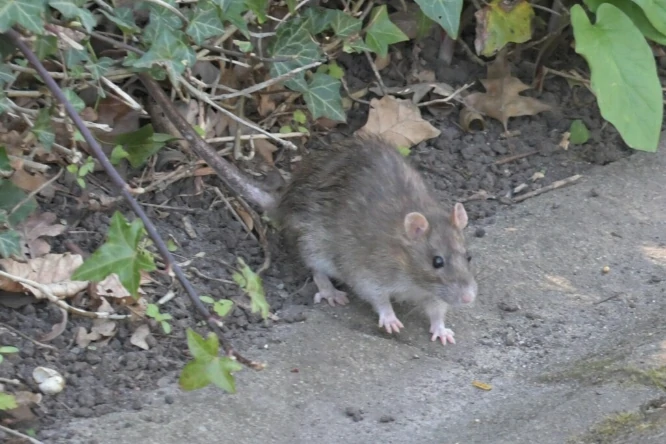
You built a bucket rat trap, set it up exactly how the instructions said, and waited. But morning after morning, you check the trap and find nothing. No rats, no signs that anything even went near it.
You’re frustrated and wondering if bucket traps are just a myth that doesn’t actually work. So why isn’t your bucket rat trap catching anything?
Bucket rat traps fail for several common reasons: wrong placement (not along rat travel routes), unstable or scary-looking setup that rats avoid, insufficient bait or wrong bait type, can that doesn’t spin freely, ramp that’s too steep or wobbly, or simply not waiting long enough for cautious rats to approach. Most problems can be fixed with simple adjustments.
The good news is that bucket traps absolutely do work when set up correctly. Thousands of people use them successfully.
If yours isn’t catching rats, there’s a specific reason why, and once you identify and fix that problem, you’ll start catching rats.
Problem 1: The Trap Isn’t Where the Rats Are
This is the single most common reason bucket traps fail. You can have a perfect trap with the best bait in the world, but if rats aren’t traveling past it, you won’t catch anything.
Rats don’t wander randomly around your property. They follow the same routes over and over, creating well-worn pathways between their nest and their food sources.
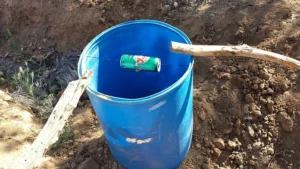
If your trap isn’t on one of these pathways, rats simply won’t encounter it.
Look for signs of rat activity before you place your trap. Rat droppings are the most obvious sign. They’re dark, pellet-shaped, and about the size of a grain of rice (for roof rats) or a bit larger (for Norway rats).
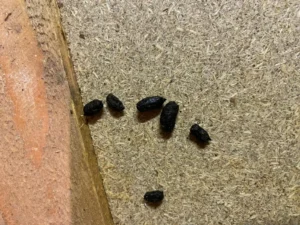
If you see a lot of droppings in one area, that’s an active zone.
Greasy smudge marks along walls are another sign. Rats have oily fur, and when they repeatedly travel the same path, they leave behind dark, greasy streaks on walls, baseboards, or other surfaces they brush against.
Gnaw marks on wood, plastic, or cardboard show that rats are feeding or nesting in that area. Fresh gnaw marks are lighter in color than old ones.
Once you’ve identified where the rats are most active, move your trap to that location. Place it right along the wall where you see the most signs.
Don’t put it in the middle of a room or open area. Rats hug walls and avoid crossing open spaces.
Problem 2: The Ramp Is Too Steep or Unstable
Rats are excellent climbers, but they’re also cautious. If your ramp is too steep, too narrow, or wobbles when weight is placed on it, rats will avoid it because it doesn’t feel safe.
The ideal ramp angle is about 30-45 degrees. Anything steeper than that becomes difficult for rats to climb comfortably. A gradual slope is much more inviting.
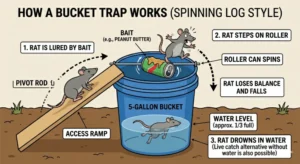
The ramp also needs to be wide enough. A narrow stick or dowel might not give the rat enough confidence to climb it.
A piece of wood that’s at least 2-3 inches wide is better. Some people even use multiple sticks side by side to create a wider climbing surface.
Stability is critical. If the ramp shifts or wobbles when the rat steps on it, the rat will immediately back off. Make sure the base of the ramp is firmly planted on the ground and doesn’t slide around.
You can secure it with tape, a weight, or by leaning it against the bucket at a stable angle.
Test the ramp yourself before leaving the trap overnight. Press down on it with your hand and see if it moves. If it does, fix it until it’s completely solid.
Problem 3: The Can Doesn’t Spin Freely
The entire bucket trap design depends on the can spinning when the rat steps on it. If the can is stuck, bound up, or turns too slowly, the trap won’t work.
After you set up your trap, test the spinning mechanism. Gently push on the can with your finger.
It should rotate easily with very little resistance. If it doesn’t spin smoothly, something is wrong.

Common causes of a stuck can include holes that are too small (the dowel is wedged too tightly in the holes), bent or dented can that doesn’t rotate evenly, dowel that’s too thick or not straight, or bait that’s been applied so thickly it’s gluing the can to the dowel.
If your can isn’t spinning freely, try these fixes. Make the holes in the can slightly larger with a drill or by twisting a knife point in the existing holes.
Replace a bent can with a straight one. Use a thinner dowel or make sure the one you’re using is straight and smooth. Remove excess bait and reapply a thinner layer.
After making adjustments, test the can again. It should spin easily and reset itself to the center position after being rotated.
Problem 4: Not Enough Bait or Wrong Type of Bait
Bait is what draws rats to your trap in the first place. If you’re using too little bait, rats won’t smell it from a distance. If you’re using the wrong type of bait, they won’t be interested even if they do smell it.
Peanut butter is the gold standard for rat bait. It has a strong smell, it’s sticky (so rats have to spend time licking it off, which increases the chance they’ll fall), and rats love it. Use a generous amount, not just a tiny dab. Spread it all over the outside of the can.
Other excellent baits include bacon or bacon grease, sunflower seeds, hazelnut spread, dried fruit, or whatever food the rats in your area are already eating.
If you’ve seen rats getting into your dog food, use dog food as bait. Rats are more likely to approach something familiar.
Make sure your bait is fresh. Old, dried-out peanut butter or rancid bacon won’t attract rats. Replace the bait every few days if you’re not getting catches.
Also, don’t put bait anywhere except on the can itself. If you put bait on the ramp, the rim of the bucket, or the dowel, rats might be able to reach it without stepping onto the spinning part of the trap.
Problem 5: The Bucket or Setup Looks Scary
Rats are extremely cautious animals. They’re constantly watching for predators and threats. If your trap looks suspicious or out of place, rats will avoid it.
A bright white or colored bucket in an area where everything else is dark might stand out too much. Rats are more comfortable approaching things that blend into their environment.
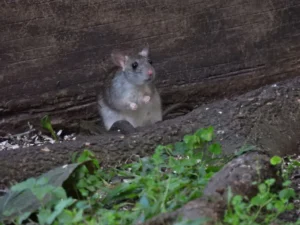
If possible, use a bucket that matches the surroundings, or place the trap in a spot where the bucket doesn’t look so obvious.
The area around the trap should be relatively calm and quiet. If the trap is in a high-traffic area where people or pets are constantly walking by, rats won’t feel safe approaching it. Put the trap somewhere more secluded if possible.
Some people cover part of the bucket with cardboard or cloth to make it look more like a shelter than a trap. This can work, but make sure the cover doesn’t interfere with the spinning mechanism.
Problem 6: Rats Are Already Getting Food Elsewhere
If rats have access to easy, safe food sources, they won’t take risks exploring new things like your trap. Why would they climb a suspicious ramp to reach peanut butter when there’s a pile of dog food on the ground or an open garbage can nearby?
Before you set your trap, remove or secure other food sources. Bring pet food bowls inside at night. Put lids on trash cans and make sure they’re tightly sealed.
Clean up fallen fruit under trees. Store birdseed in sealed containers.
The goal is to make your trap the most attractive food option available. When rats get hungry and can’t find their usual easy meals, they’ll be much more willing to investigate new food sources.
Problem 7: Not Waiting Long Enough
Rats are naturally suspicious of new objects in their environment. This is called neophobia, which just means fear of new things. When you first set up a trap, rats might avoid it for several days simply because it’s unfamiliar.
This is normal and doesn’t mean your trap is broken. Many successful trappers don’t catch anything for the first 3-5 days, then suddenly start catching rats every night once the rats get used to seeing the trap.

One trick to speed up this process is to leave the trap unset for a day or two with bait on it. Let the rats take the bait without getting caught.
This teaches them that the trap is a safe place to find food. After a couple of successful free meals, set the trap. The rats will return expecting another easy snack and get caught.
Patience is key. Don’t move or adjust the trap too frequently. Give rats time to discover it and get comfortable with it.
Problem 8: The Can Is Too Heavy
If you’ve loaded the can with so much bait that it’s become heavy, it might not spin easily enough when the rat steps on it. The can needs to be light enough that even a medium-sized rat’s weight will cause it to rotate.
This is usually only a problem if you’re using thick coatings of bacon grease or multiple layers of sticky bait. The solution is simple: use less bait.
A generous coating is good, but you don’t need it to be so thick that it adds significant weight to the can.
After applying bait, test the spinning mechanism again. The can should still rotate freely and easily.
Problem 9: Wrong Time of Day or Season
Rats are primarily nocturnal, meaning they’re most active at night. If you’re checking your trap during the day and expecting to see fresh catches, you might be checking too early.
Set your trap in the evening and check it first thing in the morning. That’s when you’re most likely to find rats.

Season can also affect rat activity. In very cold winter weather, outdoor rat activity decreases because rats stay in their nests to conserve energy.
In extreme heat, they might be less active during the hottest parts of the night.
If you’re not catching anything and you’re certain your trap is set up correctly, consider whether the season or weather might be affecting rat behavior in your area.
Problem 10: You’re Dealing With Very Smart or Trap-Shy Rats
Some rats are simply smarter or more cautious than others. If a rat has seen another rat get caught in a trap, it will avoid that trap and anything similar to it.
Older, experienced rats are generally more trap-shy than young rats.
If you suspect you’re dealing with particularly cautious rats, try these strategies.
Use multiple traps in different locations, change the type of bait you’re using, camouflage the trap by placing it under a box or tarp with openings cut for the ramp, or switch to a completely different type of trap (like a cage trap) that doesn’t look like the bucket trap.
Sometimes rats that avoid one type of trap will readily enter a different type because they don’t recognize it as dangerous.
How to Test If Your Trap Is Working
Before you blame the trap, test it to make sure the mechanism actually works. Here’s a simple test: place a small weight (like a beanbag or a sock filled with rice) on the can and see if it spins and causes the weight to fall into the bucket.

If the weight falls in, your trap is mechanically sound. The problem is probably placement, bait, or rat behavior, not the trap itself.
If the weight doesn’t fall in, there’s something wrong with the spinning mechanism that needs to be fixed.
Alternative Designs to Try
If you’ve tried everything and your basic bucket trap still isn’t working, consider trying a variation of the design. Some people have better success with these modifications.
The rolling bottle design uses a plastic water bottle instead of a soda can. The bottle is larger and might be more visible to rats.
The see-saw design uses a piece of wood balanced across the top of the bucket instead of a spinning can.
When the rat walks to the end of the wood to get the bait, the wood tips and the rat falls in.
The Tippy Tap design uses a can that’s only attached on one end of the dowel instead of running through the middle. When the rat steps on the free end of the can, it tips down and the rat falls.
Each of these variations works on the same basic principle but might appeal to rats differently depending on their individual behavior and preferences.
When to Call a Professional
If you’ve tried all these fixes and you’re still not catching rats, it might be time to call a professional pest control service.
They have experience diagnosing trap problems and can often spot issues that you might miss.
Professionals also have access to different types of traps and baits that aren’t available to homeowners. They can quickly identify what species of rat you’re dealing with and which methods work best for that species in your area.
The cost of a professional service is worth it if it saves you weeks of frustration and trial and error.
Conclusion
Bucket rat traps don’t work when they’re placed in the wrong location, have an unstable ramp, use a can that doesn’t spin freely, don’t have enough attractive bait, or when rats are still suspicious of the new object in their environment.
The most common problem is placement. Make absolutely sure your trap is on an active rat pathway where you’ve seen clear signs of rat activity.
The second most common problem is an unstable or poorly designed ramp that rats don’t feel safe climbing.
Fix these two issues first, then check that your can spins freely, your bait is fresh and generous, and you’re giving rats enough time to get comfortable with the trap’s presence. With these adjustments, your bucket trap should start catching rats within a few days.

Hi, my name is Ezra Mushala, i have been interested animals all my life. I am the main author and editor here at snakeinformer.com.