
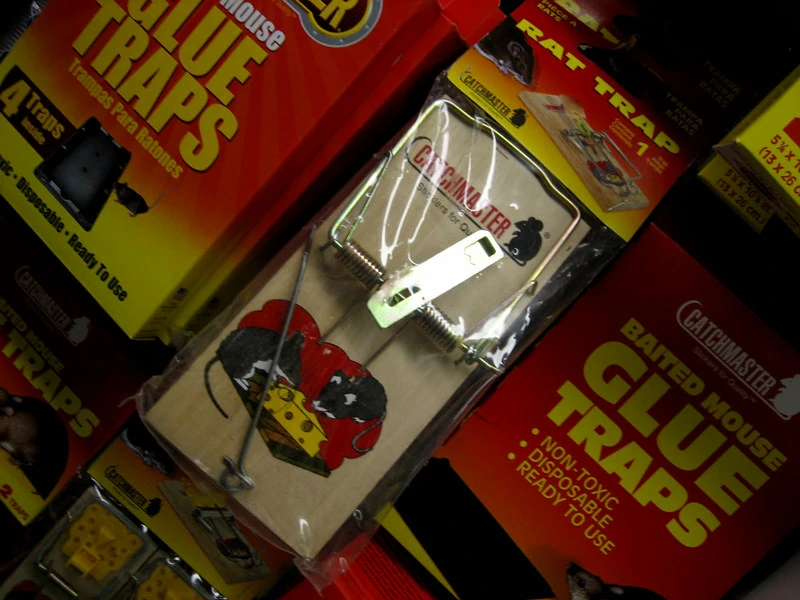
If you’ve ever dealt with a mouse problem, you’ve probably seen glue traps sitting on the shelf next to the snap traps at your local hardware store. Some packages call them glue boards. Others just say sticky traps.
But with headlines about bans and cruelty popping up more and more, you might be left wondering, are glue traps for mice illegal?
Glue traps for mice are legal in most of the United States and Canada, but illegal in a growing number of countries. There’s no nationwide US or Canadian ban yet. Places like England, Ireland, Iceland, New Zealand, and parts of Australia have already outlawed them.
The short answer really depends on where you live. Some countries have banned them outright. Others only restrict who’s allowed to use them. And in most of North America, they’re still sitting on store shelves with no legal restriction at all.
Where Glue Traps Are Legal vs Illegal
Since the legal status of glue boards and sticky traps changes so much depending on location, a quick comparison makes this a lot easier to follow.
| Location | Legal Status | Notes |
|---|---|---|
| United States (federal) | Legal | No nationwide ban. A bill (Glue Trap Prohibition Act) has been proposed but not passed. |
| Canada (federal) | Legal | No nationwide ban. A petition exists, but nothing has become law. |
| England | Restricted | Illegal for the public to use without a license. Sale is still legal. |
| Wales | Illegal | Full ban on both use and purchase. |
| Scotland | Illegal | Ban on possessing, supplying, and using glue traps took effect in 2026. |
| Ireland | Illegal | Banned under the Wildlife Act, with only rare exceptions. |
| Iceland | Illegal | Banned under the country’s animal welfare law. |
| New Zealand | Illegal | Public use and purchase banned since 2015. |
| Australia (Victoria) | Restricted | Sale and use regulated at the state level. |
| West Hollywood, Ojai, Culver City, Ventura, and Laguna Beach, California | Illegal | Local city bans, not statewide. |
As you can see, this isn’t a simple yes or no question. A lot depends on whether you’re asking about a country, a state or province, or a specific city.
Are Glue Traps Legal in the United States?
Yes, at the federal level, glue traps for mice are completely legal across the United States. There’s no law from Congress banning their manufacture, sale, or use.
That said, a bill called the Glue Trap Prohibition Act of 2024 has been introduced in Congress. It was sponsored by Representative Ted Lieu of California and is backed by groups like the Humane Society and PETA.
As of now, this bill hasn’t passed. Until it does, glue traps remain legal to buy and use anywhere in the country, unless a specific state or city has passed its own local ban.
No US State Has a Full Ban Yet, But Some Are Close
This is where things get more specific. While the federal government hasn’t banned glue traps, individual states have started introducing their own bills.
California is the furthest along. A bill known as AB 724 has been proposed to ban the sale and use of glue traps statewide. If it passes, California would be the first state in the country to do this.
New Hampshire introduced a similar bill, House Bill 152, in 2025. Like California’s bill, it hasn’t become law yet, but it shows the same kind of momentum building in more than one state.
Massachusetts has also seen public petitions pushing lawmakers to introduce a statewide ban, though nothing has been formally passed there either.
So while no full state ban exists yet in the US, the direction things are heading in is pretty clear.
Several US Cities Have Already Banned Glue Traps
Even though no state has passed a full ban, a handful of cities have gone ahead and done it locally.
West Hollywood, California became the first city in the country to ban the sale and use of glue traps, back in 2023. Ojai followed soon after in 2024.
Since then, Culver City, Ventura, and Laguna Beach have all passed similar bans. All five of these cities are in California, which lines up with the state also being the furthest along on a statewide bill.
Outside of city governments, plenty of institutions have made their own decisions too. More than 100 airports across the US no longer use glue traps, along with the New York City Police Department and major retailers like Target, CVS, Rite Aid, and Walgreens.
None of these count as legal bans in the traditional sense. They’re policy decisions made by individual businesses or organizations, not laws passed by a government.
Is New York Considering a Ban?
Yes, New York is one of the more active states on this issue, even though nothing has passed into law yet.
State Senator Jabari Brisport introduced legislation aimed at banning the sale and use of glue boards throughout New York. His argument wasn’t only about animal welfare either.
He pointed out that glue traps pose a health and safety risk to humans too, since a trapped animal will often urinate and defecate while stuck, which can spread bacteria and disease.
The Centers for Disease Control and Prevention has actually made a similar point. Their guidance specifically advises against using glue traps because of this same risk.
As of now, this remains a proposed bill in New York, not an active law. But it’s a good example of how the argument against glue traps often combines both animal welfare and public health concerns.
Why Have Other Countries Already Banned Glue Traps?
Outside of North America, several countries have already moved past the proposal stage and turned these bans into actual law.
England passed the Glue Traps (Offences) Act in 2022. Under this law, it’s illegal for the public to set a glue trap for a rodent unless they hold a special license as a professional pest controller.

Breaking this law can lead to serious consequences, including up to 51 weeks in prison or an unlimited fine. Selling glue traps is still legal in England, though, so the restriction is specifically about who’s allowed to use them.
Wales went further and banned both the sale and use of glue traps completely, starting in 2023. Scotland followed with its own full ban on possessing, supplying, and using them, which took effect in 2026.
Ireland has banned glue traps since 1976 under its Wildlife Act, though the law allows for rare exceptions in unusual situations. Since 2008, there have been several prosecutions for people caught using them illegally.
Iceland’s ban came from its animal welfare law. That law makes it illegal to use any pest control method that causes what the law calls unnecessary entrapment or pain.
New Zealand banned public use and purchase back in 2015, one of the earliest countries to do so.
What About Australia?
Australia doesn’t have one single nationwide law on glue traps. Instead, it’s handled at the state level, similar to how the US is currently approaching it.
Victoria is the strictest state so far, regulating both the sale and use of glue traps for catching animals. Other Australian states haven’t gone as far, so the legal status genuinely depends on which part of the country you’re in.
If you’re located in Australia and searching whether glue traps are banned there, the honest answer is that it depends entirely on your specific state, not the country as a whole.
What Does It Actually Mean When a Country “Restricts” Glue Traps Instead of Banning Them?
England is a good example of a country that took a middle path.
It’s worth understanding why, since a few other places may end up following a similar model.
Rather than banning glue traps outright, England created a licensing system. Only someone trained and certified as a professional pest controller is allowed to legally set one, and even then, only in specific situations where other methods have already failed.
This means an average homeowner in England can still walk into a store and legally buy a glue trap. What they can’t legally do is actually set it to catch a rodent, since that part of the process is restricted to licensed professionals.
The reasoning behind this approach is that glue traps aren’t always avoidable, especially in serious infestations where a business or property might have limited options.
Licensing tries to strike a balance. It keeps the tool available for extreme cases, while cutting down on how often it gets used carelessly.
Whether this kind of middle-ground approach becomes more common elsewhere remains to be seen. Still, it’s a useful example of how a country can restrict something without fully banning it.
What Happens to an Animal on a Glue Trap That Isn’t Checked Regularly?
Part of what makes glue traps different from other mouse traps is how long the suffering can actually last.
This is worth understanding in more detail.
A snap trap either works right away or it doesn’t. A glue trap, on the other hand, can leave an animal alive and struggling for a long stretch of time, sometimes several days, depending on how often the trap gets checked.
During that time, the animal doesn’t have access to food or water. It’s also likely to be under constant stress, which on its own can be harmful to a small animal’s body.
This is a big part of why licensing systems like the one in England require regular inspections as one of the conditions for legal use.
Left unchecked, a glue trap can turn into a much longer, more painful situation than most people using one probably intend.
For anyone who does end up using a glue trap where it’s still fully legal, checking it often matters a lot.
At least once or twice a day is a good habit to aim for. This helps the animal, and it also helps you avoid a situation that only gets harder to deal with the longer it goes on.
Why Do So Many Groups Want Glue Traps Banned?
To understand why this issue keeps coming up in state legislatures and city councils, it helps to know what actually happens once an animal gets stuck.
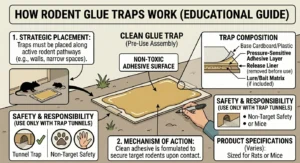
Glue traps work through a thick, non-drying adhesive strong enough to hold an animal in place. Unlike a snap trap, which is built to kill quickly, a glue trap simply holds the animal there.
This means a mouse or rat caught on a glue board can be stuck for hours, or even days, before it dies from exhaustion, dehydration, or suffocation.
Animals that panic often make things worse for themselves.
On top of the suffering itself, there’s a public health angle too. A trapped, frightened animal tends to urinate and defecate while stuck, which can spread bacteria and pathogens, something the CDC has specifically warned about.
Do Glue Traps Only Catch Mice?
No, and this is actually one of the biggest arguments used by groups pushing for bans. Glue traps aren’t selective about what gets stuck to them.
Birds, lizards, snakes, squirrels, chipmunks, bats, and even someone’s pet cat or small dog can end up caught on a glue trap just as easily as a mouse.
Wildlife rehabilitators often describe having to perform delicate, difficult rescues to free non-target animals from glue traps. Many of these animals don’t survive the process even when help arrives in time.
This is part of why several city bans, including the one in Berkeley, California being considered as of 2026, specifically mention protecting birds and other wildlife, not just pest species like mice and rats.
Are Glue Traps Actually Effective at Getting Rid of Mice?
This is a fair question, separate from the legal and ethical side of things. Even setting aside the welfare concerns, glue traps have a mixed reputation for solving rodent problems long term.
Mice and rats are drawn to a location because of food, water, or shelter. A glue trap might catch one or two individual rodents, but it does nothing to remove whatever attracted them in the first place.
Because of this, most experts recommend combining any trap with exclusion methods, like sealing entry points and removing food sources.
Groups that oppose glue traps often point to sealing and sanitation as more effective long-term solutions. Trapping alone, regardless of the method, is really just addressing a symptom rather than the actual cause.
What Alternatives Exist If Glue Traps Get Banned Near You?
If you live somewhere that’s banned glue traps, or you’d simply rather not use one, there are other proven options for dealing with mice.
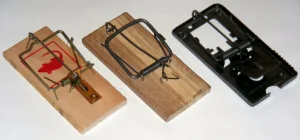
Snap traps are widely considered a faster and more humane choice, since they’re designed to kill quickly.
Electronic traps use a quick, high-voltage shock and are marketed as another humane alternative, often preferred by people who’d rather avoid a snap trap’s mechanism.
Exclusion work, meaning sealing cracks, gaps, and holes around your home, remains one of the most effective long-term solutions.
Live-catch traps are also an option for anyone who’d rather release the animal outside instead of killing it. These just take more effort to actually relocate the mouse afterward.
Will the US or Canada Ban Glue Traps Nationwide Soon?
It’s hard to say for sure, but the pattern so far gives a pretty good hint at where things are heading.
Every country that’s banned glue traps started the same way Canada and the US are right now: with local pressure, city-level bans, and public petitions, long before any national law got passed.
England, Ireland, and New Zealand all went through years of advocacy work before a real law showed up. Wales and Scotland followed only after seeing how those earlier bans played out.
Five California cities have already banned glue traps locally. California’s own statewide bill is also further along than any other US state’s.
Given that, it’s reasonable to think California could end up being the first US state to actually pass one.
Canada’s path looks similar, with British Columbia playing the same role California is playing in the US. It’s the region furthest along, even without anything formally signed into law yet.
None of this guarantees a nationwide ban is coming soon. But the direction of travel, in both countries, points toward more restriction over time, not less.
Conclusion
Whether glue traps, glue boards, or sticky traps are illegal for catching mice really comes down to where you live. In the US and Canada, they’re still legal nationwide, even though bills and petitions calling for a ban keep gaining ground.
A handful of California cities have already banned them locally, and states like California and New Hampshire have bills in progress that could eventually make a statewide ban a reality.
Outside North America, the legal picture looks very different. England, Wales, Scotland, Ireland, Iceland, and New Zealand have all restricted or fully banned glue traps, and parts of Australia regulate them too.
Given how much momentum is building globally, it’s worth keeping an eye on your local laws. This is clearly an area where the rules are shifting quickly, even if glue traps remain legal to buy in most of the US and Canada right now.

Hi, my name is Ezra Mushala, i have been interested animals all my life. I am the main author and editor here at snakeinformer.com.