
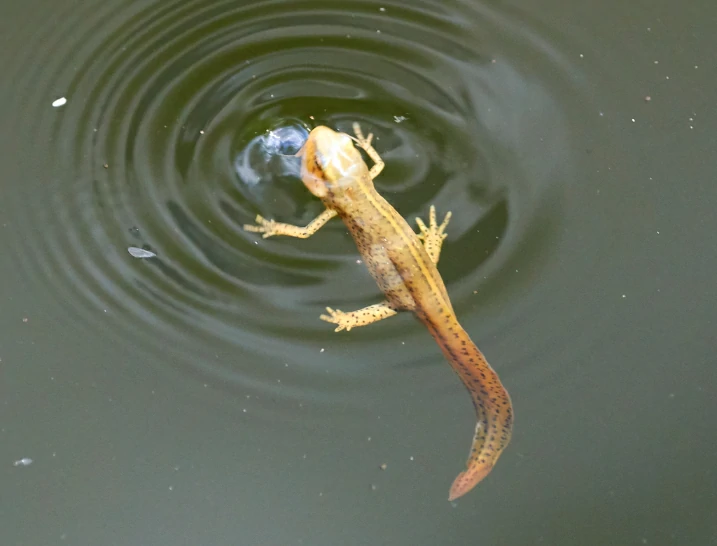
You’re walking along a damp trail after a rainstorm when something small moves near the edge of the path. At first glance it looks like a tiny frog. It’s about the right size, it’s moist and shiny, and it clearly belongs to that mysterious group of animals that love ponds and wet places.
But when you look closer, something feels a little different.
Instead of strong jumping legs and a round frog-like body, this little creature has a long tail and walks slowly across the ground. It doesn’t hop away. It just keeps crawling along.
That’s when the question naturally pops up.
Are newts frogs?
No, newts are not frogs. Both animals are amphibians, but newts belong to the salamander group while frogs belong to a completely different amphibian group called anurans. This means they share some similarities, like living near water and having permeable skin, but they are actually quite different animals with different body shapes, behaviors, and life cycles.
Once you understand how amphibians are organized, the difference becomes much clearer. Frogs and newts may look similar at first glance, especially when they are small or sitting near water, but biologically they are about as different as cats and rabbits.
And that’s where the story gets interesting, because these animals have followed very different evolutionary paths while still living in similar environments.
To really understand why people confuse them so often, it important to look at how amphibians are grouped in the first place.
Amphibians Come In Three Main Groups
All frogs and newts belong to the larger animal group known as amphibians. Amphibians are vertebrates that usually begin life in water as larvae and later develop into adults that can live on land.
They are known for their moist skin, their ability to breathe partly through that skin, and their close relationship with freshwater habitats like ponds, streams, marshes, and forest pools.
But amphibians are not just one kind of animal. In fact, scientists divide them into three main groups.
The first group includes frogs and toads. Scientists call this group Anura, which literally means “without a tail.”
The second group includes salamanders and newts. This group is called Caudata or Urodela, which means “tailed amphibians.”
The third group includes caecilians, which are long, worm-like amphibians that live underground and are rarely seen.
Right away you can see the big difference. Frogs lose their tails as adults, while newts keep theirs for their entire lives.
That single feature tells you a lot about how different these animals really are.
Frogs evolved bodies designed for jumping and swimming. Newts evolved bodies designed more for crawling, walking, and slowly exploring wet environments.
Because both animals often live around ponds and wetlands, people sometimes assume they must be closely related. But in reality, their evolutionary paths split a very long time ago.
Why Newts And Frogs Look Similar At First
If newts and frogs are so different, why do people confuse them so often?
The main reason is that amphibians share several very noticeable traits.
Both frogs and newts have moist skin instead of scales. They usually live near water or in damp environments. Many species breed in ponds or wetlands.
They also both go through a fascinating life cycle that begins with aquatic larvae.
When someone sees a small, slippery animal near a pond, their brain often just labels it “frog-like” because frogs are the amphibians most people are familiar with.
But when you look closer, the differences become obvious.
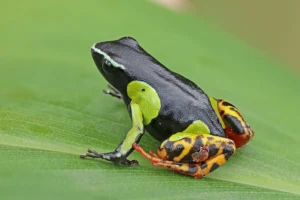
Frogs have short bodies and powerful hind legs built for jumping. Newts have longer bodies with a tail that stays visible throughout their lives.
Frogs usually move in quick bursts of hopping or swimming. Newts tend to walk slowly along the ground or glide through the water.
The body shapes alone tell a very clear story once you know what to look for.
The Body Shape Difference Is Hard To Miss
One of the easiest ways to tell a frog from a newt is simply to look at the body structure.
Frogs have very compact bodies. Their legs are long and muscular, especially the back legs, which are designed for powerful leaps.
Their bodies look almost triangular when viewed from above, and they usually sit in a crouched posture.
Newts look completely different.
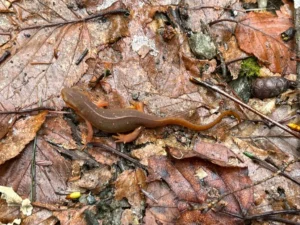
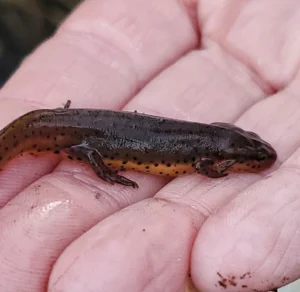
They have long, slender bodies that resemble small lizards. Their legs are shorter and stick out to the sides rather than being tucked underneath.
And most importantly, newts have a clear, obvious tail.
This tail helps them swim through the water in a slow, graceful motion that is very different from the strong kicks used by frogs.
If you ever see a small amphibian slowly walking along a pond bottom with a tail trailing behind it, you are almost certainly looking at a newt or salamander, not a frog.
Frogs Are Built For Jumping
Frogs are among the best jumpers in the animal kingdom relative to their size.
Their back legs are extremely powerful and can launch them many times their body length in a single leap.
This ability helps them escape predators quickly. A frog can sit perfectly still and then suddenly launch away in a split second.
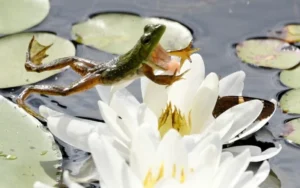
Newts do not have this ability.
Their legs are much smaller and weaker compared to frogs. Instead of jumping, newts usually crawl slowly along the ground or swim gently through water.
They rely more on camouflage and toxins for defense rather than quick escapes.
Because of this, their behavior looks completely different when you watch them in the wild.
Frogs often seem energetic and jumpy. Newts move calmly and slowly, almost like tiny aquatic lizards.
Their Life Cycles Are Similar But Not Identical
Both frogs and newts start life in water as larvae, but their development follows slightly different patterns.
Frog eggs hatch into tadpoles. Tadpoles have tails, gills, and no legs at first.
Over time they develop legs, their tails shrink, and they transform into adult frogs.
Newts also begin life as aquatic larvae with gills. But instead of becoming tail-less adults like frogs, they grow into juvenile salamanders that still keep their tails.
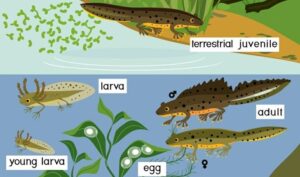
Many newts go through an interesting stage called the eft stage, especially in species like the eastern newt.
During this stage the young newt leaves the water and lives on land for a period of time before eventually returning to the water as an adult.
This multi-stage life cycle is quite different from what frogs experience.
Frogs usually go from tadpole directly to frog without the extended land stage seen in some newts.
Newts Are Actually A Type Of Salamander
Another thing that surprises many people is that newts are not a completely separate group of animals.
They are actually a specific type of salamander.
Salamanders include many species with long bodies and tails, ranging from tiny woodland species to giant salamanders that can grow over five feet long.

Newts represent a smaller subgroup within that larger salamander family.
What makes newts unique is that they typically spend part of their life on land and part in water, often returning to ponds during the breeding season.
Because of this lifestyle, they often live in the same habitats as frogs.
This shared habitat is another reason people mix them up.
If you look closely at the animals themselves though, the salamander features become very obvious.
Where Newts And Frogs Usually Live
Both animals are strongly tied to water, but they use their environments a little differently.
Frogs often stay very close to ponds, lakes, marshes, and streams because they rely heavily on water for breeding.
Their eggs are laid in large jelly-like clusters directly in water.
Newts also breed in ponds and wetlands, but many species spend long periods living on land in forests or damp grasslands.
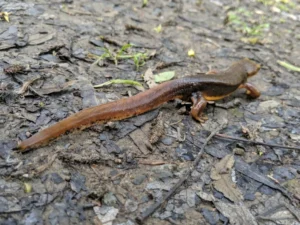
They hide under logs, stones, and leaf litter where the soil stays moist.
During the breeding season they return to water, where males often develop special features like crests or brighter colors to attract females.
Because both animals move back and forth between land and water, their habitats overlap quite a bit.
That overlap is another reason people sometimes assume they must be the same kind of animal.
Frogs And Newts Eat Similar Foods
Even though they are different animals, frogs and newts often eat similar prey.
Both are carnivores that feed mostly on small invertebrates.
Typical meals include insects, worms, slugs, snails, and small aquatic animals.
Frogs usually catch food with a quick flick of their sticky tongues. They can grab insects in a fraction of a second.
Newts hunt differently.
Instead of snapping insects out of the air, they usually stalk small prey in the water or along the ground.
Their movements are slower and more deliberate.
The result is similar though. Both animals play important roles in controlling insect populations in wetlands and forests.
Why Scientists Classify Them Separately
Scientific classification exists to group animals based on shared ancestry and physical characteristics.
When scientists examine frogs and newts, they find many fundamental differences in anatomy, reproduction, and evolution.
For example, frog skeletons are highly specialized for jumping. Their spine and pelvis are built to absorb the force of powerful leaps.
Newts have skeletons designed for walking and swimming rather than jumping.
Their ribs, vertebrae, and body proportions look more like those of other salamanders.
Genetic studies also show that frogs and salamanders diverged from a common ancestor hundreds of millions of years ago.
That means the last time their evolutionary paths overlapped was incredibly far back in Earth’s history.
Today they represent two distinct branches of amphibian evolution.
Some People Confuse Newts With Tadpoles Too
Another common misunderstanding happens when people see tadpoles in ponds.
Tadpoles have long tails, so some people assume they must grow into newts or salamanders.

In reality, most tadpoles grow into frogs or toads.
As they mature, their tails shrink and disappear.
Newt larvae look different from tadpoles in several ways, especially because they often have visible external gills early in development.
Those gills look like feathery structures sticking out from the sides of the head.
Tadpoles usually do not show those same features.
So even at the larval stage, frogs and newts are already following different developmental paths.
Both Animals Play Important Roles In Ecosystems
Despite their differences, frogs and newts both play very important roles in nature.
They help control insect populations, which can affect everything from agriculture to disease transmission.
They also serve as food for many larger animals such as birds, snakes, fish, and mammals.
Because amphibians have sensitive skin that absorbs chemicals easily, they are often considered environmental indicators.
When amphibian populations decline, it can signal that something in the ecosystem is changing or becoming polluted.
For that reason, scientists often monitor frogs and newts when studying the health of wetlands and forests.
Their presence tells us a lot about the condition of the environment around them.
Conclusion
Newts and frogs may seem similar at first glance, especially when you spot them near ponds or damp forest trails. They both belong to the amphibian family and share traits like moist skin, aquatic larvae, and a strong connection to water.
But they are actually very different animals.
Frogs belong to the amphibian group called Anura, which includes all frogs and toads. These animals lose their tails as adults and are built for powerful jumping and swimming.
Newts belong to the salamander group known as Caudata, which includes tailed amphibians that move by walking and swimming rather than hopping.
Once you know what to look for, the difference becomes obvious. Frogs have short bodies, strong back legs, and no tail. Newts have long bodies, smaller legs, and a tail that stays with them for life.
So the next time you see a small amphibian near a pond, take a closer look.
If it hops away in a powerful jump, you are probably looking at a frog.
If it slowly crawls along with a tail trailing behind it, you have most likely found a newt.

Hi, my name is Ezra Mushala, i have been interested animals all my life. I am the main author and editor here at snakeinformer.com.