

When you see a snake swallowing a mouse whole, you find yourself wondering: what happens to all the bones? Do they get digested along with the flesh, or do they get pooped out?
Snakes will sometimes pass tiny bone pieces in their poop. However, most times, their powerful digestive acids and enzymes dissolve and digest bones completely.
This is especially true for smaller, more delicate bones, such as those of rodents, birds, and frogs.
The only parts from the prey that snakes can not digest at all are fur, feathers, claws, beaks, and scales, which get pooped out intact.
Snakes Swallow Prey Whole (including Bones)
Unlike most mammals, snakes do not chew their food. They actually can’t chew even if they wanted to, because they don’t have the right teeth and jaw structure to chew.
Instead, they swallow the prey whole, bones, hair, and all.
When swallowing prey, they almost always start with the head, because it makes the food go down smoother.
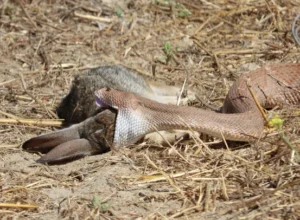
It also keeps the snake from getting hurt by the claws or other sharp parts of prey.
How do snakes manage to swallow prey that is larger than their heads? Well, the secret is their special jaws that enable them to open their mouths really wide.
Unlike humans, a snake’s jaw isn’t fixed. It has stretchy bands that enable the upper and lower jaw to move separately.
This allows the snake to open its mouth really wide, up to 150° or more!
Also, their skin stretches, and their skull bones aren’t tightly joined. This enables them to swallow objects much bigger than their heads, sometimes even bigger than their body diameter.
What Kind of Animals Do Snakes Eat?
Snakes eat different prey depending on their species, size, and environment.
Some snakes such as the tentacled snake (Erpeton tentaculatum) have a diet consisting almost entirely of fish.
Others such as the common egg eater (Dasypeltis scabra) feed exclusively on birds’ eggs.
Many other snake species (for example, Cottonmouths Agkistrodon piscivorus ) do not have specialized diets and will eat almost any prey they can catch, overpower, and swallow whole.
Snakes generally eat:
- Small mammals, e.g., mice, rats, rabbits, or small deer
- Birds (from chicks to adult birds)
- Amphibians, including frogs, toads, salamanders, and tadpoles
- Reptiles, including lizards and, in some cases, other snakes
- Fish, especially aquatic or semi-aquatic snakes
Snakes Usually Digest All the Bones of the Prey They Eat
Most of the prey snakes eat have bones. For example, rabbits have a fully developed spine, skull, and limb bones, and birds have hollow, lightweight bones.
However, snake’s bodies have a way of dealing with the bones: they have a very good digestive system and strong stomach acids.
Once the prey is swallowed and makes its way through the digestive tract, the bones do not stay intact for long.
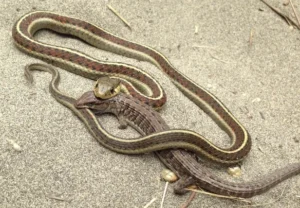
The snake’s stomach and intestines break them down using highly acidic gastric fluids and proteolytic enzymes.
Over a few days to weeks (deepening on the snake species, and prey size), the bones dissolve.
The minerals and calcium dissolved in the bones do not go to waste.
Snakes absorb these minerals and use them to make their own bones stronger, and their bodies healthier.
Things like fur, feathers, claws, and scales can’t be digested, and are pooped out later fairly intact.
If you ever take time to “dissect” the feces of a snake, you may find feathers and other undigested materials.
Sometimes, Snakes Poop Out Tiny Pieces of Bones
Even though snakes have good digestive systems, they do not always digest bones completely.
How well a snake digests bones depends on a few things:
- Size and type of the prey – Large prey with tough bones (such as rabbits) is more difficult to digest than smaller prey with soft bones (such as birds or mice).
- Species of the snake – Large, heavy snakes (such as pythons and boas) tend to digest bones more efficiently than small snakes (such as garter snakes)
- Temperature – Snakes are cold-blooded animals, so they can digest faster in warmer temperatures, and slower in colder temperatures
- Digestion Time – It can take days or weeks for a snake to fully digest food. The longer it takes, the more complete the digestion.
If digestion is interrupted (for example, due to sudden cold weather) the snake may not process every part of the prey fully.
When this happens, the snake might throw up (regurgitate) its food, or it may pass tiny fragments of undigested parts (including bones) in its poop.
How Long Does It Take for Snakes to Take to Fully Digest a Meal?
Snakes take different amounts of time to completely digest their food.
This can depend on :
- The species of snake
- The size of the prey
- How warm the temperature is
- The health of the snake
For example, a garter snake that eats a mouse will digest it in 2-4 days.
A large python, on the other hand, that eats a rabbit or goat will take 1-2 weeks or more to fully digest it.
While it digests, the snake doesn’t move around much. Sometimes, it will bask in sunlight to speed up digestion.
Once the snake has digested all the food, it will poop. Then it may not eat for several days, weeks, or even months, depending on the species of snake.
Conclusion
Snakes are interesting creatures. They have unique bodies to allow them to take all the nutrients from their food.
They never waste anything with nutrients, not even bones!
So, do snakes poop out bones? Usually no. They have extremely powerful acids in their digestive system that break down the bones.
The only things that come out as poop are what they cannot digest, such as fur or feathers.
Featured image credit: Ricard Busquets Reverte (CC BY 4.0)

Hi, my name is Ezra Mushala, i have been interested animals all my life. I am the main author and editor here at snakeinformer.com.