
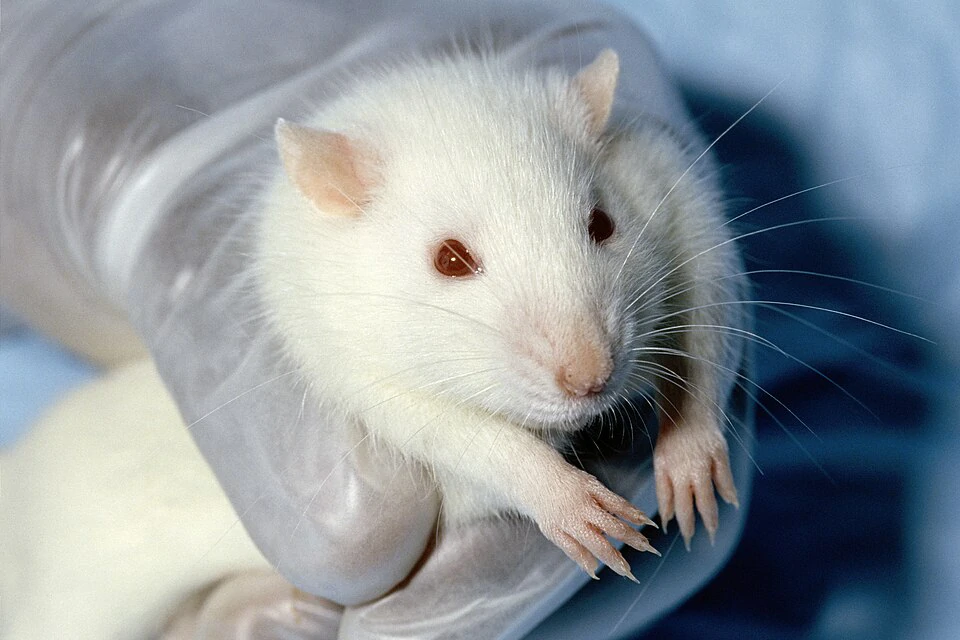
If you’ve ever looked at a rat up close, one of the first things you probably noticed is their teeth. Rats have two very large, very visible front teeth on the top and two more on the bottom.
These incisors are impossible to miss, they stick out prominently and often have a yellowish-orange color that makes them even more noticeable.
These teeth look almost comically large compared to the rat’s small face, but they’re actually incredibly important tools that rats use every single day. So why do rats have two large incisors?
Rats have two large incisors on the top and bottom of their mouths because they’re rodents, and these specialized teeth are built for gnawing through tough materials. The incisors never stop growing throughout the rat’s entire life, which allows them to constantly chew and gnaw without wearing their teeth down to useless nubs.
These continuously growing teeth are one of the defining features of all rodents (the word “rodent” actually comes from the Latin word “rodere,” which means “to gnaw”).
Without these special incisors, rats couldn’t survive in the wild or even as pets.
What Makes Rat Incisors Special
Rat incisors aren’t like human teeth at all. They’re designed completely differently and serve a totally different purpose.
Human teeth are meant for biting and chewing a variety of foods, but they don’t need to handle really tough materials. Rat teeth, on the other hand, are built for serious work.
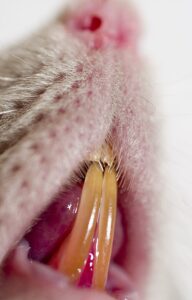
The front surface of a rat’s incisors is covered with incredibly hard enamel, while the back surface has much softer dentine. This creates a natural self-sharpening system.
When rats gnaw on things, the softer back part wears down faster than the hard front part. This keeps the teeth sharp all the time, like a chisel that sharpens itself with use.
The incisors are also curved, which helps them work more efficiently when gnawing. The curve allows rats to apply more pressure and leverage when they’re chewing through something tough.
Think of it like using a curved knife versus a straight one, the curve gives you better cutting power.
These teeth can actually grow four to five inches per year if left unchecked. That’s around 0.01 inches per day. This sounds small, but it adds up incredibly fast.
If a rat couldn’t wear down its teeth through constant gnawing, the teeth would grow so long within weeks that the rat couldn’t close its mouth or eat properly.
Why the Teeth Keep Growing Forever
The reason rat teeth never stop growing goes back to their lifestyle and diet. In the wild, rats gnaw on incredibly tough materials every single day.
They chew through wood, bark, nuts with hard shells, tough plant stems, and even concrete or soft metals when they need to get somewhere.
All this gnawing wears down their teeth constantly. If rat teeth stopped growing after reaching a certain length (like human teeth do), they’d eventually wear down to nothing and the rat would starve to death. The continuously growing teeth solve this problem perfectly.
The growth happens from the root of the tooth, which stays open throughout the rat’s life. In human teeth, the root eventually closes and the tooth stops growing.
In rat teeth, the root never closes, so new tooth material keeps being produced constantly.
This system works great as long as the rat has things to gnaw on. The tooth growth and tooth wear balance each other out, keeping the teeth at a perfect length. Problems only happen when something throws off this balance.
How Rats Use Their Incisors Every Day
Rats use their large incisors for almost everything they do. The most obvious use is eating.
Rats can crack open nuts and seeds that would be impossible for animals without these specialized teeth. They can strip bark from trees, tear into tough roots, and process hard grains and seeds.
But eating isn’t the only thing rats use their teeth for. They also use them as tools for building and moving things. Rats will gnaw wood into smaller pieces to build nests.

They’ll chew through obstacles to create pathways. They’ll even use their teeth to carry things that are too big to carry in their paws.
Wild rats use their incisors to dig burrows and create tunnel systems. While they mainly dig with their paws, they’ll use their teeth to cut through tough roots or move rocks that are in the way.
Pet rats still have this instinct and will often rearrange their cage setup using their teeth to move things around.
Rats also use their incisors for grooming. They’ll nibble gently on themselves and their cage mates to clean fur and remove debris.
This is different from the hard gnawing they do on food or objects, it’s a much gentler behavior.
Why the Teeth Are Yellow-Orange
If you look at healthy rat incisors, you’ll notice they’re not white like human teeth. They’re usually a yellowish-orange color, with the color being strongest on the front surface. This isn’t dirt or staining, it’s actually a sign of healthy teeth.
The orange color comes from iron deposits in the enamel. The iron actually makes the teeth stronger and helps them resist wear.
Teeth with more iron are harder and more durable than teeth without it. This is why the front surface (which does most of the work) has more iron and is more orange than the back surface.
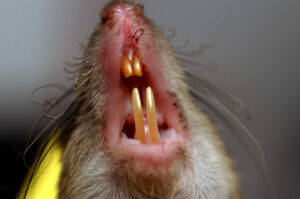
White incisors on a rat are actually a bad sign. If a rat’s incisors look white or very pale, it usually means the teeth aren’t getting enough iron or aren’t developing properly. This can happen with poor nutrition or certain health problems.
The intensity of the orange color can vary between individual rats. Some rats have bright orange teeth, while others have paler yellow teeth. Both are normal as long as the teeth aren’t white or discolored in unusual ways.
What Happens When the Teeth Don’t Wear Down Properly
Sometimes the balance between tooth growth and tooth wear gets messed up. This is called malocclusion, and it’s a serious problem.
When the teeth don’t line up right, they don’t wear down evenly. This can cause them to grow too long or grow at weird angles.
Overgrown incisors can curve backward into the rat’s mouth, sometimes even growing into the roof of the mouth or the opposite jaw.
This is incredibly painful and makes it impossible for the rat to eat. Without treatment, the rat will starve even with food right in front of it.
Malocclusion can be genetic (some rats are just born with teeth that don’t line up right), or it can be caused by injury.
If a rat breaks one of its incisors or damages the root through trauma, the tooth might grow back wrong. Lack of proper chewing materials can also sometimes contribute to the problem.
Treatment for overgrown teeth involves trimming them back to the proper length. A vet needs to do this because if it’s done wrong, the tooth can split or the root can be damaged.
Some rats with chronic malocclusion need their teeth trimmed every few weeks for their entire lives.
Why Rats Need to Gnaw Constantly
The need to gnaw isn’t optional for rats, it’s a biological necessity. Without regular gnawing, their teeth will overgrow and cause serious problems.
This is why rats in the wild gnaw on everything they can find, and why pet rats need to be provided with safe things to chew on.
Pet rats that don’t have enough gnawing opportunities can develop behavior problems. They might start chewing on cage bars (which can damage their teeth), become anxious or stressed, or even become aggressive.
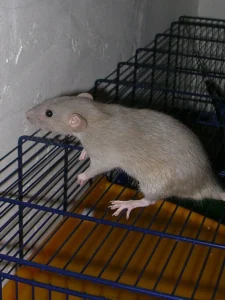
The urge to gnaw is so strong that rats will find something to chew on even if you don’t provide appropriate options.
This is also why rats can be so destructive. If given the chance, they’ll chew on furniture, baseboards, books, electrical cords, and basically anything else they can reach. It’s not that they’re trying to be bad, they’re just doing what their biology tells them they need to do.
In the wild, rats don’t have to worry about finding things to gnaw on. There’s always wood, bark, roots, nuts, and other natural materials available.
Pet rats need their owners to provide appropriate substitutes.
The Best Things for Rats to Gnaw On
Pet rat owners need to make sure their rats have plenty of safe things to chew on. Wood blocks made from safe woods (like apple, pear, or willow) work great. Avoid cedar and pine because the oils in these woods can cause respiratory problems.
Cardboard is another excellent chewing material. Rats love to shred cardboard boxes, paper towel tubes, and egg cartons. It’s free, safe, and easy to replace. The mess can be annoying, but it’s worth it for keeping the rat’s teeth healthy.
Hard dog biscuits or specially made rodent chews from pet stores also work well. Some rats like mineral blocks or lava ledges, though not all rats will use these. Nuts in shells are great because they provide both nutrition and a good gnawing workout.
Some rats also like to gnaw on hard pasta, though this should be an occasional treat rather than a main chewing material. Whimzees dog chews are also popular with rats and are safe as long as the rat doesn’t eat large amounts.
You should rotate different types of chewing materials to keep things interesting.
Rats can get bored with the same toy over and over, so having variety helps keep them engaged and ensures they’re actually using the chewing materials instead of ignoring them.
How Incisors Compare to Other Rodent Teeth
All rodents have similar continuously growing incisors, but there are some differences between species.
Rats have relatively large incisors compared to mice, but smaller incisors compared to beavers or capybaras. The size generally relates to what the animal needs to gnaw through.
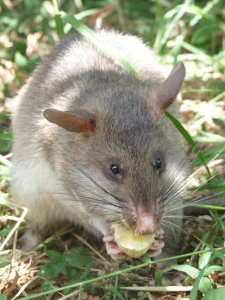
Beavers, for example, have absolutely massive incisors because they need to chew through large trees. Their teeth can grow even faster than rat teeth because they’re doing more extreme gnawing work.
Mice have smaller, more delicate incisors because they generally gnaw on smaller, softer materials.
The orange color is common in many rodents but not all. Beavers have famously orange teeth. Squirrels and chipmunks also have somewhat orange incisors, though usually not as bright as rats.
Some rodents, like guinea pigs, have whiter teeth.
The self-sharpening mechanism is the same across all rodents though. That hard enamel on the front and soft dentine on the back creates the chisel edge in every rodent species.
It’s a brilliant evolutionary solution to the problem of teeth wearing down.
The Evolution of Rodent Incisors
Rodents evolved these specialized teeth millions of years ago, and it’s one of the main reasons rodents have been so successful as a group of animals.
The ability to gnaw through tough materials opened up food sources that other animals couldn’t access easily.
Seeds and nuts with hard shells, tough roots and tubers, woody plants, all of these became available to animals with the right teeth.
This gave rodents a huge advantage and allowed them to spread into almost every environment on Earth.
The earliest rodents appeared around 60 million years ago, not long after the dinosaurs went extinct.
Their specialized gnawing teeth probably developed fairly early in rodent evolution because it’s such a defining feature of the group.
Today, rodents make up about 40% of all mammal species. There are over 2,000 different species of rodents, from tiny mice to capybaras the size of large dogs.
Every single one of them has these continuously growing incisors.
Why the Top and Bottom Teeth Work Together
The two top incisors and two bottom incisors work as a matched set. When a rat gnaws, the top and bottom teeth slide against each other, which helps keep them both sharp and at the right length.
It’s like having two sharpening stones that sharpen each other through use.

If one tooth is missing or damaged, it can cause problems for the opposing tooth. Without something to gnaw against, the unopposed tooth can overgrow quickly.
This is why even a single broken incisor can turn into a serious problem requiring ongoing vet care.
The jaw muscles that power these teeth are incredibly strong for the rat’s size. Rats can generate significant biting pressure relative to their body weight.
This is necessary because gnawing through wood or hard nuts takes real force.
Behind the incisors, rats have a gap called the diastema where there are no teeth at all. Further back are molars for grinding food after the incisors have cut it into manageable pieces.
But the molars are much smaller and less visible than the dramatic incisors.
Signs Your Pet Rat Has Tooth Problems
Pet rat owners need to watch for signs of tooth problems. Drooling is a major red flag. Rats don’t normally drool, so if you see wetness around your rat’s mouth or wet fur on the chest, something is wrong. Often it’s a tooth problem.
Weight loss or refusal to eat hard foods can also indicate tooth trouble. If your rat is only eating soft foods and ignoring the hard pellets or treats it used to love, check the teeth.
Pawing at the mouth or grinding teeth excessively (different from the normal happy bruxing sound) can also signal pain or discomfort.
Visible problems include teeth that look too long, teeth growing at wrong angles, or teeth that have broken off. Sometimes you’ll see sores or cuts inside the mouth from teeth poking into soft tissue. Any of these require an immediate vet visit.
Regular tooth checks should be part of your rat care routine. Once a week or so, gently check your rat’s incisors to make sure they look normal.
They should be roughly the same length on top and bottom, orange or yellow in color, and slightly curved. If something looks off, get it checked out.
Conclusion
Rats have two large incisors on both the top and bottom of their mouths because these specialized teeth are perfectly designed for a life of gnawing.
The teeth grow continuously throughout the rat’s life, which lets them chew through tough materials without wearing their teeth down to nothing.
This system of continuous growth balanced by constant wear has made rodents incredibly successful animals.
The orange color comes from iron in the enamel, which makes the teeth stronger. The curved shape and hard front surface with softer back surface creates a self-sharpening chisel that stays sharp with use.
These teeth aren’t just for eating, they’re tools that rats use for building, digging, carrying, and changing their environment.
For pet rats, these continuously growing teeth mean owners need to provide plenty of safe things to gnaw on. Without proper gnawing materials, rats can develop serious dental problems that require veterinary care.
Understanding why rats have these impressive teeth helps you take better care of them and appreciate just how well-adapted these animals are to their gnawing lifestyle.

Hi, my name is Ezra Mushala, i have been interested animals all my life. I am the main author and editor here at snakeinformer.com.