

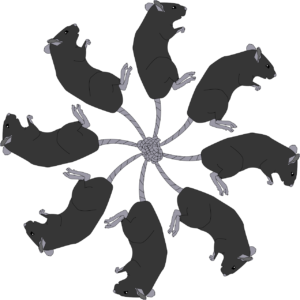
One of the strangest and most disturbing images you can find of rats is what’s called a “rat king.” Multiple rats literally stuck together by their tails, creating a writhing mass of bodies that can’t separate.
It looks like something out of a horror movie. Historical accounts describe finding these tangled groups of rats, sometimes still alive, unable to escape their bizarre prison.
This raises uncomfortable questions about how such a thing could even happen. Why do rats tails get tangled, and do rats actually tie their tails together on purpose?
Rats’ tails get tangled when multiple young rats nest together in cramped, cold conditions with sticky substances (like tree sap, ice, blood, or feces) present that freeze or glue their tails together, then the rats’ movements pull the tails into tight, impossible-to-untangle knots as they struggle to separate.
The idea that rats deliberately tie their tails together is a myth. It happens by accident under specific conditions, and it’s actually rare despite how much attention the phenomenon gets.
What Is a Rat King?
Before diving into how tails get tangled, it helps to understand what people mean when they talk about rats with tangled tails. The term “rat king” comes from European folklore.
A rat king consists of multiple rats (usually 3 to 50) whose tails have become knotted together in a mass. The rats themselves remain alive but connected, unable to separate from each other.

Historical records mention rat kings going back to the 1500s. Museums in Europe have preserved specimens that were found centuries ago. These aren’t just stories, actual physical evidence exists.
The rats in a rat king aren’t always all alive when discovered. Sometimes some are dead while others are still living. Sometimes they’re all dead by the time humans find them. Rarely, all are still alive.
Most documented rat kings involve young rats, not adults. This detail matters for understanding how it happens. Adult rats with fully developed coordination and strength can usually avoid or escape situations that trap younger rats.
The term “rat king” itself comes from the idea that the tangled group looks like a crown when viewed from above. European folklore suggested these were bad omens or supernatural occurrences.
Do Rats Actually Tie Their Tails Together on Purpose?
Let’s kill this myth right away. Rats don’t deliberately tie their tails together. This idea doesn’t make any biological sense.
Rats have no reason to tie themselves together. It doesn’t help them survive, reproduce, or accomplish any useful goal. Evolution doesn’t create behaviors that trap and starve animals.
Rats are social, but not suicidal. While rats do live in groups and cooperate, they also value their individual mobility and freedom. Being permanently stuck to other rats would be a death sentence.
The mechanics don’t work. A rat can’t use its tail to tie knots the way humans use hands to tie rope. Tails don’t have that kind of dexterity or control. They can wrap around things, but deliberate knot-tying is impossible.
When rat kings are studied, the tails show damage consistent with the rats trying to pull free. If they’d tied themselves on purpose, there wouldn’t be evidence of struggle and injury from escape attempts.
What Conditions Lead to Tangled Tails?
For rat tails to become tangled, several specific conditions need to line up. It’s not random and it doesn’t happen often.
Cold weather is almost always involved. When rats are cold, they huddle together for warmth. Multiple young rats pressed tightly together creates the opportunity for tails to overlap and intertwine.
A sticky substance must be present. Just touching isn’t enough. Something needs to glue or freeze the tails together initially. Common substances include tree sap, blood, ice, urine that freezes, or sticky feces.
Cramped nesting conditions force rats close together. In a spacious nest, rats can position themselves without tails overlapping much. In a tight space, especially with many rats, tails get pressed together.
Young or weak rats can’t escape easily. Healthy adult rats with full strength could probably pull free before things got too tangled. Young rats or sick rats don’t have the strength to separate before the knots tighten.
Time is required for the tangle to become permanent. The initial sticking of tails might be escapable, but as rats move and struggle, the tails wind around each other more tightly until separation becomes impossible without cutting.
How Do Sticky Substances Cause the Tangling?
Understanding the role of sticky materials helps explain how something so weird could happen naturally. It’s all about what glues the tails together initially.
Tree sap is mentioned in several historical accounts. Rats nesting in tree cavities or areas with sap drips can get sap on their tails. When multiple sap-covered tails touch, they stick together.
Frozen urine and feces happen in winter nests. Rats urinate and defecate in their nests (more so when they’re young). In freezing conditions, this waste freezes and can cement tails together if the rats are huddled closely.
Blood from injuries plays a role sometimes. If one rat in a nest is injured and bleeding, blood can get on other rats’ tails. Blood is sticky when fresh and can freeze solid when temperatures drop.
Ice formation in very cold conditions can freeze tails directly to each other. If rats are packed tightly in below-freezing temps, moisture from their breath and bodies can freeze their tails together.
Once the initial bond forms, movement makes it worse. As rats try to pull apart, their tails wrap around each other more. The sticky substance might even spread, involving more tails in the tangle.
Why Does It Happen to Young Rats More Often?
The pattern of rat kings involving mostly young rats isn’t coincidental. Several factors make juveniles more susceptible.
Young rat tails are more flexible and delicate. They bend and twist more easily than adult tails, making them easier to knot. Adult tails are stiffer and stronger, resisting tangling better.
Baby rats huddle together more intensely. They can’t regulate their body temperature as well as adults, so they pack together very tightly for warmth. This creates more opportunities for tail contact.

Young rats have less strength to pull free. An adult rat might be strong enough to break free when tails first stick. A young rat might not be able to generate enough force before the tangle tightens.
Juvenile rats are less coordinated. They don’t position themselves as carefully as adults do. They’re more likely to end up in awkward positions with tails overlapping without realizing it.
Young rats in the same litter all have similar-sized tails that can knot together more easily. Adult rats of different sizes might have tail-size mismatches that prevent tangling as effectively.
Are Rat Kings Real or Just Folklore?
Given how weird the concept is, skepticism makes sense. But the evidence that rat kings actually exist is pretty solid.
Museum specimens prove they’re real. You can go to museums in Germany, the Netherlands, and other European countries and see preserved rat kings. These are physical objects, not just stories.
Scientific examination of specimens confirms they’re genuine. The tails are actually knotted together, not faked with glue or string. The knots show patterns consistent with animals struggling to separate.
Modern cases still occur occasionally. People find rat kings in barns, abandoned buildings, and other locations even today. These get documented with photos and sometimes the rats are taken to wildlife centers.
The rarity makes some people doubt them, but rarity doesn’t equal impossibility. The specific conditions needed for a rat king to form don’t happen often, which explains why they’re not found all the time.
Scientific papers have been written about rat kings. Researchers have studied the specimens, the conditions that create them, and the mechanics of how tails can become so thoroughly tangled.
How Many Rats Are Usually in a Rat King?
The size of rat kings varies a lot, and the numbers tell us something about how they form and how sustainable they are.
Small rat kings of 3 to 6 rats are most common when found alive. This size allows the group to move somewhat and potentially find food, even while connected.
The largest documented rat king contained 32 rats. This specimen from Germany in 1828 is preserved and can still be seen. It’s hard to imagine how 32 rats could become so tangled.
Most documented cases involve between 6 and 20 rats. This seems to be the range where conditions can create enough tangling to trap the rats but not so many that other factors prevent it.
Rat kings with all live rats are usually smaller. Groups larger than about 10 rats rarely survive long enough to be found alive. The logistics of moving, eating, and surviving while connected become impossible with too many rats.
Dead rat kings can be larger because the size doesn’t matter once they’ve died. The knot can keep tightening even after death as bodies dry and shift.
Can Rats Survive Long-Term in a Rat King?
The grim reality is that being in a rat king is basically a death sentence for the rats involved. They might survive briefly, but long-term survival is nearly impossible.
Movement becomes extremely limited. The rats can’t separate to find food. If food isn’t immediately accessible where they’re tangled, they’ll starve. Even if food is close, eating while connected is difficult.
Predators become a bigger threat. A tangled group of rats can’t escape from cats, dogs, or other predators. They’re essentially trapped and helpless.
Stress from the situation weakens the rats. Being stuck is terrifying for animals that depend on mobility for survival. Chronic stress suppresses immune systems and hastens death.
Injuries from struggling to escape cause problems. Rats pull and twist trying to get free, injuring their tails and each other. These injuries can become infected, especially since the rats can’t properly groom themselves.
If discovered by humans, the rats might be separated or euthanized. Wildlife rehabilitators occasionally receive rat kings and attempt to separate them, but the tails are often damaged beyond recovery.
Why Are There More Historical Rat Kings Than Modern Ones?
Most documented rat kings come from the past, especially from Europe in the 1600s to 1800s. Modern cases are much rarer, and there are reasons for this.
Living conditions have changed. Rats today, even wild rats, often have access to warmer spaces. Heated buildings, sewer systems, and urban infrastructure provide warmth that reduces the intense huddling that leads to tangling.
Rat populations are managed differently. Modern pest control means fewer rats reaching the population densities where rat kings might form. Fewer rats overall means fewer opportunities for this rare event.
We find rat kings less often because buildings are cleaner and accessed more regularly. In the past, barns and storage areas might go undisturbed for long periods. Today, spaces where rats nest are cleaned and inspected more frequently.
Better documentation might make old cases seem more common. In the past, a rat king was unusual enough to report and preserve. Today, someone finding one might just dispose of it without documenting it formally.
Climate change could play a role. Milder winters in many areas mean less extreme cold, which means less freezing of sticky substances that cement tails together.
Do Other Animals Get Their Tails Tangled?
Rats aren’t the only animals this happens to, though they’re the most famous for it. Looking at other species helps understand the phenomenon.
Squirrel kings have been documented. The same basic conditions (cold, sticky substances, multiple young animals huddled together) can affect squirrels. Several cases exist in museum collections and modern photos.

Mice can theoretically form mouse kings, but it’s documented less often. Mice are smaller, so the same principle applies, but perhaps the smaller size makes it less likely or less noticeable.
Other long-tailed animals might experience this, but documentation is scarce. Anything with a long, thin tail that huddles in groups could potentially tangle under the right conditions.
The common factor is always social species with long tails that nest together in cold conditions. Solitary animals wouldn’t end up tangled because they don’t huddle with others.
What Happens to Tails in a Rat King?
The damage to the tails in a rat king is severe and provides evidence about how the tangling happens and how rats respond.
Circulation gets cut off by tight knots. Tails wrapped tightly around each other stop blood flow. The tail tissue beyond the knot can die from lack of blood, turning black and eventually falling off.
Abrasion and wounds appear from struggling. As rats pull against the knots, their tails get rubbed raw. Skin breaks down, fur comes off, and open wounds develop. These wounds can become infected.
Broken bones occur in severe cases. Rat tail bones are delicate. Extreme pulling or twisting can fracture them. Broken tail bones in rat king specimens show how hard the rats fought to escape.
Necrosis (tissue death) happens when parts of the tail lose blood supply for too long. Dead tissue turns black and starts to decompose even while the rat is alive. This is both painful and dangerous due to infection risk.
If rats are separated by humans or if one rat manages to break free, the tail damage is often permanent. Many rats lose part or all of their tail in the process. This affects balance and temperature regulation but doesn’t kill them immediately.
Can Rat Kings Be Prevented?
In theory, yes, but it would require controlling conditions that are hard to control when dealing with wild rats. For pet rats, prevention is easier.
Providing warm nesting areas for wild rats would reduce huddling intensity. But humans generally don’t want to make wild rats more comfortable, so this isn’t practical from a pest control perspective.
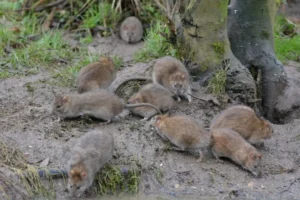
Removing sticky substances from rat environments could help. But you can’t control when rats nest near tree sap or when conditions create frozen waste in their nests.
For pet rats, prevention is straightforward. Keep the cage warm enough that rats don’t need to huddle desperately. Clean regularly to prevent buildup of sticky waste. Provide enough space that tails aren’t forced together.
Multiple rats in captivity should have appropriately sized housing. Cramming too many rats into too small a space increases the chance of any kind of injury or entanglement, even if full rat kings are unlikely in controlled environments.
What Should You Do If You Find a Rat King?
Finding a rat king is incredibly unlikely, but if it happens, knowing how to respond matters for both human safety and animal welfare.
Don’t touch it with bare hands. Rats can carry diseases, and stressed, trapped rats are likely to bite. If any rats in the tangle are alive, they’re desperate and dangerous.
Call animal control or a wildlife rehabilitator. Professionals have the tools and knowledge to handle the situation safely. They can assess whether the rats can be saved or should be humanely euthanized.
Document it if possible. Rat kings are rare enough that photos and videos contribute to scientific understanding. But don’t risk your safety for documentation.
Keep pets and children away. A rat king discovered in a barn or basement needs to be quarantined from other animals and people until professionals arrive.
If all rats are clearly dead, disposal should follow local regulations for dead animals. Many areas have specific rules about disposing of potentially diseased animal remains.
Conclusion
Rats’ tails get tangled when young rats huddle together in cold conditions with sticky substances like sap, ice, or frozen waste present that glue their tails together. As the rats struggle to separate, their movements create tighter and tighter knots until escape becomes impossible without cutting the tails.
This isn’t deliberate behavior. Rats don’t tie their tails together on purpose. It’s an accident that happens when specific environmental conditions align in just the wrong way. The phenomenon is rare, which is why rat kings are more legend than common occurrence.
The idea of a rat king is disturbing because it seems so unnatural. But it’s entirely natural, just extremely uncommon. Understanding how it happens takes away some of the mystery and replaces it with sympathy for animals that ended up trapped through bad luck and harsh conditions.
Modern rat kings are rarer than historical ones due to better living conditions, pest control, and climate changes. But they still happen occasionally, proving that the right combination of cold, crowding, and sticky substances can still create this bizarre phenomenon.

Hi, my name is Ezra Mushala, i have been interested animals all my life. I am the main author and editor here at snakeinformer.com.