

Rats are notorious for their ability to reproduce at alarming rates. This rapid breeding is one of the main reasons they’re such a persistent and difficult pest to control.
If you’ve spotted rats on your property or suspect you might have an infestation, understanding just how fast they can multiply is important. So, how quickly do rats breed?
Rats breed extremely quickly. Female rats can have a litter every 3 weeks, with each litter containing 6 to 12 babies. They reach sexual maturity at just 5 weeks old, which means baby rats can start breeding within weeks of being born.
This explosive reproductive rate means a small rat problem can turn into a massive infestation in just a couple of months.
The speed at which rats multiply is honestly shocking when you break down the numbers, which is why immediate action is so critical when dealing with these pests.
The Rat Breeding Timeline
Understanding the specific timeline of rat reproduction helps you see just how quickly things can spiral out of control.
Female rats (called does) reach sexual maturity at about 5 weeks old. Some females can mature even earlier, around 4 weeks, if they’re well-fed.
Male rats (called bucks) mature slightly later, between 6 and 8 weeks old.

Once a female is sexually mature, she goes into heat (estrus) every 4 to 5 days. During this time, she’s receptive to mating.
If she mates, the pregnancy (gestation) lasts only 21 to 23 days. That’s just over 3 weeks.
After giving birth, the female can go into heat again within 24 to 48 hours. This means she can get pregnant again almost immediately.
This is called postpartum estrus, and it’s one of the key factors that makes rat reproduction so fast.
So the cycle looks like this: mate, pregnant for 3 weeks, give birth, mate again within 2 days, pregnant for another 3 weeks, give birth again.
This cycle can repeat continuously as long as the female has access to food, water, and shelter.
How Many Babies Do Rats Have?
Each litter typically contains 6 to 12 babies (called pups). Some litters can be smaller (4 to 5 pups) or larger (up to 14 or even 16 pups in rare cases).
First-time mothers usually have smaller litters. As females mature and have more litters, the size often increases.

Well-nourished rats with consistent access to high-quality food tend to have larger litters.
The pups are born completely helpless. They’re hairless, blind, and deaf.
But they develop incredibly fast. By 2 weeks old, they have fur and their eyes open. By 3 weeks, they’re weaned and eating solid food.
By 5 weeks old, the female pups can start breeding themselves.
This means the babies from one litter can be having their own babies within just 8 weeks of being born (5 weeks to maturity plus 3 weeks of pregnancy).
How Many Litters Can One Rat Have?
A single female rat can have 5 to 10 litters per year if conditions are ideal.
Let’s use a conservative estimate of 6 litters per year with 8 pups per litter. That’s 48 babies from one female in one year.
But remember, half of those babies will be female. That’s 24 new breeding females.
If each of those females starts breeding at 8 weeks old and has just 2 litters before the year ends, you’re looking at hundreds of rats from just one original breeding pair.

Some estimates suggest that one pair of rats can produce over 1,500 descendants in a single year if all conditions are perfect and all babies survive.
In reality, not all babies survive. Predators, disease, lack of food, and other factors kill some rats.
But even with a lower survival rate (let’s say 50%), you could still end up with hundreds of rats from just one pair within a year.
Week-by-Week Breakdown of Rat Population Growth
Here’s a simplified example of how quickly a rat population can grow, starting with one breeding pair:
Week 0: 1 male, 1 female (2 rats total)
Week 3: Female gives birth to 8 pups (10 rats total)
Week 6: Female gives birth to second litter of 8 pups (18 rats total)
Week 8: First litter reaches sexual maturity (4 females begin breeding)
Week 9: Female gives birth to third litter of 8 pups (26 rats total)
Week 11: First generation females give birth (4 litters of 8 = 32 pups added, 58 rats total)
Week 12: Female gives birth to fourth litter (66 rats total)
By week 12 (just 3 months), you could have over 60 rats from one original pair.

By month 6, you could easily have 200+ rats if conditions remain good and survival rates are reasonable.
This is a simplified model that doesn’t account for all factors, but it shows how quickly exponential growth happens with rats.
What Makes Rats Breed So Fast?
Several biological factors contribute to the rapid breeding rate of rats.
First is the short gestation period. At just 3 weeks, rats have one of the shortest pregnancies among mammals of their size.
Compare this to cats (about 2 months), dogs (about 2 months), or humans (9 months). Rats can complete several breeding cycles in the time it takes these other animals to have one litter.
Second is postpartum estrus. The ability to get pregnant again within 48 hours of giving birth means there’s almost no downtime between litters.
Many animals need weeks or months to recover before breeding again. Rats don’t.
Third is early sexual maturity. Most mammals don’t reach breeding age until they’re at least a few months old.
Rats start breeding at just 5 weeks, which means new generations start reproducing almost immediately.
Fourth is large litter size. Having 6 to 12 babies at once (compared to 1 to 4 for many mammals) means each breeding cycle produces many new potential breeders.
Finally, rats are opportunistic breeders. They don’t have a specific breeding season. They’ll breed year-round if conditions are right.
This is especially true for rats living in human structures where food, water, and shelter are consistently available.
Factors That Speed Up Rat Breeding
Certain conditions can make rats breed even faster than normal.
Abundant food is the biggest factor. Rats that have unlimited access to high-quality food (especially protein-rich food) breed more successfully.

Females come into heat more regularly, have larger litters, and the babies grow faster.
Access to water is also critical. Rats need water daily. Consistent water sources keep the population healthy and breeding.
Shelter and safety matter too. Rats that feel safe from predators and have good nesting sites breed more successfully.
Indoor environments (homes, warehouses, restaurants) provide all these conditions year-round, which is why indoor rat populations can explode so quickly.
Warm temperatures also help. Rats prefer temperatures between 65°F and 80°F. When it’s consistently warm, they don’t waste energy maintaining body heat and can put more energy into reproduction.
This is why rat populations often surge during spring and summer, though indoor rats breed fast regardless of season.
Factors That Slow Down Rat Breeding
On the flip side, certain conditions can slow breeding rates.
Food scarcity is the most effective natural limiting factor. If rats don’t have enough to eat, females won’t come into heat as often, litters will be smaller, and many babies won’t survive.
Lack of water also limits breeding. Without daily access to water, rats become stressed and breeding decreases.
Extreme temperatures can slow reproduction. Very cold or very hot conditions make it harder for baby rats to survive.
Predators naturally control rat populations by killing adults and babies.
Disease can sweep through rat populations and kill many individuals, especially when populations are dense and living conditions are poor.

Stress from overcrowding can also reduce breeding success. If too many rats are competing for limited resources, breeding rates decline.
But here’s the problem: in human environments, most of these limiting factors are absent or minimal.
Rats in homes or buildings usually have plenty of food, water, and shelter. They’re protected from weather and often safe from predators.
This is why infestations can grow so explosively in human structures.
How Inbreeding Affects Rat Populations
You might wonder if rats breeding with close relatives slows down population growth.
Rats will breed with siblings, parents, and other close relatives if they’re the only mates available. This is common in isolated populations.
Inbreeding can lead to genetic problems over time. Inbred rats might have weaker immune systems, deformities, or reduced fertility.
But in the short term, inbreeding doesn’t significantly slow population growth. The rats still breed at the same rapid rate.
It just means the population might be less healthy overall, which could eventually lead to disease problems or reduced survival rates.
In larger rat populations with genetic diversity, inbreeding is less of an issue because rats have access to unrelated mates.
Why Young Rats Breed Immediately
One of the most problematic aspects of rat reproduction is that young females start breeding as soon as they’re physically capable.
There’s no behavioral or social restriction preventing young rats from breeding. As soon as they reach sexual maturity at 5 weeks, they can and will breed.

This is very different from many mammals where young females might not breed until they’re socially mature or until they’ve established territory.
Rats don’t have these restrictions. If a young female goes into heat and a male is present, she’ll breed.
This means every new generation starts contributing to population growth almost immediately.
It’s like compound interest in finance. Not only is the original female still breeding, but her daughters are breeding, and their daughters are breeding, all at the same time.
This creates the exponential growth that makes rat populations so difficult to control.
How Quickly Can an Infestation Become Serious?
A “serious” infestation usually means dozens or hundreds of rats, significant property damage, and obvious health risks.
Starting from just one breeding pair, you can reach “serious infestation” status in as little as 3 to 4 months.
By month 3, you could have 50+ rats. By month 6, you could have 200+ rats.
At these population levels, you’ll see rats frequently, droppings will be everywhere, gnaw damage will be extensive, and the smell will be noticeable.
The food consumed and damage caused by hundreds of rats is substantial. They’ll contaminate food stores, chew through walls and wires, and create serious health hazards.
This is why early intervention is so critical. If you address the problem when you first notice signs (droppings, noises, seeing one rat), you can prevent it from exploding.
But if you ignore it for even a few weeks, thinking “it’s just one rat,” you could quickly have dozens or more.
Signs Rats Are Breeding in Your Property
If rats are actively breeding on your property, you’ll see certain signs.
Fresh droppings that appear daily indicate an active population. Rat droppings are about 1/2 to 3/4 inch long, dark, and capsule-shaped.
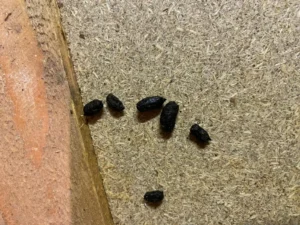
If you see many droppings, especially in multiple locations, you probably have multiple rats.
Hearing squeaking sounds, especially high-pitched squeaks, suggests baby rats. Adult rats are relatively quiet, but babies are very vocal.
Finding nests is a clear sign of breeding. Rats build nests from shredded materials like paper, fabric, or insulation.
If you find a nest with babies in it, breeding is definitely happening.
Seeing multiple rats at different sizes suggests a breeding population with different age groups.
Seeing rats during the day is a bad sign. Rats are nocturnal, so daytime sightings usually mean the population is large enough that some rats are forced out during daylight.
Increased gnaw damage and greasy rub marks along walls show heavy rat traffic, which indicates a growing population.
What to Do If Rats Are Breeding
If you have a breeding rat population, you need to act immediately.
Set traps right away. Snap traps are most effective. Place them along walls where rats travel, near burrows, and anywhere you’ve seen droppings.
Bait with peanut butter and check daily.
Remove food sources. Store all food in sealed containers, keep garbage in bins with tight lids, don’t leave pet food out, and clean up spills immediately.

Eliminate water sources. Fix leaky pipes and faucets, don’t leave water bowls out, and remove any standing water.
Seal entry points. Check your entire property for gaps, cracks, and holes. Rats can squeeze through openings as small as 1/2 inch.
Seal everything with steel wool, caulk, or metal mesh.
Remove nesting sites. Clean up clutter, debris, and dense vegetation. The fewer hiding spots available, the harder it is for rats to breed successfully.
Consider professional help. If the infestation is large or you can’t get it under control, call a pest control company.
They have experience and professional-grade tools to handle serious infestations.
The most important thing is to act fast. Every week you wait, the population grows larger and the problem becomes more difficult and expensive to fix.
Conclusion
Rats breed extremely quickly, with females capable of having a new litter every 3 weeks and up to 10 litters per year.
Each litter contains 6 to 12 babies, and those babies can start breeding themselves at just 5 weeks old.
This means one pair of rats can produce hundreds of descendants within a year if conditions are right.
The key factors that make rat breeding so fast are: short pregnancy (3 weeks), immediate postpartum fertility, early sexual maturity (5 weeks), large litter sizes, and year-round breeding.
If you see signs of rats, act immediately. Set traps, remove food and water sources, seal entry points, and eliminate nesting sites.
The longer you wait, the worse the problem becomes. A few rats can turn into dozens or hundreds within just a few months.
When you address rat problems early and remove the conditions they need to thrive, you can stop their population from exploding and protect your property from infestation.

Hi, my name is Ezra Mushala, i have been interested animals all my life. I am the main author and editor here at snakeinformer.com.