
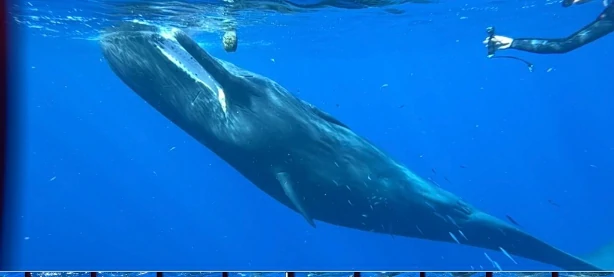
Sperm whales are the largest toothed predators on Earth. They can grow over 60 feet long and weigh up to 45 tons. With teeth that can be 8 inches long and powerful jaws, they look pretty scary. When you hear stories about whales and humans, it’s natural to wonder: do sperm whales eat humans?
No, sperm whales don’t eat humans. There are no confirmed cases of a sperm whale ever eating a person. While they’re massive predators with huge teeth, their diet consists almost entirely of deep-sea squid. Humans aren’t prey for sperm whales, and these animals generally avoid contact with people.
Sperm whales are built to hunt squid in the deep ocean, not to eat large mammals like humans.
Their throats, teeth, and hunting behavior are all adapted for catching slippery, fast-moving squid in total darkness thousands of feet below the surface.
What Sperm Whales Actually Eat
Sperm whales have a pretty specific diet. They eat squid. Lots and lots of squid. In fact, squid makes up about 90% of what a sperm whale eats.
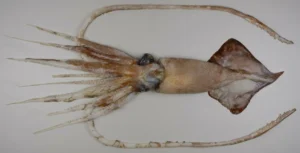
These aren’t your average squid either. Sperm whales hunt deep-sea squid, including giant squid and colossal squid. These creatures can be absolutely massive (some grow over 40 feet long), and they live in the deep ocean where it’s completely dark.
A single sperm whale can eat around 2,000 pounds of squid per day. That’s roughly one ton of food every single day. To get this much food, they spend hours diving deep into the ocean, sometimes going down 3,000 feet or more.
Besides squid, sperm whales occasionally eat deep-sea fish, octopuses, and rays. But squid is definitely their main food source.
Why Sperm Whales Don’t Eat Humans
There are several reasons why sperm whales don’t (and really can’t) eat humans. The first reason is simple: we’re not what they’re built to eat.
Sperm whales have teeth, but they don’t actually use them for chewing. Their teeth are used mainly for gripping slippery squid. In fact, many sperm whales have worn or broken teeth, and some even have no teeth at all, yet they still eat just fine.
This tells us that sperm whales swallow their prey whole. They don’t tear chunks off or chew their food like a shark would. They just grab the squid and swallow it down.
A human body wouldn’t be easy for a sperm whale to swallow whole. We’re the wrong shape, and we’re too big. Even if a sperm whale somehow got a human in its mouth, it would probably just spit the person out.
The Size of a Sperm Whale’s Throat
Here’s something really interesting that people often get wrong. Even though sperm whales have huge mouths, their throats aren’t actually that big.
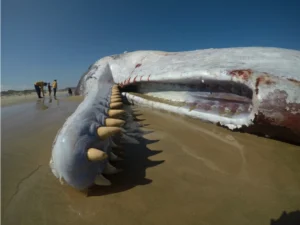
A sperm whale’s throat is only about 4 to 8 inches in diameter. That’s roughly the size of a grapefruit or a small melon. It’s wide enough to swallow large squid (which are pretty flexible and can squeeze through), but not wide enough for a human.
Your body is just too wide and rigid to fit down a sperm whale’s throat. Even a small child would have a hard time fitting through that opening.
This is actually true for most whales. People think whales can swallow huge things because of their massive size, but most of them have relatively small throats compared to their overall body size.
There Are No Confirmed Cases of Sperm Whales Eating People
Scientists and whale experts have been studying sperm whales for hundreds of years. In all that time, there’s never been a single confirmed case of a sperm whale eating a human.
There have been stories and legends, sure. Sailors have told tales of whales swallowing men whole. But when you actually investigate these stories, they always fall apart or turn out to be exaggerations.
The most famous story is probably the biblical tale of Jonah and the whale. But that’s a religious story, not a documented historical event. And even in that story, Jonah was supposedly swallowed alive and survived in the whale’s belly, which just isn’t possible in reality.
In modern times, with cameras, boats, and countless people on the water every day, there’s never been a verified case of a sperm whale attacking or eating a person.
Sperm Whales Generally Avoid Humans
In fact, sperm whales tend to avoid humans when they can. They’re intelligent animals, and they seem to recognize that humans and boats are not part of their normal environment.
When boats approach sperm whales, the whales often dive deep or swim away. They’re not aggressive toward people. They’re not curious about us in a predatory way. They just want to be left alone to do their whale things.
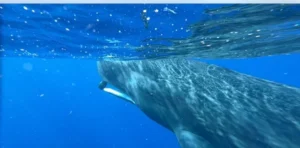
Divers who have encountered sperm whales in the water report that the whales are gentle and keep their distance. There are some amazing videos of divers swimming near sperm whales, and the whales are always calm and careful not to hurt the humans.
This behavior is totally different from how a predator acts around potential prey. If sperm whales saw humans as food, they’d be aggressive and attack us. But they don’t.
Could a Sperm Whale Accidentally Hurt a Human?
While sperm whales don’t eat humans, they could definitely hurt someone by accident. These are absolutely massive animals, and they’re incredibly powerful.
A sperm whale’s tail (called a fluke) is strong enough to stun or kill large squid. If a whale accidentally hit a person with its tail, it could cause serious injury or death.
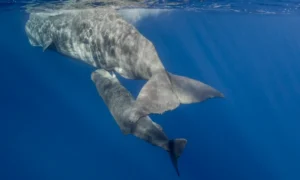
This has happened a few times in history. There are documented cases of sperm whales hitting boats with their tails and causing damage or injuries. But these incidents were always defensive or accidental, never predatory.
In the whaling days (when people hunted sperm whales), angry whales would sometimes attack the boats and crews. The most famous case is the Essex, a whaling ship that was sunk by an angry sperm whale in 1820. This incident inspired the novel “Moby-Dick.”
But even in these cases, the whale was defending itself from humans who were trying to kill it. It wasn’t trying to eat anyone.
The Myth of Being Swallowed by a Whale
The idea of being swallowed by a whale has been part of human storytelling for thousands of years. It’s a powerful image that shows up in religious texts, sailor legends, and even modern movies.
But it’s just a myth. The physical reality is that most whales can’t swallow a human, and the ones with throats big enough (like some baleen whales) don’t have teeth and only eat tiny fish and krill.
There was one famous story from the 1890s about a whaler named James Bartley who supposedly survived being swallowed by a sperm whale. The story claimed he was found alive in the whale’s stomach when the crew killed and butchered the animal.
But historians and scientists have investigated this story thoroughly, and it’s almost certainly false. The details don’t add up, and there’s no reliable evidence it actually happened. It’s probably just an old sailor’s tale that got repeated so many times people started believing it was true.
What Happens If You’re Near a Sperm Whale’s Mouth
If you somehow ended up near a sperm whale’s mouth while diving, the whale would most likely just swim away or move you aside with its body.
Sperm whales have echolocation (like a biological sonar system), so they know exactly where you are. They’re not going to accidentally gulp you down while feeding, because they’re not feeding at the surface where humans swim. They hunt in the deep ocean.
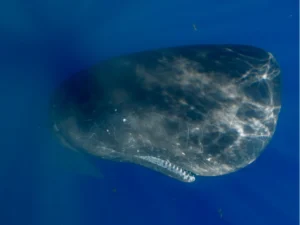
The clicks that sperm whales make for echolocation are actually so loud they can stun or even hurt you if you’re too close. Some divers have reported feeling disoriented or having their chests vibrate from the clicks. This isn’t an attack though. It’s just the whale using its sonar to figure out what you are.
Once the whale realizes you’re not a squid and not a threat, it’ll probably ignore you or move away. You’re just not interesting to a sperm whale.
Other Whales and Humans
What about other species of whales? Do any of them eat humans?
The short answer is no. No whale species eats humans. Here’s why:
Baleen whales (like blue whales, humpbacks, and gray whales) don’t have teeth at all. They have baleen plates that filter tiny organisms from the water. Their throats are too small for large prey, and they only eat small fish, krill, and plankton.
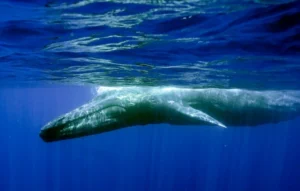
Other toothed whales (like orcas and pilot whales) eat fish, seals, and other marine mammals. But there are no documented cases of wild orcas or other toothed whales eating humans either.
Orcas are sometimes called “killer whales,” but this name is misleading. They got this name because sailors saw them killing other whales, not humans. Wild orcas have never killed a person, and they show no interest in eating us.
Why These Myths Persist
So if sperm whales don’t eat humans, why do so many people think they might?
Part of it is just fear of the unknown. The ocean is huge and mysterious, and whales are massive, powerful animals. It’s natural to be a little scared of them.
Old stories and legends also play a role. Before people understood marine biology, sailors made up stories to explain things they saw. These stories got exaggerated over time and became part of popular culture.
Movies and books don’t help either. “Moby-Dick” features an aggressive white sperm whale that attacks humans. While it’s a great novel, it’s fiction, not a guide to real whale behavior.
Finally, there’s just a general lack of understanding about how whales actually live and what they eat. Most people don’t know much about marine biology, so it’s easy for myths to spread.
Real Dangers When Swimming With Whales
While whales don’t eat people, there are still risks if you’re in the water with them. The main danger is accidental injury.
Whales are huge and powerful. A tail slap, an accidental bump, or even just the water displacement from a whale moving nearby could hurt you.
If you’re in a small boat and a whale surfaces suddenly underneath you, the boat could flip over. This has happened to researchers and whale watchers before.

There’s also the risk of getting tangled in fishing gear or other ocean debris if whales are moving around nearby. Whales sometimes have fishing nets stuck to them, and you don’t want to get caught up in that.
But these are all accidental dangers, not deliberate attacks. Whales aren’t trying to hurt people. We’re just sometimes in the wrong place at the wrong time.
How to Safely Observe Sperm Whales
If you want to see sperm whales in person, there are safe ways to do it. Whale watching tours operate in many parts of the world where sperm whales live.
The best locations include the Azores (islands off Portugal), New Zealand, Sri Lanka, and parts of the Caribbean. These areas have populations of sperm whales that sometimes come close to shore.
Responsible whale watching tours keep a safe distance from the whales. Most countries have laws about how close boats can get. These laws protect both the whales and the people.
If you’re lucky enough to dive with sperm whales, always listen to your guide. Stay calm, move slowly, and don’t try to touch the whales. They’re wild animals, and you need to respect their space.
Remember that you’re a guest in their environment. The goal is to observe these amazing animals without disturbing them or putting yourself at risk.
Conclusion
Do sperm whales eat humans? No, they absolutely don’t. There’s no evidence that sperm whales have ever eaten a person, and there are good biological reasons why they can’t and wouldn’t.
Sperm whales are specialized squid hunters. Their teeth, throat size, and hunting behavior are all adapted for catching deep-sea squid, not for eating large mammals like humans.
While these whales are powerful and could accidentally hurt someone, they’re not aggressive toward people. They generally avoid us and have shown no interest in attacking or eating humans.
The myths about whales swallowing people whole come from old stories and misunderstandings about how whales actually live.
In reality, you’re safer in the water with a sperm whale than you are driving to the beach. These gentle giants just want to be left alone to hunt squid in the deep ocean.

Hi, my name is Ezra Mushala, i have been interested animals all my life. I am the main author and editor here at snakeinformer.com.