

When you watch a shark glide through the water, it’s easy to wonder how it breathes. You see dolphins and whales coming up to the surface to breathe air, and you know fish extract oxygen from water somehow.
Sharks are fish, but they’re also really different from the small fish you see in an aquarium. This leads to a common question about their respiratory system. Do sharks have lungs?
No, sharks don’t have lungs. Sharks are fish and they breathe using gills, not lungs. They extract dissolved oxygen from water as it flows over their gills. Unlike marine mammals like whales and dolphins that have lungs and need to surface for air, sharks get all the oxygen they need directly from the water.
This might seem obvious when you think about it, but it’s actually a common source of confusion. Sharks are such large, powerful animals that people sometimes forget they’re fish.
They don’t need to come to the surface to breathe, and they can’t breathe air at all. If you took a shark out of water, it would suffocate because its gills need water to function properly.
How Sharks Breathe Using Gills
Sharks breathe through gills, which are organs specifically designed to extract oxygen from water. If you look at the sides of a shark’s head, you’ll see a series of slits (usually five, though some species have six or seven).

These are the gill slits, and they’re the openings to the gill chambers where the actual breathing happens.
Here’s how it works: water enters the shark’s mouth and passes over the gills inside the gill chambers. The gills are made up of thin filaments with lots of tiny blood vessels.
As water flows over these filaments, oxygen dissolved in the water passes into the blood, and carbon dioxide (a waste product) passes out of the blood into the water. The water then exits through the gill slits.
This process is called respiration, and it’s how all fish breathe. The key difference between species is how they get water to flow over their gills.
Some sharks can actively pump water over their gills by opening and closing their mouth, while others need to swim continuously to keep water flowing.
The gill filaments are incredibly delicate and efficient. They have a huge surface area packed into a relatively small space, which allows for maximum oxygen exchange.
This efficiency is important because water holds much less oxygen than air does, so the gills need to be really good at extracting what’s available.
Blood flows through the gills in the opposite direction to the water flow. This counter-current exchange system is extremely efficient at pulling oxygen from the water.
By the time water exits through the gill slits, the gills have extracted most of the available oxygen from it.
Why Some Sharks Must Keep Swimming to Breathe
You’ve probably heard that some sharks will die if they stop swimming. This is actually true for certain species, and it has everything to do with how they breathe.

These sharks use a breathing method called “ram ventilation.”
Ram ventilation means the shark has to swim forward with its mouth open to force water over its gills. As the shark moves through the water, water enters the mouth, flows over the gills, and exits through the gill slits.
If the shark stops swimming, water stops flowing, and the shark can’t breathe.
Great white sharks, mako sharks, whale sharks, and several other species rely primarily on ram ventilation. These are usually active, open-ocean sharks that spend most of their time swimming anyway.
For them, the constant motion required for breathing isn’t a problem because they’re naturally always on the move.

This is why you’ll never see these sharks resting on the ocean floor like some other shark species do. They’re constantly swimming, even when they’re resting (which they do while swimming slowly).
Scientists believe these sharks might sleep in a way similar to dolphins, with half their brain resting while the other half stays active to control swimming and breathing.
The need for constant movement does create some challenges. If a shark gets tangled in a net or trapped in an area where it can’t swim forward, it can suffocate.
This is a serious concern for shark conservation, as fishing nets and other human activities can be deadly to these species.
Some of these obligate ram ventilators might have limited ability to pump water over their gills when necessary, but it’s not their primary breathing method and they can’t sustain it for long. They’re built for moving, and that movement is essential to their survival.
Sharks That Can Breathe While Staying Still
Not all sharks need to keep swimming to breathe. Many species can actively pump water over their gills while remaining stationary. These sharks use a breathing method called “buccal pumping.”
Buccal pumping works like this: the shark opens its mouth and expands its throat, drawing water in. Then it closes its mouth and contracts its throat, forcing the water over the gills and out through the gill slits.
It’s like the shark is “breathing” with its mouth and throat muscles, similar to how you breathe with your diaphragm.
Nurse sharks are probably the best-known example of sharks that use buccal pumping.

You’ll often see nurse sharks resting on the ocean floor, sometimes even stacked on top of each other in caves or under ledges. They’re breathing the whole time, but they don’t need to move to do it.
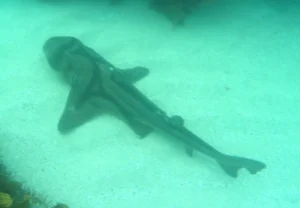
Other sharks that can breathe while stationary include wobbegongs, angel sharks, leopard sharks, and Port Jackson sharks. These are typically bottom-dwelling species that spend a lot of time resting.
The ability to breathe without swimming is essential for their lifestyle.
Some shark species can actually use both methods. They might use ram ventilation while actively swimming and hunting, then switch to buccal pumping when they want to rest.

This flexibility gives them the best of both worlds. They can be efficient swimmers when they need to be, but they can also take breaks and conserve energy.
The ability to breathe while stationary is one reason these sharks do well in aquariums. Sharks that must keep swimming are much harder to keep in captivity because they need large tanks with good water flow.
Bottom-dwelling sharks that can pump water over their gills can live in smaller spaces (though they still need adequate room to be healthy).
What’s The Difference Between Shark Gills and Fish Gills?
You might think all fish gills work the same way, but there are actually some differences between shark gills and the gills on bony fish (like trout, bass, or tuna).
These differences have to do with the structure and how water flows through them.
Bony fish have a bony flap called an operculum covering their gills. This flap acts like a pump, helping draw water over the gills and providing protection.
When you look at a goldfish or a salmon, you see the operculum moving as the fish breathes. The gill slits are hidden underneath this flap.
Sharks don’t have an operculum. Their gill slits are exposed, which is why you can see them clearly on the sides of the shark’s head. Instead of one covered opening, sharks have multiple visible slits (usually five, sometimes more). This gives sharks their distinctive appearance.

The lack of an operculum means sharks have less ability to actively pump water over their gills compared to bony fish. This is one reason why many sharks rely on ram ventilation.
Without that bony flap to help create suction and pressure, they depend on forward motion to move water through their gills.
Shark gill filaments are also arranged slightly differently than in bony fish. The structure is optimized for their particular lifestyle and breathing needs.
Some sharks have larger gill filaments with more surface area, while others have more compact gills.
Despite these differences, the basic function is the same. Both types of gills extract oxygen from water and release carbon dioxide. The differences are mainly in the mechanics of how water flows over the gills and how the structures are supported and protected.
Why Can’t Sharks Can’t Breathe Air?
Since gills extract oxygen, and air contains more oxygen than water, you might wonder why sharks can’t just breathe air like we do.
The answer is that gills are specifically designed to work in water, not air.
When gills are in water, the thin filaments spread out and float separately, exposing lots of surface area for oxygen exchange.

But when gills are exposed to air, the filaments collapse and stick together. This dramatically reduces the surface area available for gas exchange, making breathing ineffective.
Also, gills need to stay moist to function. In air, they dry out quickly. Once the gill filaments dry out, they can’t absorb oxygen even if air is flowing over them.
The whole system is designed for an aquatic environment, and it fails when removed from water.
This is why a shark dies if it’s out of water for too long. It’s not that air doesn’t have oxygen (air actually has much more oxygen than water does).
The problem is that the shark’s respiratory system can’t extract that oxygen from air. The gills need water to work properly.
Some fish (called lungfish) have both gills and primitive lungs, allowing them to breathe air when water conditions are poor. But sharks never evolved this ability.
They’re fully adapted to aquatic life and have no mechanisms for breathing air.
When a shark is pulled out of water (like when caught by fishermen), it suffocates relatively quickly. Even though it’s surrounded by oxygen-rich air, its gills can’t use that oxygen. The shark essentially drowns in air, which is a sad irony.
This is why catch-and-release fishing for sharks needs to be done carefully. The less time the shark spends out of water, the better its chances of survival when released.
Some conservation-minded fishermen keep sharks in the water entirely while removing hooks, recognizing that even brief air exposure can be harmful.
How Do Sharks Get Enough Oxygen from Water?
Water contains much less oxygen than air does. Air is about 21% oxygen, while water typically contains less than 1% dissolved oxygen.
This means sharks need to be really efficient at extracting oxygen to survive.
Sharks have several adaptations that help them get enough oxygen from water. First, their gills have a massive surface area.

Those thin filaments are covered in even tinier structures that maximize the area available for gas exchange. It’s like having a huge net to catch as much oxygen as possible from the water passing through.
The counter-current exchange system is also crucial. Blood flows through the gills in the opposite direction to water flow. This means that blood that’s already picked up some oxygen still encounters water that has oxygen in it.
This system allows sharks to extract much more oxygen than would be possible if blood and water flowed in the same direction.
Sharks also have a protein in their blood called hemoglobin (just like we do) that binds to oxygen and carries it throughout the body.
Some species have variations of hemoglobin that are particularly good at grabbing oxygen from water, even when oxygen levels are low.

The amount of water a shark needs to process depends on several factors. Larger, more active sharks need more oxygen, so they process more water through their gills. Smaller, less active sharks can get by with less water flow.
Water temperature also matters. Cold water holds more dissolved oxygen than warm water. This is one reason you find some shark species in colder waters. They can get more oxygen per gulp of water in cold environments.
During high activity (like when hunting or fleeing from a predator), sharks breathe faster. They either swim faster (forcing more water over their gills) or pump water over their gills more rapidly.
This is similar to how you breathe harder when you exercise.
Some Sharks have Extra Breathing Holes Called Spiracles
Some sharks have an extra structure that helps with breathing, especially bottom-dwelling species. These are called spiracles, and they’re basically modified gill slits located behind the eyes.
Spiracles look like small holes or slits behind and slightly above each eye. Not all sharks have them.
They’re most common in rays (which are closely related to sharks) and in bottom-dwelling shark species like wobbegongs and angel sharks.

Here’s why spiracles are useful: when a shark is lying on the ocean floor, its mouth is often pressed against the sand or mud.
If the shark tried to breathe through its mouth in this position, it would suck up sediment along with water. Spiracles solve this problem by providing an alternate water intake on top of the head, away from the substrate.
Water enters through the spiracles, flows over the gills, and exits through the regular gill slits. This allows the shark to breathe clean water even when its mouth is buried or pressed against the bottom. It’s a clever adaptation for a bottom-dwelling lifestyle.
Sharks that swim in open water usually have small spiracles or no spiracles at all. Great white sharks have tiny, almost vestigial spiracles that probably don’t contribute much to breathing.
They don’t need them because they’re always swimming with their mouth open, so there’s no risk of sucking up sediment.

Rays have very prominent spiracles because they spend almost all their time on the bottom. If you look at a stingray, you’ll see the spiracles clearly on top of its head.
This is their primary way of drawing in water for breathing.
The presence or absence of spiracles is one clue scientists use to understand a shark’s lifestyle and evolutionary history. Sharks with large spiracles probably spend a lot of time on the bottom. Sharks with small or no spiracles are likely active swimmers.
Can Sharks Drown?
Since sharks breathe using gills and extract oxygen from water, the question of whether they can drown is interesting. The answer is yes, sharks can drown, but it’s different from how land animals drown.
For sharks that need to keep swimming (the ram ventilators), drowning can happen if they’re prevented from moving forward.
If they get caught in a net, trapped in a small space, or injured in a way that stops them from swimming, water stops flowing over their gills.

Without water flow, they can’t extract oxygen, and they suffocate.
This is one of the tragic consequences of certain fishing practices. Sharks caught in nets can drown if they’re not released quickly enough.
Commercial fishing operations sometimes catch sharks accidentally (called bycatch), and many of these sharks don’t survive because they can’t breathe while trapped.
Even sharks that can pump water over their gills can drown under certain circumstances.
If the water they’re in doesn’t have enough dissolved oxygen (a condition called hypoxia), they might not be able to extract enough oxygen to survive, even though they’re breathing normally.

This can happen in polluted water or in areas where excessive algae growth has depleted oxygen levels.
Interestingly, sharks can also suffocate if they’re swimming backward. Their gill structure is designed for water to flow from front to back.
If water flows the wrong way (which can happen if a shark is pulled backward through water), it doesn’t flow properly over the gills and the shark can’t breathe effectively.
There are documented cases of sharks suffocating because they were hooked and fought so hard that they exhausted themselves and couldn’t maintain the swimming or pumping motion needed to breathe.
This is particularly sad because it shows how the stress of capture can be fatal even if the shark isn’t physically injured.
Understanding how sharks breathe and what can prevent them from breathing properly is important for conservation.
Many fishing regulations now require quick release of accidentally caught sharks to prevent drowning.
Some areas also prohibit certain types of nets that are particularly dangerous for sharks.
Conclusion
So do sharks have lungs? No, they don’t. Sharks are fish and they breathe using gills that extract oxygen from water. They can’t breathe air, and they don’t need to surface like dolphins or whales do.
Some sharks must swim continuously to keep water flowing over their gills, while others can pump water over their gills while staying still.
Either way, they’re completely adapted to extracting oxygen from water and would suffocate if removed from their aquatic environment.
The next time you see a shark, remember that those slits on the sides of its head aren’t just decorative. They’re essential breathing structures that allow the shark to extract oxygen from water.
It’s a different way of breathing than what we’re used to, but it’s worked perfectly well for sharks for over 400 million years.

Hi, my name is Ezra Mushala, i have been interested animals all my life. I am the main author and editor here at snakeinformer.com.