

Dog doors provide convenient access for your pets to go in and out of your house, but they can also create concerns about unwanted visitors. If you have a dog door, you might wonder what else could be using it to get inside.
These doors are designed for your dog, but they’re just openings in your walls or doors that lead directly into your home. Can mice actually come in through dog doors?
Yes, mice can definitely come in through dog doors. Any opening large enough for your dog to pass through is more than large enough for a mouse. Mice only need a gap about ¼ inch wide to squeeze through, so a dog door provides an enormous opening that mice can easily use to enter your home.
Dog doors are one of the easier entry points for mice because they provide a direct, ground-level path from outside into your living space. Even doors with flaps don’t stop mice since the flaps are designed to be pushed open easily.
Why Dog Doors Are Easy Entry Points for Mice
Dog doors are specifically designed to be easy to use, which unfortunately makes them easy for mice too.
The flaps on most dog doors are lightweight and flexible so your dog can push through them without much effort. A mouse can easily push through the same flap.

Dog doors are typically installed at ground level or close to it, which is exactly where mice naturally travel. Mice don’t have to climb or do anything unusual to access a dog door.
Many dog doors stay slightly open or don’t seal completely, especially older ones or doors with worn flaps. Even small gaps around or under the flap provide easy access for mice.
Unlike other potential entry points that might be hidden or hard to find, dog doors are obvious openings. Mice exploring around your house will definitely find and investigate a dog door.
The opening itself is huge compared to what mice actually need. While mice only require about ¼ inch to squeeze through, most dog doors are at least 6-8 inches wide and tall, even for small dogs.
Types of Dog Doors and Mouse Vulnerability
Different styles of dog doors have varying levels of vulnerability to mice, though honestly, all of them can let mice in unless you take specific precautions.
Standard flap dog doors are the most common type. These have a flexible flap that swings open when your dog pushes through. These offer no real barrier to mice since the flaps are so easy to push open.
Electronic or automatic dog doors are activated by a sensor on your dog’s collar. These only open when your dog approaches. While these do provide better security against mice (since the door isn’t constantly accessible), mice can still potentially get through in the brief moments when the door is open for your dog.
Sliding glass door inserts are dog doors that fit into the track of your sliding door. These are convenient but often have gaps around the edges of the insert panel that mice can use even without going through the actual dog door opening.

Wall-mounted dog doors require cutting a hole in your exterior wall. These can have gaps around the frame where it meets your wall, providing additional entry points besides the main opening.
Screen door dog doors are installed in screen doors. These are particularly vulnerable because screen materials can be chewed through by mice, creating additional entry points.
Signs Mice Are Using Your Dog Door
If mice are using your dog door to get into your home, you’ll usually see evidence of their activity.
Mouse droppings near the dog door (on either side) are a clear sign. Look on the floor just inside and just outside the door. Mouse droppings are small (about the size of a rice grain), dark, and pellet-shaped.
Tracks or paw prints can sometimes be visible. If you have dust or dirt near the dog door, you might see tiny mouse footprints.
Your dog might act strangely near the dog door. Dogs can smell mice, and if mice are using the door, your dog might sniff around it more than usual, whine, or seem alert in that area.
You might actually see mice using the door. If you’re quiet and watch at night (when mice are most active), you might catch them coming or going through the dog door.
Smudge marks (dark, greasy streaks) along the edges of the dog door or on the flap can indicate mice are traveling through regularly.
If you notice more mouse activity in the room where your dog door is located, this could indicate it’s their entry point.
Chew marks on the dog door frame or flap might be visible if mice have been gnawing on the materials.
Why Mice Are Attracted to Homes With Dog Doors
Beyond just providing easy access, dog doors can make your home especially attractive to mice.
Dog food is a major attraction. Many people keep their dog’s food and water bowls near the dog door for convenience. Mice can smell the food from outside and know there’s a food source inside.
Even if you don’t keep food right by the dog door, mice know that homes with dogs usually have pet food somewhere inside.
The scent trail your dog leaves when using the door can actually guide mice. Your dog’s scent might indicate to mice that this is a well-used passage and therefore probably safe.
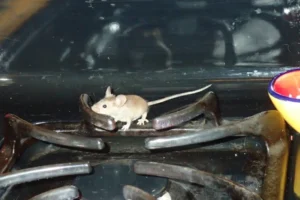
Dog doors often lead into mudrooms, laundry rooms, or kitchens where there might be additional food sources, making them even more attractive entry points.
The fact that the door is used regularly means it’s unlikely to be blocked or sealed up, giving mice reliable access.
How to Make Your Dog Door Less Accessible to Mice
While you can’t completely mouse-proof a dog door without losing its functionality for your dog, there are steps you can take to make it harder for mice to use.
Install a dog door with a better seal. Look for doors with magnetic closures or weighted flaps that close more securely. These won’t stop determined mice, but they make it slightly harder.
Consider an electronic dog door that only opens for your dog’s specific collar tag. This reduces the window of opportunity for mice to slip through, though they can still potentially get in when the door opens for your dog.
Use a dual-flap dog door. These have two layers of flaps (like a double door), which mice would have to push through twice. This makes entry slightly more difficult.
Keep the area around your dog door clean and free of clutter. Mice like to travel along walls and hide behind objects. A clear, open area might make them feel more exposed and less likely to use the door.
Install motion-activated lights near the dog door (inside and outside). Mice prefer darkness, and sudden bright lights might deter them.
Some people use motion-activated sound deterrents near dog doors. These emit high-frequency sounds that bother rodents but don’t affect dogs or humans. The effectiveness varies, but they might help as part of a larger strategy.
Controlling Dog Door Access
One of the most effective ways to prevent mice from using your dog door is to control when it’s accessible.
If your dog only needs to go outside at certain times, consider blocking the dog door when it’s not in use. You can use a sliding panel or a removable insert to close off the opening.
This is especially useful at night. Most mice are active at night, so blocking the dog door after your dog’s last evening trip outside can prevent nighttime mouse entry.

Some dog doors come with locking panels or covers for this purpose. If yours doesn’t, you can make or buy a panel that fits the opening.
For people with regular schedules, training your dog to use the door only at specific times (and blocking it otherwise) can significantly reduce mouse access.
If you work from home or someone is usually home, you could even remove the dog door entirely and just let your dog in and out manually. This completely eliminates the mouse entry point but obviously requires more effort.
Managing Food and Attractants Near Dog Doors
Since dog food is a major attractant for mice, how you manage it matters a lot.
Don’t keep your dog’s food bowl near the dog door. Move it to a different area of your house, preferably somewhere you spend more time where you’re more likely to notice mice.
Feed your dog on a schedule rather than leaving food out all the time (free feeding). Put the food down at meal times and pick it up 30 minutes later. This gives mice less opportunity to access the food.
Store dog food in sealed, airtight containers that mice can’t chew through. Metal or thick plastic containers work well. Don’t leave bags of dog food sitting out.
Clean up spilled dog food right away. Even small amounts of kibble on the floor can attract mice.
Don’t leave water bowls near the dog door either. While dogs need water, mice are also attracted to water sources.
If you give your dog treats or chews, don’t leave these lying around near the dog door.
Alternative Solutions to Standard Dog Doors
If mice using your dog door is a persistent problem, you might want to consider alternative access solutions for your dog.
A dog doorbell system teaches your dog to ring a bell when they want to go out. You then let them out manually. This eliminates the constant opening but requires you to be home and responsive.
Smart home integration can help if you have an electronic dog door. Some systems allow you to control when the door is active through an app, so you can lock it remotely when you’re away.

A covered or enclosed dog run can be a compromise. Instead of giving your dog access to your entire yard through a door, you could install the dog door to lead into a secure, enclosed area. This at least keeps mice from coming directly into your house, though they could still get into the run.
For very small dogs, there are dog doors designed to be as small as possible while still accommodating your pet. The smaller the door, the less inviting it is for mice (though they can still use it).
Some people with serious rodent problems eventually decide to remove the dog door entirely and manage their dog’s outdoor access manually.
Dealing With Mice That Are Already Coming In
If mice are already using your dog door and have established a pattern, you need to actively deal with them.
Set traps near the dog door on both the inside and outside. Place them along walls and in corners since mice prefer to travel along edges.
Use snap traps or live traps baited with peanut butter. These are more effective than cheese (despite what cartoons suggest).
Check traps daily and remove any caught mice right away.
Look for other entry points besides the dog door. Mice rarely use just one way in and out. Check around your entire house for gaps, cracks, and holes that need to be sealed.
Clean up mouse droppings regularly. Wear gloves and a mask when cleaning, and use disinfectant.
Consider setting up a routine where you close the dog door at night and set traps in that area. This can catch mice that are trying to use the door when it’s blocked.
If you’re catching mice regularly (multiple mice over several weeks), you might have a larger infestation that requires professional pest control help.
Conclusion
Mice can absolutely come in through dog doors. Any opening large enough for a dog is far larger than what mice need to squeeze through, making dog doors one of the easier entry points for these rodents.
Standard flap dog doors offer almost no barrier to mice since the flaps are designed to be easily pushed open. Electronic doors provide slightly better protection but mice can still potentially slip through when the door opens for your dog.
The biggest attractants near dog doors are usually dog food and water. Keeping these away from the door and feeding on a schedule rather than free feeding can help reduce the attraction for mice.
You can make your dog door less accessible to mice by using magnetic or weighted flaps, installing dual-flap doors, using electronic doors, and blocking the door when it’s not needed (especially at night).
If mice are already using your dog door, set traps near the door, look for additional entry points around your house, and consider whether you need to modify how your dog accesses the outdoors.
In severe cases where mouse problems persist despite your efforts, you might need to remove the dog door entirely and let your dog in and out manually. While less convenient, it completely eliminates this entry point for mice.

Hi, my name is Ezra Mushala, i have been interested animals all my life. I am the main author and editor here at snakeinformer.com.