
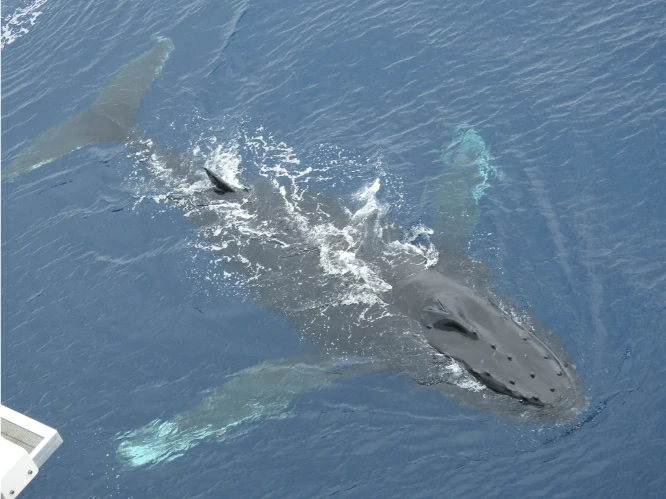
Whales spend their entire lives in the ocean. They’re born in water, they hunt in water, they sleep in water, and they never come onto land. When you watch whales swimming in the deep ocean, it really looks like they belong there completely.
But here’s something that surprises a lot of people: can whales actually breathe underwater like fish do?
No, whales can’t breathe underwater. They’re mammals, not fish, so they have lungs instead of gills. Whales have to come to the surface regularly to breathe air through their blowholes, just like you have to breathe air to survive.
This is one of the most important things to understand about whales. They might live in the ocean, but they need air just like we do.
They’ve just gotten really, really good at holding their breath for long periods of time.
Why Whales Need Air
Whales are mammals, which means they’re more closely related to you than they are to fish. Millions of years ago, the ancestors of whales actually lived on land.
Over time, these land animals went back to living in the ocean. Their bodies changed to help them swim and hunt in water.
Their front legs became flippers, their back legs disappeared, and they developed smooth, streamlined bodies.
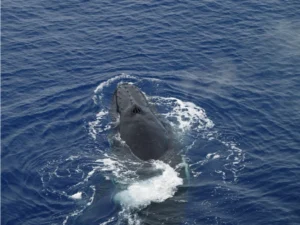
But one thing didn’t change: their lungs. Whales kept their lungs because the mammal body plan is built around breathing air. Switching to gills would require rebuilding basically everything about how their bodies work.
So whales ended up as mammals living in water, which means they need to surface regularly to breathe.
It’s like if you had to hold your breath between trips to the surface while swimming, except whales can hold their breath way longer than you can.
Whales Breathe Breathe Through a Blowhole
Instead of breathing through a nose and mouth like land mammals do, whales breathe through a blowhole on top of their head.
The blowhole is basically a nostril that moved to the top of the head over millions of years of change.
This location is perfect because the whale can breathe while keeping most of its body underwater.
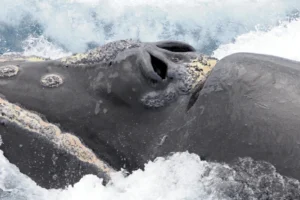
When a whale is underwater, a muscular flap seals the blowhole shut. This keeps water from getting into the lungs, which would be deadly.
The seal is so tight that no water leaks in even when the whale dives thousands of feet deep.
When the whale comes to the surface, it relaxes the muscles and opens the blowhole.
The whale breathes out first, creating that famous “blow” or spout of water vapor that you see in photos and videos.
Then the whale takes a big breath of fresh air in through the blowhole. The whole process only takes a second or two.
Then the whale closes the blowhole again and can dive back down.
How Long Can Whales Hold Their Breath?
Not all whales can hold their breath for the same amount of time. It depends on the species and what they’re doing.
Sperm whales are the champions of breath holding. They can stay underwater for 90 minutes or even longer when they’re hunting deep in the ocean.
That’s an hour and a half without breathing!
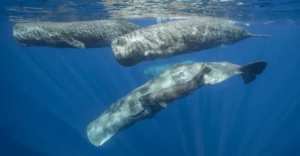
Beaked whales are also incredible at holding their breath. Some species can stay down for two hours or more.
Scientists have recorded dives lasting over three hours in some cases.
Humpback whales usually dive for 10 to 20 minutes when they’re feeding. They can go longer if needed, but they don’t usually push it.
Gray whales typically stay underwater for 3 to 5 minutes between breaths when they’re traveling along the coast. They can go up to 15 minutes if they need to.
Blue whales, the biggest animals on Earth, usually dive for 10 to 20 minutes at a time. They come up to breathe every 10 minutes or so when they’re feeding near the surface.
To make things easier, here is a table showing approximately how long different whale species can hold their breath:
| Whale Species | Typical Dive / Breath‑Hold | Maximum Recorded or Estimated |
|---|---|---|
| Cuvier’s Beaked Whale | ~60–90 minutes | Up to ~222 minutes (3 hr 42 min) |
| Sperm Whale | ~45–90 minutes | ~90+ minutes |
| Blue Whale | ~10–20 minutes | Up to ~30–36 minutes |
| Humpback Whale | ~5–15 minutes | ~30–45 minutes |
| Beluga Whale | ~15–25 minutes | ~30–34 minutes |
| Killer Whale (Orca) | ~2–15 minutes | ~15–17 minutes |
| Gray Whale | ~5–15 minutes | ~20 minutes |
| Fin Whale | ~5–20 minutes | ~50–60 minutes (varies by source) |
How Whales Can Hold Their Breath So Long
Humans can maybe hold their breath for one or two minutes if they’re trained. Most people can’t even do one minute.
So how do whales manage to stay underwater for 30 minutes, 60 minutes, or even longer?
Whales have several special tricks that help them hold their breath.
First, their blood can hold way more oxygen than ours can. They have much more hemoglobin (the stuff in blood that carries oxygen) than land mammals do.
Every breath they take loads up their blood with tons of oxygen.
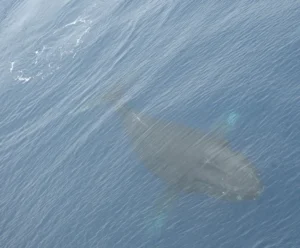
Second, their muscles store extra oxygen in a protein called myoglobin. Whale muscles are dark red because they’re packed with so much myoglobin.
This stored oxygen gets used during long dives.
Third, whales can slow down their heart rate when they dive. This is called bradycardia
. Their heart might beat only 4 to 10 times per minute instead of the normal 30 to 40 times. This saves oxygen.
Fourth, whales can shut down blood flow to parts of their body that don’t need it during a dive.
Blood goes mainly to the brain, heart, and muscles that are working.
Everything else gets put on pause. This makes their oxygen last much longer.
What Happens If a Whale Can’t Surface?
Since whales need air to survive, what happens if something stops them from getting to the surface? Sadly, they can drown just like a human can.
Whales that get tangled in fishing nets or lines are in serious danger. If they can’t swim to the surface to breathe, they’ll run out of oxygen and die. This is one of the biggest threats to whales today.
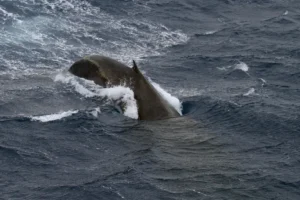
Whales can also drown if they get beached (stranded on land). When a whale is lying on a beach, its blowhole is above water, so you’d think it could breathe fine.
But the whale’s own body weight crushes its lungs when it’s not supported by water. It can’t breathe properly and will eventually die.
Injured or sick whales that are too weak to swim to the surface will also drown
. Baby whales sometimes drown if they’re born in difficult conditions and can’t make it to the surface for their first breath.
This is why rescue teams work so hard to save beached whales. They need to get the whale back into water before it suffocates under its own weight or drowns from exhaustion.
How Fish Are Different From Whales
To really understand why whales can’t breathe underwater, it helps to know how fish do it.
Fish have gills instead of lungs. Gills are organs that can pull oxygen directly out of water.
Water flows in through the fish’s mouth, passes over the gills, and flows out through gill slits on the sides of the head.
As water passes over the gills, tiny blood vessels in the gills absorb the oxygen that’s dissolved in the water.
The fish doesn’t need to surface because it’s getting oxygen from the water itself.
This system works great for fish, but it only works in water. If a fish is taken out of water, its gills collapse and it can’t get oxygen from air.
That’s why fish die when they’re out of water.
Whales have the opposite problem. They can get oxygen from air, but not from water. They need to surface regularly or they’ll drown.
How Do Whales Breathe When They Sleep?
Here’s a weird question: how do whales sleep if they need to breathe?
Humans breathe automatically, even when we’re asleep. Our brain handles it without us thinking about it.
But whales have to consciously decide to breathe. It’s not automatic for them.
So whales can’t fall into a deep sleep like we do, or they’d forget to breathe and drown. Instead, they’ve developed a really cool solution.
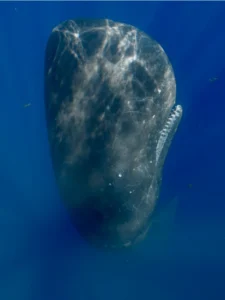
Whales sleep with only half their brain at a time. One half of the brain stays awake and aware while the other half sleeps.
The awake half reminds the whale to surface and breathe.
After a few hours, they switch. The half that was awake goes to sleep, and the half that was sleeping wakes up.
This way, the whale gets rest but never completely loses consciousness.
You can sometimes see sleeping whales floating at the surface with one eye open. The open eye is connected to the awake half of the brain.
Baby Whales Are Born Underwater
When a baby whale is born, it’s born underwater. The moment of birth is actually really critical because the baby needs to get to the surface immediately to take its first breath.
Mother whales usually give birth tail-first, which is the opposite of most mammals.
This is important because it means the baby’s head stays inside the mother until the last second.
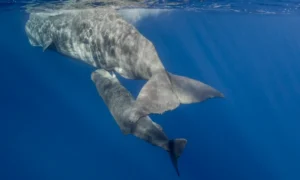
If the head came out first, the baby might try to breathe while still underwater and drown.
As soon as the baby is fully born, the mother or other adult whales help push it to the surface. The baby takes its first breath within 10 seconds of being born.
If the baby doesn’t make it to the surface fast enough, it will drown. This is one reason why whales usually give birth in shallow, calm water when possible. It’s safer for the baby.
The Spout: That’s Not Water
When a whale surfaces and breathes out, you see a big spout or blow of what looks like water shooting out of the blowhole. But it’s actually not water, or at least not mostly water.
The spout is mainly air that was in the whale’s lungs. When the whale breathes out really forcefully, this air shoots up into the cooler air above the ocean surface.
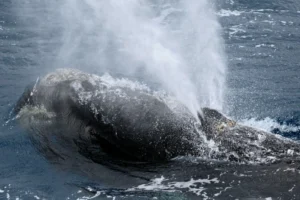
The warm, moist air from the whale’s lungs hits the cool outside air and condenses into a mist, kind of like how you can see your breath on a cold day. That’s what makes the visible spout.
There might be some seawater mixed in too. A little bit of water sits on top of the blowhole, and it gets blown away when the whale breathes out.
Some mucus from the whale’s respiratory system might also be in the spout.
Different whale species have different shaped spouts. This is actually how scientists can identify which type of whale they’re seeing from a distance.
Blue whales have tall, straight spouts. Right whales have V-shaped spouts. Sperm whales have spouts that angle forward and to the left.
Whales Handle Water Pressure Really Well
When whales dive deep underwater, they deal with enormous pressure. At 3,000 feet deep, the pressure is about 1,300 pounds per square inch.
That’s enough pressure to crush most things.
But whales handle this pressure really well. One of the reasons is because they don’t have rigid lungs full of air that could get crushed.
As a whale dives, the increasing pressure compresses its lungs. The air in the lungs gets squeezed into smaller and smaller spaces. Eventually, the lungs almost completely collapse.
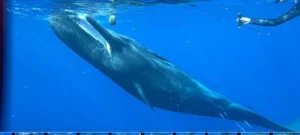
This sounds bad, but it’s actually fine for whales. Their ribs are flexible and their lungs are designed to collapse safely. The oxygen they need is already in their blood and muscles, so they don’t need to keep air in their lungs during the dive.
When the whale comes back to the surface, the pressure decreases and the lungs expand back to normal.
The whale takes a fresh breath and everything goes back to the way it was.
Humans can’t do this. If we dive too deep while holding our breath, the pressure can damage our lungs. That’s why deep divers use special equipment.
Why Don’t Whales Just Evolve Gills?
You might wonder why whales haven’t evolved gills over millions of years of living in the ocean. Wouldn’t that be easier than having to surface all the time?
The answer is that evolution doesn’t work that way. Evolution can only modify what’s already there. It can’t completely redesign an animal from scratch.
Whales started as mammals with lungs. To develop working gills, they’d need to evolve completely new organs and completely change how their circulatory system works. That’s such a massive change that it’s basically impossible.
It’s easier (from an evolution perspective) to just get really good at holding your breath. And that’s exactly what whales did.
They developed larger lungs, more oxygen-carrying blood, and all the other tricks we talked about earlier.
Also, lungs actually work pretty well for the lifestyle whales have. They can hold a lot of oxygen in one big breath, which lets them dive deep for a long time.
Gills need a constant flow of water over them, which would be harder to manage during deep dives.
Learning About Whales Is Important for Conservation
Understanding that whales need to breathe air is important for protecting them. A lot of whale deaths happen because human activities interfere with their ability to surface and breathe.
Fishing nets and lines that drift in the ocean are a huge problem. Whales can get tangled up and held underwater until they drown.
This is called bycatch, and it kills thousands of whales and dolphins every year.
Ship strikes are another issue. When ships hit whales, the injuries might not kill them immediately, but they can make it hard for the whale to swim to the surface to breathe.
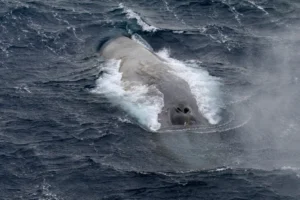
Noise pollution in the ocean can also affect whales. Loud sounds from ships, military sonar, and oil drilling can confuse whales and interfere with their ability to hunt and navigate.
Stressed whales might make poor decisions about when to surface for air.
Protecting whales means making sure they have safe access to the surface so they can breathe.
This includes things like making fishing gear safer, having ships slow down in whale areas, and reducing underwater noise.
Conclusion
Whales are amazing animals that have adapted to live their entire lives in the ocean. But despite spending all their time in water, they can’t breathe underwater.
Whales are mammals with lungs, not fish with gills. They have to come to the surface regularly to breathe air through their blowholes.
They’ve just gotten incredibly good at holding their breath for long periods of time.
Different whale species can hold their breath for anywhere from a few minutes to over an hour.
They do this by storing extra oxygen in their blood and muscles, slowing down their heart rate, and shutting down blood flow to parts of their body that don’t need it.
Understanding that whales need air helps us better protect them. Many of the threats whales face today, like fishing nets and ship strikes, are dangerous because they can prevent whales from getting to the surface to breathe.
Next time you see a whale surface and blow, remember that you’re watching it do something absolutely necessary for survival.
That breath of air is just as important to the whale as your next breath is to you.

Hi, my name is Ezra Mushala, i have been interested animals all my life. I am the main author and editor here at snakeinformer.com.