

Rats are surprisingly capable swimmers, and part of that ability involves holding their breath underwater. Whether you’re curious about rat behavior or trying to understand how they navigate through plumbing systems, this is useful information to know.
The breath-holding ability of rats is actually pretty impressive for such a small animal. How long can rats hold their breath?
Rats can hold their breath for about 3 minutes on average. Some healthy adult rats can hold their breath for up to 5 minutes in rare cases, but most will need to surface well before that. This ability allows rats to swim underwater through pipes and escape predators by diving under the surface.
This relatively long breath-holding time is one of the things that makes rats such successful survivors in urban environments, especially in sewer systems where they sometimes need to swim through water-filled pipes.
Why Rats Can Hold Their Breath So Long
For their body size, rats have pretty efficient respiratory systems. When a rat holds its breath, its body automatically makes changes to conserve oxygen.
The heart rate slows down, which reduces how fast the body uses up oxygen. Blood flow gets redirected away from less important areas and focuses on keeping the brain and heart supplied with oxygen.
This is called the “mammalian dive response,” and lots of animals have it (including humans). But rats have a particularly strong version of it for their size.
Rats also have a higher tolerance for carbon dioxide buildup in their blood than many animals. This means they don’t feel the desperate urge to breathe as quickly as some other animals would.
Their small body size actually helps too. Smaller bodies can make their oxygen last longer when they’re not moving much, so a rat floating calmly underwater uses oxygen pretty slowly.
Rats Don’t Hold Their Breath for Fun
Just because rats can hold their breath for 3 minutes doesn’t mean they do it regularly or enjoy it. Rats are air-breathing mammals, and they’d rather breathe normally.
When rats swim, they almost always keep their nose and mouth above water. They paddle with their legs and steer with their tail while breathing the whole time.
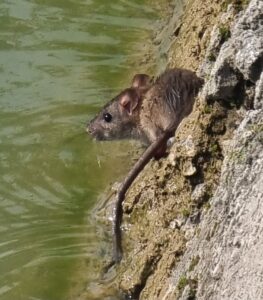
Rats only go completely underwater when they have to. This might be to escape from a predator, to get through a flooded pipe, or if they fall into deep water and panic.
In sewer systems, rats sometimes encounter water-filled sections of pipe. They’ll hold their breath and swim through these sections to get to dry areas on the other side.
A rat choosing to stay underwater voluntarily is really rare. Most of the time, if a rat is underwater, it’s because it’s been forced into that situation.
What Happens to a Rat Underwater?
When a rat first goes underwater, it’s usually pretty calm for the first 30 seconds or so. The dive response kicks in, and the rat’s body starts conserving oxygen.
Between 30 seconds and 2 minutes, the rat is starting to feel uncomfortable. The carbon dioxide is building up in its blood, creating the urge to breathe.
After 2 minutes, the rat is getting desperate. It’ll be actively trying to reach the surface, and if it can’t, it’ll start to panic.
At the 3-minute mark, most rats are at their absolute limit. If they can’t get air right now, they’re going to start drowning.
Past 3 minutes, the rat will involuntarily gasp and inhale water. This is the point of no return, and the rat will die unless it’s pulled out and resuscitated immediately (which is possible but difficult).
Young Rats Can’t Hold Their Breath as Long
Baby rats and young rats have much shorter breath-holding times than adults. Their lungs are smaller and less developed, and their oxygen needs are higher relative to their body size.
A young rat might only be able to hold its breath for 30 seconds to maybe a minute. This makes them really vulnerable around water.

Baby rats that fall into even shallow water can drown in seconds if they panic and inhale. They don’t have the lung capacity or the dive response that adults have.
As rats grow and their lungs develop, their breath-holding ability improves. By the time they’re full adults (around 4-6 months old), they can do the full 3 minutes.
If you have pet rats, be extra careful with young ones around water. Never put them in situations where they’d need to hold their breath.
How Rats Use This Ability to Survive
In the wild, the ability to hold their breath helps rats escape from predators. If a cat or hawk is chasing a rat near water, the rat might dive under the surface to hide.
Most predators won’t follow underwater, so the rat can hold its breath for a minute or two until the threat leaves. Then it surfaces and escapes.
Rats in sewer systems use breath-holding to navigate through flooded pipes. They can swim through water-filled sections and come up in new areas.
This is actually how rats sometimes end up in toilets. They swim through the sewer pipes, hold their breath through the trap, and pop up in the bowl.
Flooding also forces rats to hold their breath. When burrows or sewers flood suddenly, rats need to swim and hold their breath to escape to higher ground.
Temperature Affects Breath-Holding Time
Cold water is actually more dangerous for rats than warm water when it comes to breath-holding. When a rat hits cold water, it can go into shock.
The sudden cold causes the rat to gasp, which might make it accidentally inhale water right away. Cold water also makes the heart rate spike before the dive response kicks in.

In really cold water, a rat might only be able to hold its breath for 1-2 minutes instead of 3. The cold drains body heat fast, and the rat uses more energy trying to stay warm.
Warm water is easier for rats to handle, but it’s still not fun for them. Rats prefer to stay out of water entirely if they have a choice.
The ideal temperature for rat breath-holding (if there is such a thing) is probably around room temperature. But again, rats aren’t diving for recreation here.
Rats Can’t Actually Dive Deep
While rats can hold their breath, they’re not good at diving down. Their bodies are naturally buoyant, which means they float.
If a rat wants to stay underwater, it has to work hard to swim down or stay down. This uses up oxygen faster, which shortens the breath-holding time.

Rats are built for swimming on the surface, not for diving. Their eyes aren’t protected underwater, and they can’t see well when submerged.
They also can’t equalize pressure in their ears like diving animals can. Deep water would be painful and disorienting for a rat.
Most rats never go more than a few inches below the surface, even when they’re holding their breath. They’re just trying to get through a submerged area, not explore the depths.
The Difference Between Holding Breath and Drowning
There’s a critical difference between a rat voluntarily holding its breath and a rat that’s drowning. When holding its breath, the rat is in control.
The rat can decide to surface whenever it wants. It’s managing its oxygen and staying calm. This is when the 3-minute timeline applies.

When a rat is drowning, it’s lost control. Maybe it’s trapped underwater or too weak to surface. Panic sets in, which uses up oxygen much faster.
A panicking rat will drown much faster than a calm rat, sometimes in under a minute. The panic makes everything worse and speeds up the whole process.
If you see a rat in water, you can usually tell if it’s just swimming (head above water, calm) or drowning (head under water, thrashing). Drowning rats need immediate help.
How This Compares to Other Animals
Three minutes is actually pretty good for an animal the size of a rat. Mice, which are smaller, can only hold their breath for about 30 seconds to a minute.
Larger rodents like beavers can hold their breath much longer (up to 15 minutes) because they’re built for an aquatic lifestyle. But they’re also much bigger and have specialized adaptations rats don’t have.
Compared to other urban pests, rats are some of the best breath-holders. Cockroaches can hold their breath for about 40 minutes, but they’re insects with totally different respiratory systems.
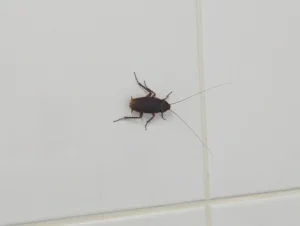
Humans in good shape can hold their breath for about 1-2 minutes on average, so rats are actually better at this than most people. Professional free divers can go much longer, but that’s with training.
Dogs and cats can hold their breath for about 30 seconds to a minute, which is less than rats. This is one reason why rat-catching dogs need to be fast at grabbing rats from water.
Rats Learn to Respect Deep Water
Rats are smart animals, and they learn from experience. If a rat has a scary experience with deep water, it’ll avoid similar situations in the future.
Wild rats generally avoid jumping into water they can’t see the bottom of. They’ll test the depth first if they can, or look for shallower crossing points.

Rats that live near water their whole lives become more comfortable with swimming, but even they don’t seek out situations where they’d need to hold their breath.
Pet rats are the same way. Some pet rats will play in very shallow water (an inch or two), but most hate being out of their depth.
If you need to bathe a pet rat, always use shallow water where the rat can keep its feet on the bottom. Never submerge a rat’s head or force it underwater.
Breath-Holding Isn’t the Same as Swimming Ability
A rat can swim for much longer than it can hold its breath because swimming doesn’t require being underwater. A rat can potentially swim for hours if it has to.
The limiting factor in long-distance swimming isn’t breath, it’s muscle fatigue and body temperature. A rat will get tired or cold long before it runs out of air.

This is important to understand if you’re trying to rat-proof a property. A moat or water barrier won’t stop rats unless it’s wider than they can swim across.
Rats can swim the length of several football fields if they’re motivated and the water isn’t too cold or rough. Breath-holding only comes into play if they need to go under the surface.
For pest control purposes, water barriers need to be designed with the understanding that rats are strong swimmers, not animals that avoid water entirely.
Signs That a Rat Is Running Out of Breath
If you’re watching a rat swim (maybe through a window or on a security camera), you can tell when it’s getting desperate for air. The movements become more frantic and less coordinated.
The rat will start swimming toward the surface more aggressively if it’s underwater. If it’s trapped somehow, it’ll start thrashing instead of swimming smoothly.

Bubbles coming from the rat’s nose or mouth are a bad sign. This means it’s running out of breath and might be about to inhale water.
If a rat goes limp underwater, it’s either unconscious or dead. At that point, it’s probably too late to save it even if you pull it out immediately.
Healthy rats that are just swimming normally will have smooth, coordinated movements and will keep their head above water. They should look calm, not panicked.
Conclusion
Rats can hold their breath for about 3 minutes, which is pretty impressive for animals their size. This ability helps them navigate through sewer systems, escape predators, and survive temporary flooding.
But rats don’t enjoy being underwater and will avoid it whenever possible. They’re surface swimmers, not divers, and they’d much rather keep their nose in the air.
If you’re dealing with rats, remember that they can hold their breath long enough to swim through most pipes and water-filled areas. Proper barriers need to account for this ability.

Hi, my name is Ezra Mushala, i have been interested animals all my life. I am the main author and editor here at snakeinformer.com.